The decision in brief
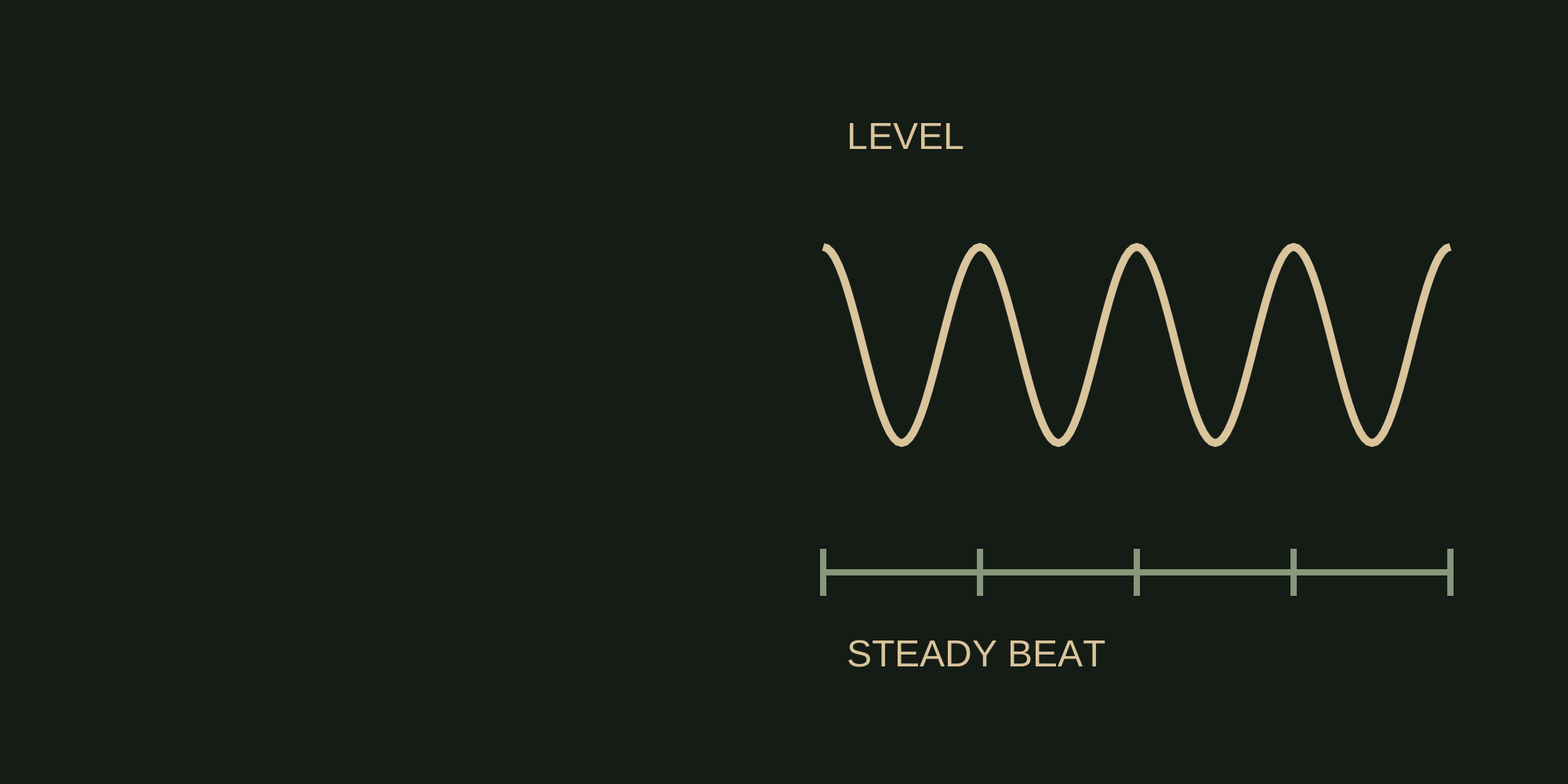
A conventional tremolo effect repeatedly raises and lowers signal level, creating a pulse. Rate sets how quickly it repeats; depth sets how strong the level change is. Shape controls, where provided, change how gradual or abrupt the pulse feels. This volume effect is different from vibrato pitch movement and from a guitar bridge commonly called a tremolo.
What matters most
- Rate, depth and pulse shape answer different listening questions.
- A tempo calculation does not establish knob position or cycle phase.
- Include the amp’s gain stage when comparing placement.
Separate volume movement from pitch movement
BOSS describes the TR-2 as periodically changing volume. Its tremolo article distinguishes that from vibrato, which changes pitch. A conventional volume pulse can be heard on a held note without physically moving the guitar’s bridge.
Guitar hardware terminology can be confusing: an arm-operated bridge commonly called a tremolo changes the strings’ pitch. Read the bridge comparison for that mechanical choice. This article concerns ordinary volume tremolo; specialised harmonic, stereo and multi-mode designs need their own documentation.
Sources: BOSS TR-2 owner’s manual: Rate, Wave, Depth and connections; BOSS: volume modulation, vibrato distinction and routing alternatives
Change one control at a time
| Control | Question to hear | Starting comparison |
|---|---|---|
| Rate or Speed | How quickly does the pulse repeat? | Keep depth fixed and compare slow with faster movement |
| Depth | How large is the level change? | Keep rate fixed and compare subtle with pronounced pulsing |
| Shape or Wave, if fitted | Does the transition feel gradual or abrupt? | Hold rate and depth steady while changing shape |
The TR-2 manual identifies Rate, Depth and Wave. It states that fully reducing Depth produces no tremolo effect. On another unit, names, ranges and bypass behaviour may differ. A clock position is a setting on that device, not a universal speed or modulation depth.
Begin with a held chord at a modest listening level. Find a clearly audible but manageable depth, then explore rate. Add the actual rhythmic part after you can identify the pulse. Keep a record of the setting that serves the phrase.
Sources: BOSS TR-2 owner’s manual: Rate, Wave, Depth and connections
Relate the pulse to the beat
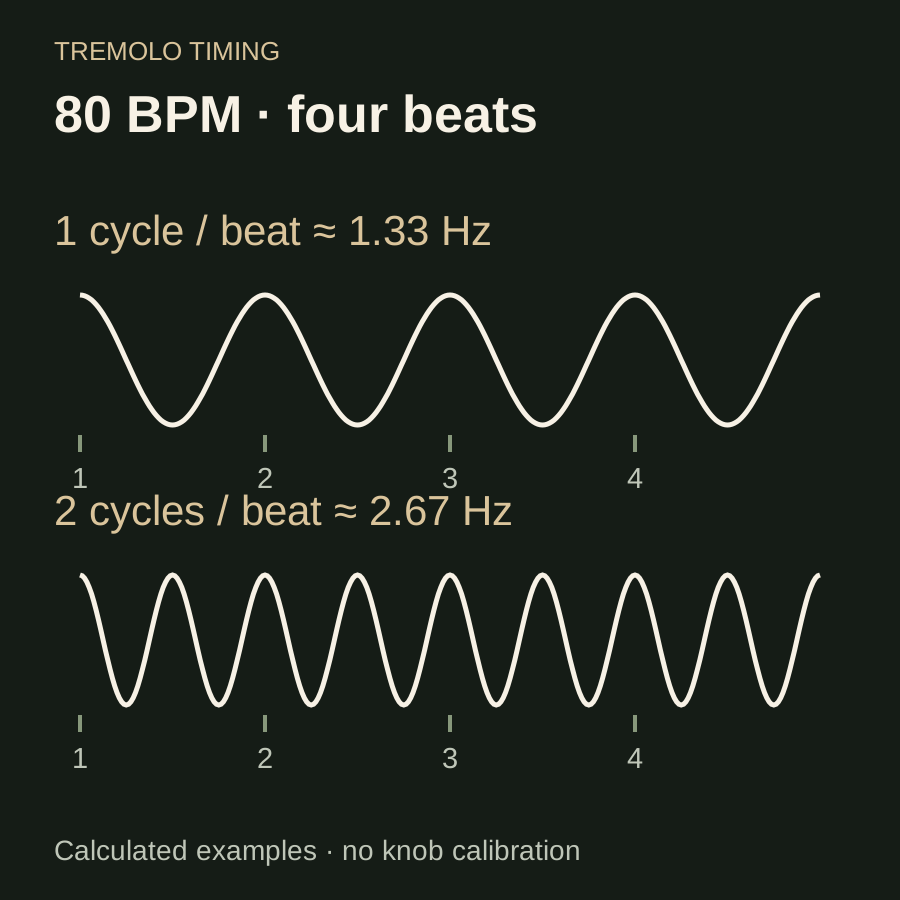
BPM means beats per minute; Hz means complete cycles per second. Decide whether you want the volume cycle to line up with a beat subdivision or move freely as a texture. For a deliberate relationship, count the beat first and choose how many complete volume cycles you want per beat.
Cycles per second = beats per minute × cycles per beat ÷ 60. For an illustrative 80 BPM pulse, one cycle per beat is 1.33 Hz; two cycles per beat is 2.67 Hz. Values are rounded to two decimal places. One cycle means a full repeat of the volume pattern, not each individual rising or falling edge.
This arithmetic does not calibrate a pedal knob. A unit may lack a Hz display, tap tempo or a supported subdivision setting. Use its instructions, then listen against a metronome or the actual backing part. Matching average speed also does not establish where the cycle starts relative to the beat; check the entrance and restart behaviour if that matters.
Set the effect with the part you need
This is a proposed listening routine, not a pedal test we performed. Establish documented connections and power first; the TR-2 manual calls for lowering volume and switching devices off before changing connections.
- Establish the bypassed sound and record guitar, amp channel, gain and listening output.
- Enable the effect on a held note or chord. Set a useful pulse rate, then adjust depth.
- Try shape if the device provides it. Revisit depth if the change makes the pulse too intrusive.
- Play the actual part, including rests and the entrance. Check that important attacks remain useful in the arrangement.
- Switch between bypass and the saved setting at a similar listening level where a supported output control permits it. Record any unmatched loudness instead of treating louder as better.
A sustained sound reveals the pulse; a busy picked part can make it harder to separate the effect from your own attacks. Use both as different listening tasks. Do not turn a perceived level change into a measured fault or a promise about every tremolo design.
Sources: BOSS TR-2 owner’s manual: Rate, Wave, Depth and connections
Compare the placement around drive
BOSS suggests trying tremolo after drive and before delay or reverb as a conventional starting arrangement, while acknowledging alternatives. In a simple clean-amp setup, compare drive → tremolo with tremolo → drive. In the second route the changing level reaches the drive stage; do not assume its output will preserve the same pulse.
A driven amplifier remains another gain stage even if the tremolo follows your drive pedal. Include the amp channel in the record. The pedal-order guide explains this wider routing question and effects-loop compatibility.
Lower volume and follow connection instructions before moving cables. Change one pair of positions, repeat the same phrase and note the depth, texture and level you actually hear. Neither order is a universal winner. Check the result again in the complete rig before saving it.
Sources: BOSS: volume modulation, vibrato distinction and routing alternatives
Save a setting you can reproduce
| Field | Write down |
|---|---|
| Task | The song section, held or picked part, and desired pulse relationship |
| Device | Exact unit, mode and Rate/Depth/Shape positions |
| Timing | Backing tempo, chosen cycle relationship and entrance behaviour |
| Path | Pedal order, amp channel, other gain stages and listening output |
| Observation | Useful pulse, loudness difference and a question still open |
If the effect seems absent, check bypass, depth, power and the documented route before increasing several controls. If a setting works alone but disappears in the arrangement, return to the actual part and change one factor. Unexplained loss of output or intermittent operation needs a basic cable/power check and, if it persists, service guidance.
For repeatable input while comparing settings, a looper placed before the effect can help. It repeats the recorded phrase; it does not check a fresh live entrance or guarantee that the tremolo cycle will restart in phase with the loop.
How this guide was prepared
We checked the BOSS TR-2 manual and BOSS’s tremolo explanation. The control example is specific to the TR-2; other tremolo designs can offer different modes and controls. Pulse-rate examples are arithmetic, not measured pedal calibrations. The setting and order comparisons are proposed editorial exercises. We auditioned or measured no pedal, and claim no human expert review.
Documentation checked .