The decision in brief
A fixed bridge is usually the simpler starting point for frequent tuning changes and string replacement. Choose a movable bridge when arm-controlled pitch changes serve your music, then check whether it is floating, decked or blocked and what maintenance that exact system needs. A floating bridge couples the strings through its balance. Neither bridge label guarantees tuning stability; strings, nut, installation, setup and technique still matter.
Identify the mechanism and its installed state
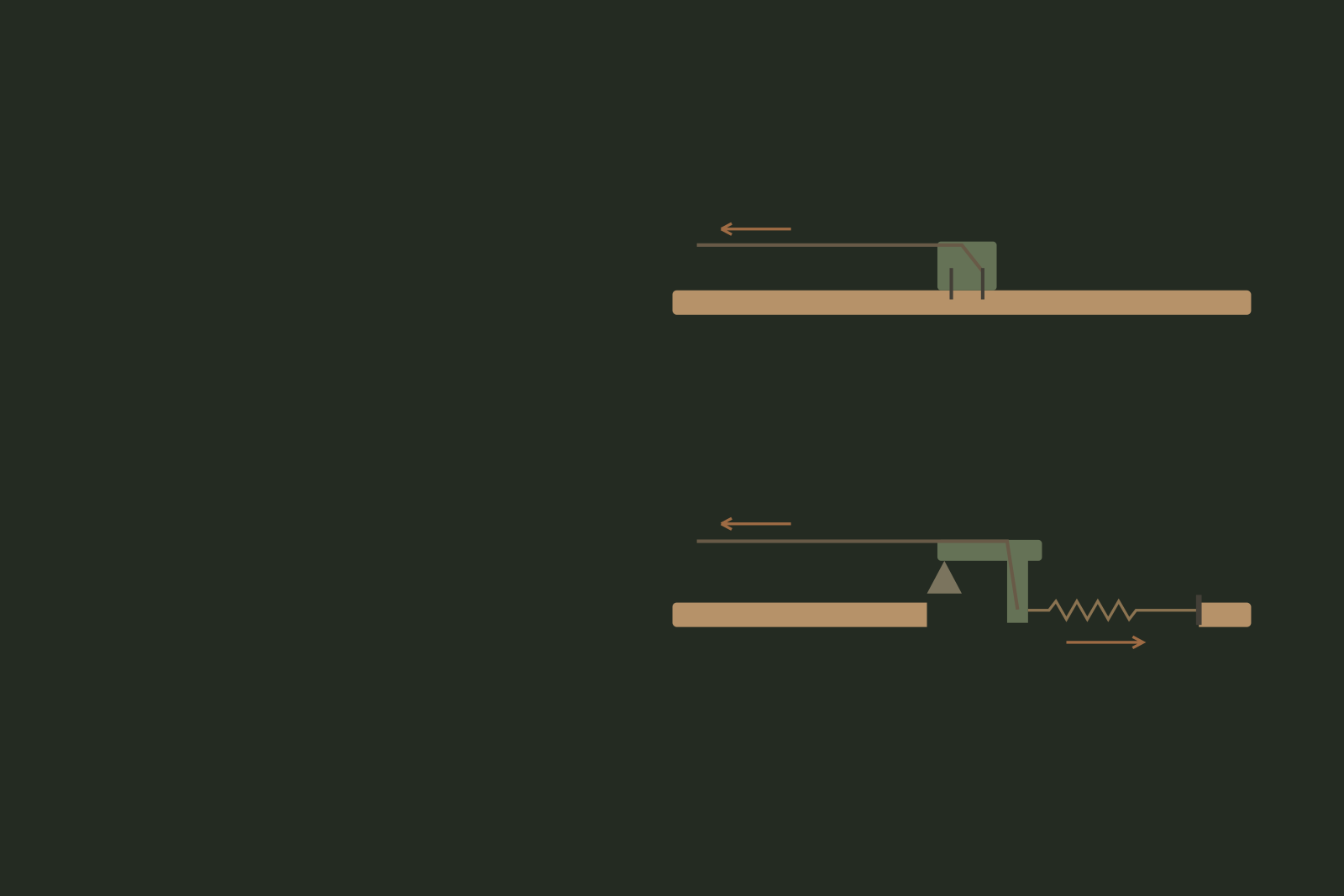
A fixed bridge has no arm-operated pitch movement. Hardtail plates and bridge/stop-tailpiece combinations are familiar examples, but their stringing and adjustment details differ.
Guitar hardware is commonly called “tremolo” although its arm changes pitch, which is vibrato in musical terminology. A movable system may float in both directions, rest against a stop or the body for restricted motion, or be blocked. Verify the installed state rather than inferring it from the body outline or whether an arm is present. Locking tuners alone do not make a bridge double-locking.
Compare fixed with a typical floating system
| Need | Fixed bridge | Typical floating tremolo |
|---|---|---|
| Arm-controlled pitch | Unavailable at the bridge | Available within the design and setup’s travel |
| Alternate tuning | No moving-bridge spring balance to reset | Changed string tension can move the bridge and affect other strings |
| Bends with another note ringing | No floating-bridge coupling | The unbent string may drop in pitch |
| String changes | Follow the bridge’s loading method | Also preserve or restore balance; locking versions add their clamp procedure |
| Maintenance | Check strings, nut, saddles and fastening | Also check springs, pivots and any locking hardware as applicable |
The table compares a conventional fixed bridge with a typical spring-balanced floating system. It does not describe every vibrato design or promise a result for a decked, blocked or stabilised mechanism. Floyd Rose explicitly describes other strings dropping during a bend on its floating system; the installed bridge state matters.
Sources: Floyd Rose: floating-bridge interaction during string bends
Changing strings or tuning can change the balance
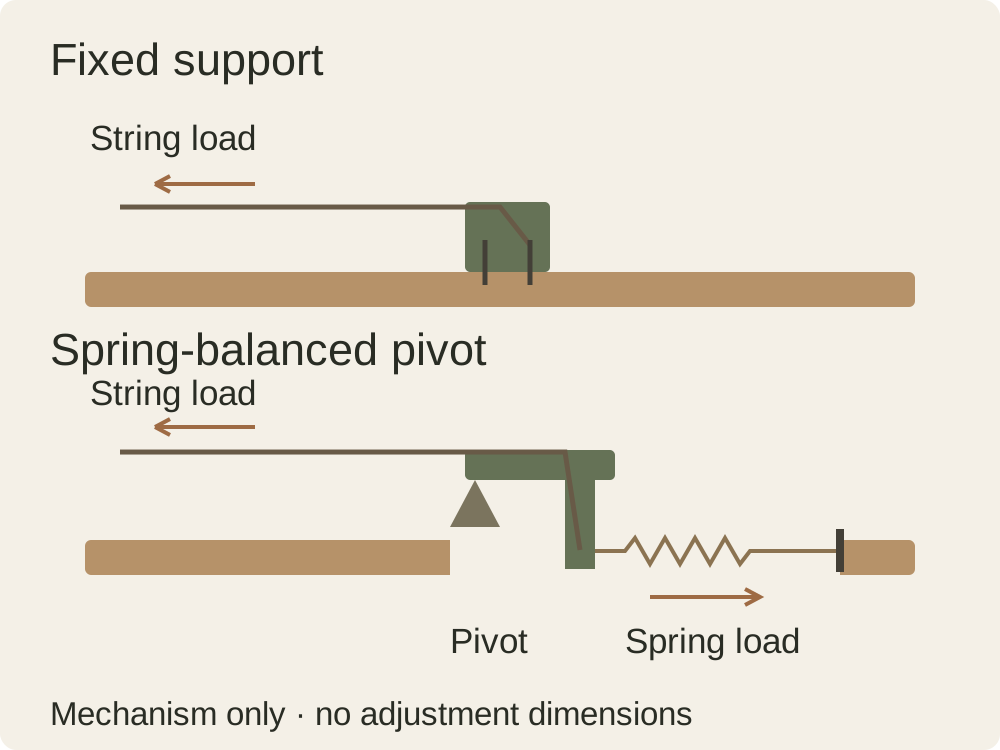
A floating bridge balances the string load against its spring system. Changing tuning or strings can change its resting position and the pitch of strings you have already tuned. Recheck the whole set while following the model’s instructions.
PRS’s September 2026 guide calls for retuning during its spring-claw adjustments and notes model exceptions to its usual bridge position. That is guidance for the named PRS systems, not a universal angle, gap or screw setting. Use the exact maker’s procedure; do not treat pivot screws and spring-claw screws as interchangeable controls.
On a fixed bridge there is no floating balance to restore, but a string or tuning change can still require relief, action, nut or intonation checks. Some locking systems have a prescribed unclamp, tune and reclamp sequence. Follow it rather than forcing fine tuners beyond their intended travel.
Sources: PRS: setup sequence and model-dependent tremolo bridge angle (updated September 2026)
Inspect the whole string path
A label cannot guarantee return to pitch. Check correct string installation, settled strings, seating at the saddle and nut, visible damage and the model’s intended bridge state. Use only maker-compatible maintenance methods. Lubricant cannot establish the cause of a fault or repair a damaged contact surface.
If one string fails to return while the others remain close, record that. If several strings move together, record the bridge state too. These patterns help choose an inspection, but are not a diagnosis. Do not dismantle, block or alter a bridge merely to confirm a guess; ask a repairer when the method or condition is uncertain.
Sources: PRS: setup sequence and model-dependent tremolo bridge angle (updated September 2026)
Make the choice around your own passages
A fixed bridge can suit a player who changes tuning frequently and does not use an arm. A floating system can suit a player whose passages need controlled downward and upward pitch changes and who can maintain its intended tuning. A restricted-motion setup may be appropriate when only downward travel is needed, if the exact design permits it.
Try a chord, a bend beside a sustained unbent note, and any gentle arm movement permitted by the setup. Listen before, during and after, using the same tuner and monitoring path. Judge the sound and convenience for your music. The exercise is not a brand ranking or a proof that one bridge is universally more reliable.
Record the comparison instead of assuming stability
| Personal trial record | Write down |
|---|---|
| Identity and state | Exact guitar and bridge; fixed, floating, decked or blocked; any unknowns |
| Conditions | Strings, tuning, date, tuner and clean monitoring path |
| Task | Your passage; bend plus unbent note; permitted arm movement |
| Result | Pitch and note behaviour before/after; changes needed; unresolved issues |
| Maintenance | Current maker procedure, tools and help available |
Check loose or damaged hardware visually and ask the seller about modifications. A photograph cannot confirm hidden springs or their balance. Repeat an affected observation after a legitimate setup change; do not combine observations from different string sets into a single stability claim. The scale guide explains another part of the feel comparison.
Choose useful movement and manageable upkeep
Start with the music’s need for pitch movement, then identify the actual bridge state. Compare tuning changes, bends and string replacement under known conditions. Choose the instrument whose movement and maintenance suit your use; preserve any unresolved condition questions before buying.
Frequently asked questions
Is a fixed bridge always more stable?
No. It removes floating-bridge balance from the comparison, but installation, strings, nut condition, hardware and setup still affect the result.
Why can a bend flatten a second ringing string?
On a typical floating bridge, the added load can move the shared spring-balanced mechanism and reduce the pitch of the other string. The behaviour depends on the installed state and design.
Are decked and floating bridges the same?
No. A floating system permits movement in both directions within its travel. A decked or otherwise stopped system restricts movement. Confirm what the particular bridge allows and how it is set.
Does a beginner need a tremolo?
Only if the music and intended technique benefit from it. Compare the pitch movement, string-changing procedure and available setup help; a fixed bridge is a reasonable choice when the arm has no role.
How this guide was prepared
We checked PRS’s September 2026 setup sequence and model-position exceptions, and Floyd Rose’s explanation of pitch interaction during bends on its floating system. The table describes conventional fixed and typical spring-balanced floating states, with restricted-motion exceptions stated. The personal trial is a proposed observation method; no bridge was tested, blocked or adjusted and no return-to-pitch measurements were made. The drawings illustrate a mechanism, not a complete model or adjustment target.
Documentation checked .
Focused the comparison on players, distinguished installed bridge states, consolidated the duplicate PRS source, added a specific floating-bend reference and personal trial record, and replaced generic photos with bounded mechanism diagrams.