
The decision in brief
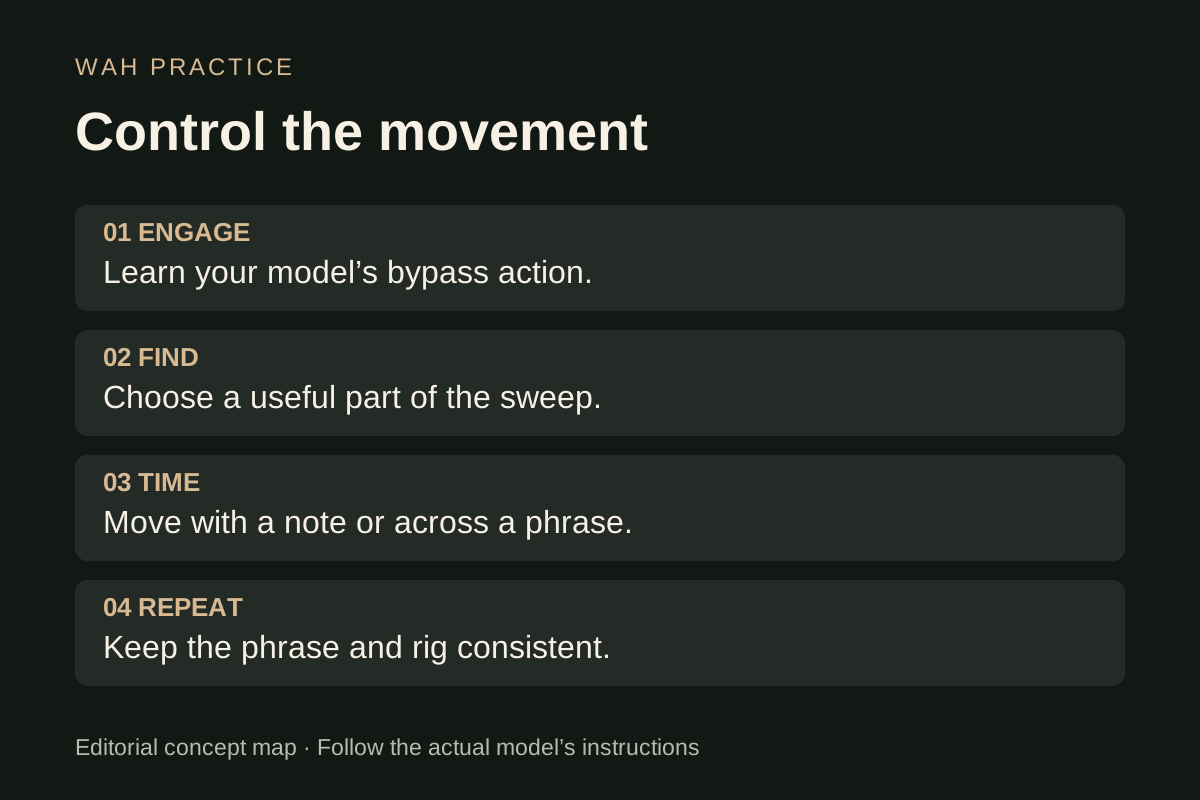
Start by learning how your particular wah engages and bypasses. Find a comfortable part of its sweep at a modest listening level, then practise moving the pedal in relation to a repeated phrase. Change one thing at a time: the foot movement, the phrase or the pedal’s position relative to drive.
Learn the switch before practising the sweep
A rocker pedal does not have one universal on/off action. Dunlop’s GCB95F instructions specify pressing the toe down until the switch clicks. Dunlop describes the 95Q as engaging automatically when you put your foot on it. That difference matters when you want a phrase to begin with the effect already engaged.
Read your model’s bypass instructions. At low volume, compare the dry signal with the engaged effect and establish what action returns you to bypass. Do this before trying to coordinate the rocker with a fast passage. Use the power supply and input/output connections specified for your pedal.
If you are still deciding which effect you need, read Whammy vs wah. This guide concentrates on using a wah, rather than choosing a pitch-shifting effect.
Sources: Dunlop GCB95F manual: setup instructions; Dunlop 95Q: auto-return switching
Map a useful sweep without chasing the endpoints
Play a short, familiar note or chord and move the rocker slowly. Listen for the portion of travel that gives the vowel-like change you want. Some positions may sound too pointed or too subdued for your phrase. You can use a smaller movement; a musical gesture does not have to cover all available travel.
Keep your guitar pickup, volume, amp settings and listening level fixed while learning that movement. Then repeat with your intended drive sound. The useful range you choose may change when the rest of the rig changes. Treat this as a listening exercise, not a measurement of the pedal’s filter.
First check that your stance is comfortable and the pedal stays put on a stable surface. Avoid making the movement depend on twisting your knee or holding a strained ankle position. Stop and reposition if it is uncomfortable.
Practise movement against a phrase, not just a beat
Choose a short phrase you can repeat without looking at your fretting hand. A slow, comfortable pulse is enough; no particular tempo is required. Try these passes and keep the notes the same:
- Hold: keep the rocker at a useful position for the whole phrase. Learn what the position contributes before adding movement.
- Open with the note: move toward the toe as you pick the note you want to accent. Return only as far as the phrase needs.
- Open after the attack: begin the same note with the rocker farther back, then move forward while it sustains. Compare the articulation with the previous pass.
- Move across the phrase: use one slower sweep over several notes rather than one motion per note.
These are proposed exercises, not rules for a genre. Choose the version that supports the rhythm and articulation you hear. If your timing drifts, simplify the phrase before increasing speed. The goal is a controllable gesture you can repeat.
Compare drive placement with the same movement
Once the movement is repeatable, compare wah before drive and wah after drive if both devices’ manuals allow the connections. Turn down, power down as instructed by the devices, and follow their connection and power-up sequence before repatching. Return to a modest listening level. Use the same phrase and foot movement for each pass.
Record what you actually hear: how strongly the moving emphasis stands out, whether chords remain clear enough, and whether any position becomes unpleasantly sharp. Do not pick a winner from the routing diagram alone. An already distorted amp adds another stage after pedals connected to its input.
The wider routing question belongs in guitar effects pedal order. For this exercise, move only the wah relative to the drive pedal; leave the rest of the chain unchanged.
Keep a short practice record
| Pass | Keep fixed | Write down |
|---|---|---|
| Held position | Phrase, pickup and listening level | Useful position and whether it suits the whole phrase |
| Movement with the attack | Same notes and rig | Which note receives the accent; whether your timing stays steady |
| Movement after the attack | Same notes and rig | How the sustained note changes; whether you can repeat it |
| Alternative drive placement | Phrase and intended foot movement | Exact chain, control settings and the result you prefer |
Save the settings or photograph your own controls for reference. A phone recording can help you compare your timing; it does not establish the pedal’s frequency response or a universal sound-quality ranking. If you change the amp channel or pickup later, note that change beside the observation.
Separate a technique problem from a setup problem
If nothing changes, confirm the effect is actually engaged, check the correct jacks and power requirements, and compare with a short known-working guitar-to-amp path. If the effect works but the phrase sounds awkward, return to a held position and add movement gradually.
A wah left at one position can be a deliberate sound, but the pedal must stay engaged there. An auto-return model may bypass as you remove your foot; consult its own switching instructions. Do not assume a stationary rocker means the filter is still in the signal.
If the sound becomes harsh only with drive, compare a smaller sweep and a less aggressive drive setting at a comfortable level. For the control roles involved, continue with setting an overdrive pedal. Persistent faults or unexplained switching should be checked against the manual or by a qualified technician rather than opening a powered unit.
Sources: Dunlop GCB95F manual: setup instructions; Dunlop 95Q: auto-return switching
Frequently asked questions
Do I have to rock a wah on every beat?
No. Try holding a position, moving on a selected note or sweeping across a longer phrase. Choose the movement that supports your articulation and that you can repeat comfortably.
Can I leave a wah in one position?
Only if that pedal remains engaged at the chosen position. Check how its bypass works: a toe-switch model and an auto-return model may behave differently when you take your foot away.
How this guide was prepared
We checked Dunlop’s GCB95F setup instructions and 95Q switching description, then developed the practice sequence and observation sheet below as editorial suggestions. We did not play-test these pedals, measure filter response or verify a particular player’s technique. Switching examples apply to the named models; your manual takes precedence.
Documentation checked .