
The decision in brief
Match the exact used guitar to the listing, record visible condition and known repairs, then test comfortable playing and normal functions with permission. Treat a symptom as an unresolved question until its cause and required work are established. Compare the actual total cost and written seller terms. If identity, structure, function or repair feasibility remains uncertain, obtain appropriate help or leave the purchase undecided.
Prepare for the exact guitar
Save the listing and ask for model/version, identifying details, included items, alterations, known repairs and current faults. Decide which playing tasks and condition you require. A model description is not proof of the unit’s history.
Bring a tuner, a known working cable where applicable and a suitable light. Agree what you may operate or photograph. Do not adjust rods, remove hardware or open compartments without permission and the correct model procedure. Ask a competent seller or technician to handle unfamiliar checks.
Check identity and disclosed condition
Compare the instrument, its identifying marks and included items with the listing. Ask about ownership context and repairs, while retaining only the personal information needed for the transaction. Fender states that missing serial-lookup results do not establish a lack of authenticity. A matching database description still leaves this unit’s condition and history to verify.
Reverb’s categories assess cosmetic wear first and then functionality; its guidance requires disclosure of issues, missing parts and prior repairs. Those are Reverb’s categories. Use the actual selling channel’s definitions and agreement rather than treating a grade as a universal guarantee.
Sources: Fender: serial lookup coverage and its limits; Reverb: its condition categories and issue disclosure
Observe the body and joints
Look at the front, back, edges, neck joint and, for an acoustic, the visible bridge and body seams in angled light. Record the location of cracks, gaps, movement or previous work with context and detail photographs. Do not pry at a bridge or press a top to establish a fault.
A mark may be cosmetic, but appearance alone cannot establish its depth, cause or repairability. An unexplained gap, movement or suspected structural fault needs a qualified assessment. A photograph does not verify hidden braces, wood construction or the quality of a repair.
Read neck and setup observations together
Have the guitar tuned as intended. Note fitted strings, visible fret wear, fret ends, neck alignment and nut condition. Try comfortable open notes and fretted positions. Ask for a demonstration where your playing ability limits coverage.
If measurements are needed, record the string, fret/location, units, method, tuning and tools used. Fender’s setup guidance differentiates instrument types and states conditions for its factory references; it is not a universal purchase threshold. Rod function, fret-level work and whether an acoustic has enough adjustment available require suitable expertise. Do not assume high action or buzz is an inexpensive setup.
Sources: Fender: setup measurement conditions and model-specific guidance
Test normal functions and your music
With permission, operate tuners, normal bridge functions, pickup positions and controls. Use a known working signal path at a suitable level and record it. For active electronics, verify the approved power or battery arrangement; have the seller handle access. Do not force sockets or dismantle circuits.
Play the same short chords, single notes and bends where appropriate, followed by the music the guitar must support. Record dead notes, intermittent sound, retuning needs and persistent buzz. These observations locate a problem; they do not certify every fret, diagnose a component or prove long-term stability. Stop if a function is unsafe or cannot be assessed.
Identify what a remote check leaves unknown
Request current images of this unit, known repairs and any reported problem, plus a demonstration tied to a stated tuning, strings and signal path. Ask for relevant measurements with their method. A processed video or ruler photographed at an angle does not provide a reliable diagnosis or comparable sound ranking.
Keep unresolved questions in writing. Check the actual payment channel, included items, delivery arrangement and applicable seller/platform terms before committing. This guide verifies no particular seller, current market price or universal return right. Inadequate evidence is a reason to request inspection or leave the decision open.
Use a decision record before paying
Keep the seller’s explanation alongside your observation and any independent assessment. Obtain an actual service quotation when work affects the decision; include accessories and other necessary costs. A proposed fix is not a confirmed result.
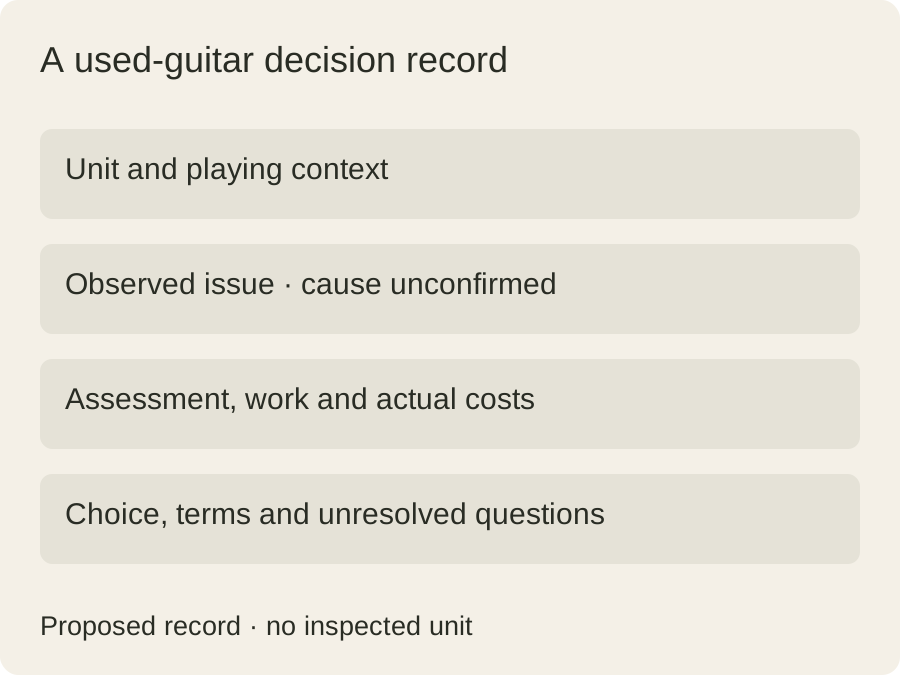
Use the record below for either a local or remote purchase. Buy only when the significant unknowns are resolved within your requirements and the agreed terms are clear. Otherwise seek a qualified assessment or decline. There is no fixed time that makes this inspection complete.
| Record | What to retain | Decision limit |
|---|---|---|
| Unit and context | Model/identifier, date, strings, tuning and signal path | Do not substitute model claims for unit evidence |
| Observed issue | Location, photo and conditions that reproduce it | Cause remains unknown unless established |
| Required work | Assessment, quote and agreed responsibility | An assumed adjustment is not approval |
| Final choice | Acceptable compromise, written terms or outstanding question | Unresolved structure or function keeps the choice open |
Frequently asked questions
Does an absent serial-lookup result prove a guitar is fake?
No. Fender explicitly notes incomplete database coverage. Check this unit’s identity and supporting evidence; the lookup is not a condition inspection.
Does fret buzz always mean a cheap setup is enough?
No. Record where and how it occurs. A suitable assessment must establish cause and feasible work before you use a repair cost in the decision.
Can a video replace an inspection?
It can answer some questions, but not certify hidden structure, complete function or unprocessed sound. Retain the unknowns and agree how they will be resolved.
How this guide was prepared
We checked Fender’s serial-lookup notice and setup instructions and Reverb’s current condition guidance. This is a proposed personal screening and decision record, not a report on an inspected guitar. We did not test a unit, establish authenticity, diagnose faults, check current prices or verify a seller’s terms. Photos and demonstrations have the limits described above.
Documentation checked .
Added permission and diagnosis limits, model-specific measurement context, remote evidence gaps and a decision record; removed the fixed inspection-time implication and replaced misleading imagery.