
The decision in brief
Nut width is the width of the neck where the nut sits, measured across its two outer edges. It is not the distance between the outer strings. The latter depends on where the six nut slots are cut and how much margin remains at each fingerboard edge. Compare nut width, string spacing, neck shape, scale, setup and an actual playing task before deciding which guitar feels better.
What matters most
- Ask for nut width and outer-string spacing as separate measurements.
- Compare neck depth and shoulders alongside width before judging fit.
- Repeat the same chord or fingering on the actual candidates.
What guitar nut width actually measures
The nut is the small slotted part at the headstock end of the fingerboard. Nut width describes the overall width of the neck at that location, usually given in millimetres or inches. The number is useful because it describes one boundary of the first-position playing area. It does not tell you how far apart the strings are, how thick the neck is, or whether the strings sit comfortably away from the fingerboard edges.
Imagine two necks that are both 43 mm wide at the nut. One maker may leave generous outer-string margins, while another cuts the outer slots closer to the edges. The first can feel more compact between the strings even though both products carry the same nut-width specification. Similarly, two guitars with different nut widths can have surprisingly similar outer-string spacing.
When reading a catalog, keep the original unit and the model revision attached to the number. A rounded inch conversion may differ slightly from the maker's metric specification. For a used instrument, a replacement nut or neck can make the current guitar differ from an old product page. The number gives a useful starting point; the physical instrument remains the final reference.
How to measure nut width without mixing up reference points
Use calipers, if available, to measure across the outer sides of the neck where the nut sits. A ruler can provide a reasonable approximate reading, but it is less precise around rounded edges and binding. State whether you measured the nut itself or the adjacent neck: an overhanging or replacement nut may extend past the wood. Measure straight across, perpendicular to the neck's length, rather than along the angled headstock.
Record two measurements when fit matters
Record the overall width and the distance between the centres of the outermost strings at the nut. The second figure is often called E-to-E spacing on a six-string guitar. It cannot be inferred safely from nut width alone. If you need to compare a four-string bass or a seven-string guitar, identify the outer strings instead of assuming the same six-string notation.
Also look at the clearance between each outer string and its fingerboard edge. A string placed too close to an edge may slip off during a forceful pull-off; excessive margin can crowd the inner pairs. StewMac's nut-spacing instructions explicitly account for outer-string position and slot distribution rather than dividing the full width into equal intervals. If the guitar already plays cleanly, do not alter a nut merely because a number is different from another model.
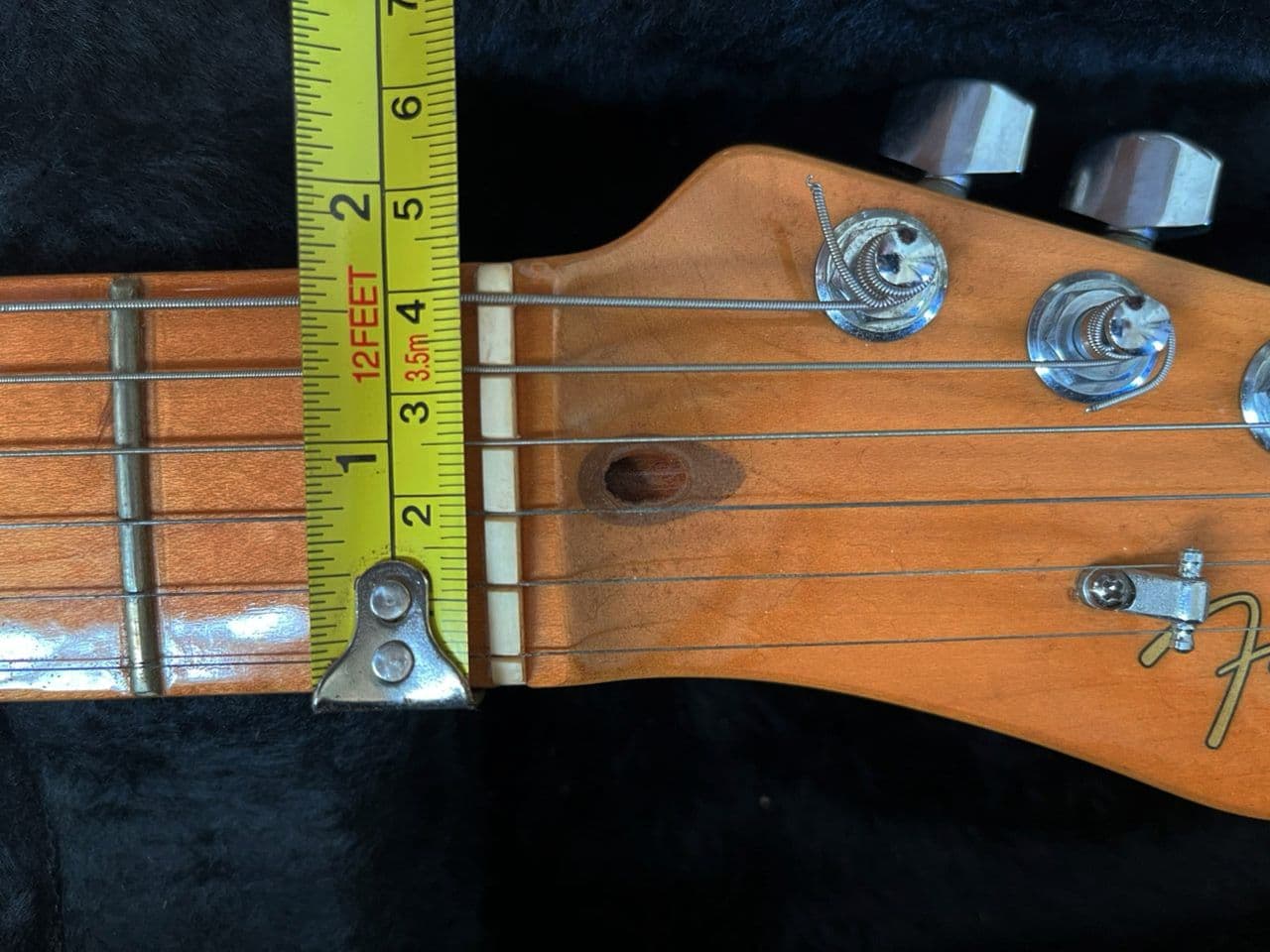
Common figures are examples, not a ranking
Steel-string acoustics and electric guitars appear in overlapping width ranges. Taylor’s 2022 handfeel article, for example, documents 1 11/16-inch and 1 3/4-inch neck-width examples in its ranges. Those are examples from particular models, not a rule that an entire guitar family uses one width. Classical and nylon-string designs often offer more room at the nut, but modern crossover models can narrow the gap. Always check the exact current specification.
| Example width | Approximate metric value | Question to ask |
|---|---|---|
| 1 11/16 in | 42.86 mm | Is the actual string spacing comfortable for chords and single notes? |
| 1 3/4 in | 44.45 mm | Does the extra total width also create useful room between the strings? |
| 1 7/8 in | 47.63 mm | How do the neck profile and nylon-string layout change the hand feel? |
The conversions are arithmetic examples rounded to two decimal places, not measurements of a particular guitar. A 1.6 mm difference between the first two example widths can be noticeable to some hands and negligible to others. That reaction depends on neck profile, shoulder shape, string spacing, technique and adaptation. Avoid describing one figure as universally "beginner" or "professional."
The conversion uses NIST’s exact relation of 1 inch = 25.4 mm. Multiply the original inch value by 25.4, then round the result for this table. For example, 1 11/16 inches is 1.6875 inches, which gives 42.8625 mm before rounding to 42.86 mm. A precise conversion does not improve the accuracy of the original model specification or a tape reading.
Sources: Taylor: its published nut-width examples; NIST: inch-to-millimetre relation
Nut width versus string spacing: the distinction that changes a purchase
Nut width is an outside dimension. E-to-E spacing is a string-centre dimension. Slot-to-slot spacing is another measurement: the distance between neighbouring strings. On a six-string instrument, the wound bass strings and plain treble strings have different diameters, so equal centre-to-centre spacing need not look or feel equally open between the string surfaces. Some nut-layout methods adjust the slot positions for more visually or physically even gaps.
This distinction matters when a player says, "My fingers collide while fretting chords." A wider nut may help, but only if the actual string layout creates more room where the fingers land. A thicker neck back may make reaching the far strings harder even when the nut is wide. Conversely, a narrow neck with sensible slot margins and a comfortable profile may work well for the same player.
Ask a seller for a straight-on close photograph of the nut and first few frets if shopping remotely. Confirm six strings occupy six corresponding slots and that the strings are not visibly pulled against the edges. A photograph cannot replace caliper measurements or a playing trial, but it can reveal a damaged, miscut or poorly seated nut. A generic stock photograph cannot confirm the condition of a used guitar.
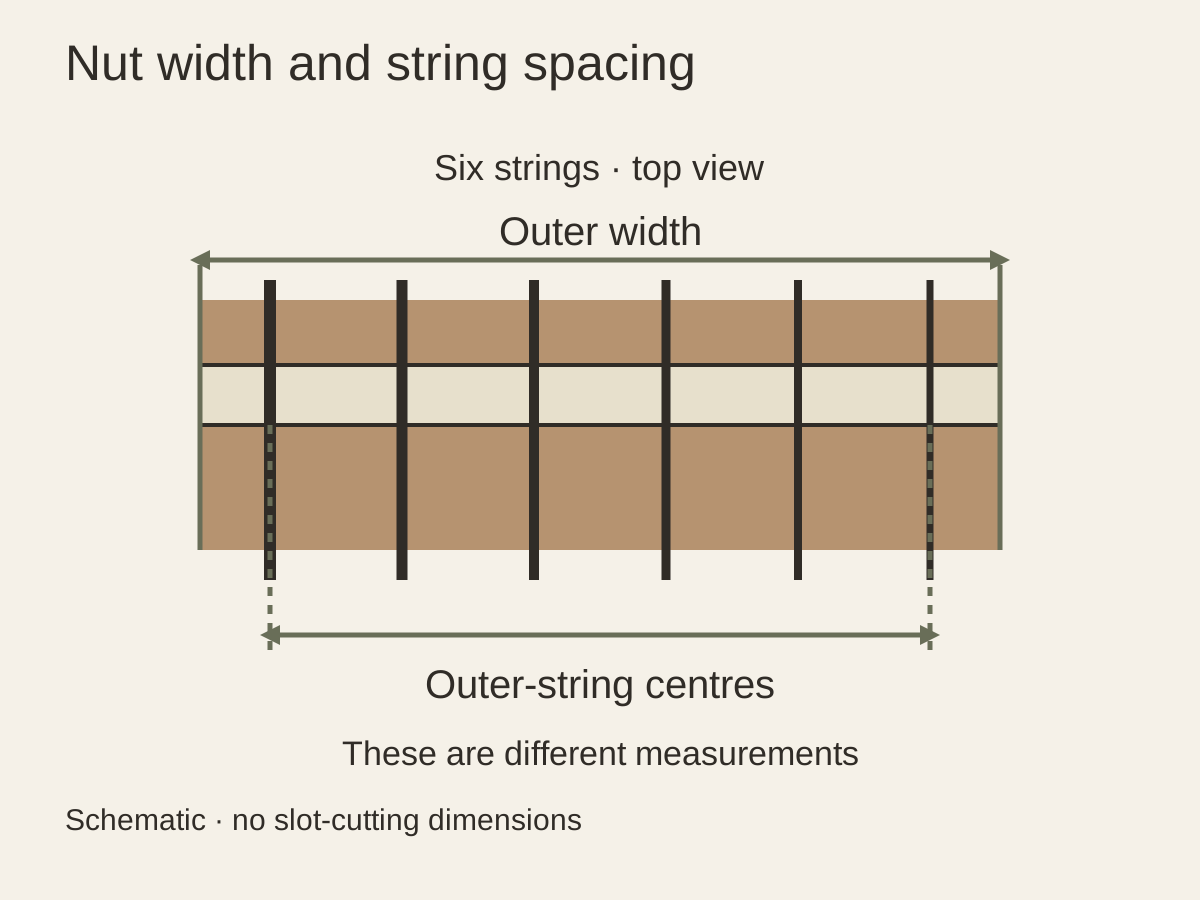
Two widths can leave the same room between strings
Consider two hypothetical six-string nuts: A is 43 mm wide and B is 44.5 mm wide. Both have 35 mm between the centres of their outer E strings. If those strings are centred symmetrically, the centre-to-edge distance is 4 mm on A and 4.75 mm on B. The wider nut has not increased the measured E-to-E spread.
Those centre-to-edge figures are arithmetic examples, not suggested slot positions or actual clearance at the string surface. Surface clearance also depends on string diameter; fret-end bevel and the fingerboard edge influence usable margin. The middle strings may also be arranged differently. Do not use the example to cut a replacement nut.
| Measurement | Hypothetical A | Hypothetical B |
|---|---|---|
| Nut width | 43 mm | 44.5 mm |
| Outer E-string centres | 35 mm | 35 mm |
| Symmetric centre-to-edge distance | 4 mm | 4.75 mm |
For a real comparison, record outer width, E-to-E spread and the actual hand-feel problem separately. If fingers collide, inspect spacing and technique. If strings slip off the edge, inspect margins and fret ends. If pressing open chords is difficult, the nut height and action may deserve more attention than width. For a stretch along the neck, compare scale length and the neck profile.
For the symmetric centre-to-edge calculation, subtract the E-to-E centre spacing from the outside width and divide by two: (43 − 35) / 2 = 4 mm, and (44.5 − 35) / 2 = 4.75 mm. A real surface-to-edge gap also needs the outer string’s radius, so these values remain centre-based examples rather than slot-cutting instructions.
Sources: Taylor Guitars: All About Handfeel
Compare the complete neck before judging comfort
Nut width is only one crosswise dimension. The back-of-neck profile, depth, shoulder shape, fingerboard radius, fret size, scale length and current setup can each influence what the hand notices. The first-position feel also changes with string gauge and nut-slot height. If an open chord feels unusually hard to press, high nut slots may be involved; a different nominal width is not necessarily the answer.
Separate permanent design from adjustable condition. A basic setup can change relief, string height and sometimes nut-slot height within safe limits. It cannot routinely turn a 43 mm neck into a 48 mm neck or change the carved profile. A nut replacement can adjust slot placement modestly if there is sufficient edge margin, but a technician should evaluate the actual neck before any cutting. Removing too much material can create open-string buzz or other problems.
For a useful trial, tune both guitars and play the same open chords, a barre chord, a short fingerstyle passage and a single-note phrase near the nut. Keep the playing position comparable. Note exactly what feels easier: finger clearance between strings, thumb support, reach, or pressure needed to fret. The answer may point to spacing, profile or setup rather than overall width.
Match the layout to the playing task
Chord-focused playing
Test the chords you actually use, especially shapes where adjacent fingertips compete for room. A slight spacing difference can matter, but hand position and fretwork matter too. Try a clean, slow chord test before interpreting an amplifier or room sound.
Fingerstyle and hybrid picking
Room at the bridge can matter as much as room at the nut for the picking hand. Do not buy a wider nut expecting a wider saddle spacing without verifying both numbers. Many acoustic spec sheets publish them separately for this reason.
Classical and nylon-string technique
Traditional classical technique is often taught on a wider, flatter-feeling neck, but individual nylon-string guitars vary. The string material, action, neck shape and right-hand spacing all belong in the comparison. A narrower crossover model can be useful for a player moving between steel and nylon strings; it is not automatically the best choice for every classical repertoire.
Small hands or hand discomfort
Hand size alone is not a reliable prescription. A narrower nut can shorten lateral reach yet still feel bulky if the neck is deep or heavily shouldered. Compare actual grips and consult an appropriate teacher or professional for persistent discomfort; an article cannot diagnose an individual's physical needs.
A remote-buying checklist for nut and neck fit
- Get the exact model and current nut-width specification in the original unit.
- Ask whether the nut and neck are original on a used instrument.
- Request outer-string spacing if the hand-fit decision is close.
- Check straight-on photographs for six strings in six matching slots and reasonable edge clearance.
- Record the neck profile, scale length, radius, fret size and installed string gauge.
- Ask whether the instrument has been set up and what work was done to the nut.
- Read the seller's return and adjustment policy before purchase.
If a seller cannot provide E-to-E spacing, compare with an instrument you already know. Measure both with the same method and note the difference without turning a single figure into a promise. For a used instrument, inspect wear and tuning behavior as well as nominal dimensions. A nut can be correctly spaced yet still bind a string because of slot shape, burrs or an inappropriate string gauge.
When this advice changes
The comparison changes when the instrument is not a conventional six-string guitar. Seven- and twelve-string guitars, basses, traditional classical guitars and other extended-range instruments use different string counts, edge margins and playing requirements. Compare measurements only within a clearly identified instrument type, and state which outer strings define the spacing.
A replaced nut, refretted neck, rolled fingerboard edge or repaired headstock can also make the current instrument differ from its original specification. For persistent hand discomfort, repeated string slip or a planned nut replacement, an in-person assessment by a qualified teacher or repair professional is more useful than choosing from a width number alone.
Key takeaways and conclusion
Nut width tells you how wide the neck is at a specific point. It does not, by itself, tell you how much room exists between the strings, whether an outer string will stay on the board, or whether the whole neck will be comfortable. Measure or verify width and string spacing separately, then judge the complete neck and setup through the music you intend to play.
Use a current specification to narrow the search, a correctly photographed instrument to check construction, and an actual playing trial or fair return policy to resolve the remaining uncertainty. If the neck feels wrong, identify the exact cause before ordering a replacement nut or another guitar. For related dimensions, read our neck-profile guide, fingerboard-radius guide and scale-length explanation.
Frequently asked questions
Is guitar nut width the same as string spacing?
No. Nut width measures the total neck width at the nut; string spacing describes the positions of the strings within that width. Outer-string margins and slot layout can differ between guitars with the same nut width.
Where do I measure nut width?
Measure straight across the neck at the nut, from one outer edge to the other. State whether the reading is from the neck or an overhanging nut, and record the unit and method.
Is a wider nut always better for fingerstyle?
No. It may provide more room near the first frets, but actual nut and saddle string spacing, neck profile and the player's technique matter. Compare the full instrument.
Can a replacement nut change string spacing?
Sometimes, within the safe edge margins of that neck. A qualified technician should assess the instrument; poorly placed or cut slots can cause strings to slip, bind or buzz.
Can a photograph prove nut width?
A photograph can show the nut and slot condition but rarely provides a dependable measurement unless a suitable scale and camera angle are clear. Ask for a measured figure or current maker specification.
Why can two guitars with the same nut width feel different?
They may have different outer-string spacing, neck depth, profile, radius, fret size, scale length, strings or setup. Nut width describes only one dimension.
How this guide was prepared
Taylor documentation supplies neck-fit context and historical width examples; StewMac explains one workshop string-spacing method. Unit conversions and the two hypothetical nuts are editorial arithmetic, not measured specifications or slot-cutting targets. The credited photographs show real instruments; no comfort or replacement-nut test was performed for this guide.
Documentation checked .
This update places references beside the measurement and spacing explanations, shows the conversion and margin calculations and retains the original photograph credits.

