
The decision in brief
Guitar action is the gap from the top of a named fret to the underside of a named string under stated conditions. Tune the instrument, use the selected method and record the string, fret, units, string set, capo/fretting condition and tool resolution. Compare readings only when those conditions match. A useful setting balances playing effort, clearance and the intended sound; the smallest number is not a general target. A reading or symptom does not establish the required repair.
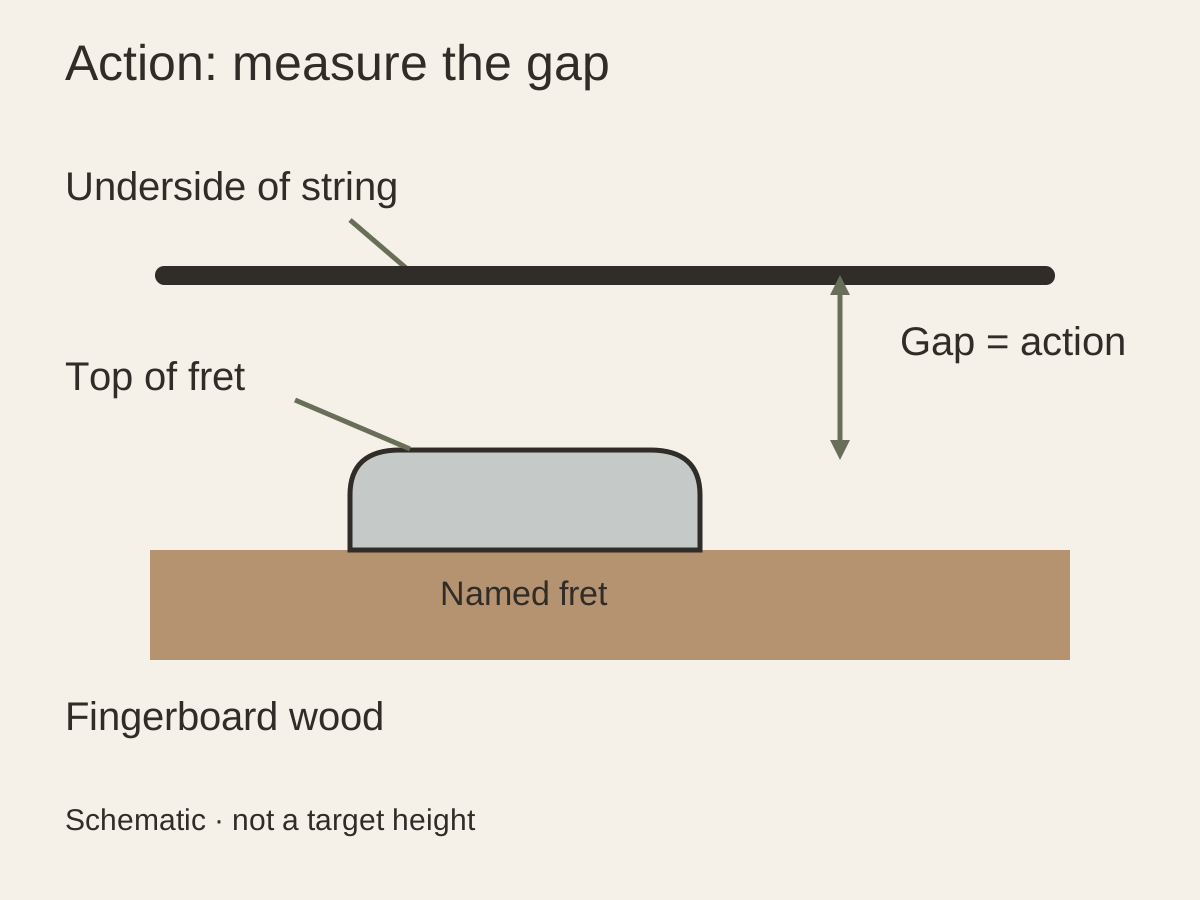
Define the two contact points
Measure from the fret crown to the lower surface of the string, not from fingerboard wood or to the top of the string. Those alternatives include fret height or string diameter and are different quantities. Keep action separate from neck relief, the curvature checked by another method.
Fender’s action article describes a 12th-fret measurement. Its factory support procedure uses the 17th fret for electric-guitar action and gives conditional references. These are different procedures, not interchangeable numbers. Follow the current manual for the actual model, including special layouts.
Sources: Fender: action measurement and clearance trade-off; Fender: model-specific setup conditions and measurement locations
Prepare a measurement another person can repeat
On your own guitar, or with the owner’s permission, identify the installed strings and intended tuning. Follow the model’s arrival instructions where relevant. Use a stable playing orientation and a suitable readable action gauge. Check its contact/zero reference; a scale printed above the physical edge can change the reading.
Keep the string open unless the chosen procedure requires a capo or fretting condition; record any such condition. Place the gauge gently on the named fret crown and sight the lower string surface without pressing the string or changing the instrument position. Record relevant bass and treble readings and any other string at issue.
Retune and repeat with the same method if the observation is doubtful. Read only what the markings support. A photo taken at an angle, unit conversion or additional decimal places does not increase measurement accuracy. This guide establishes no calibrated or certified result.
Sources: Fender: model-specific setup conditions and measurement locations
Write the value together with its conditions
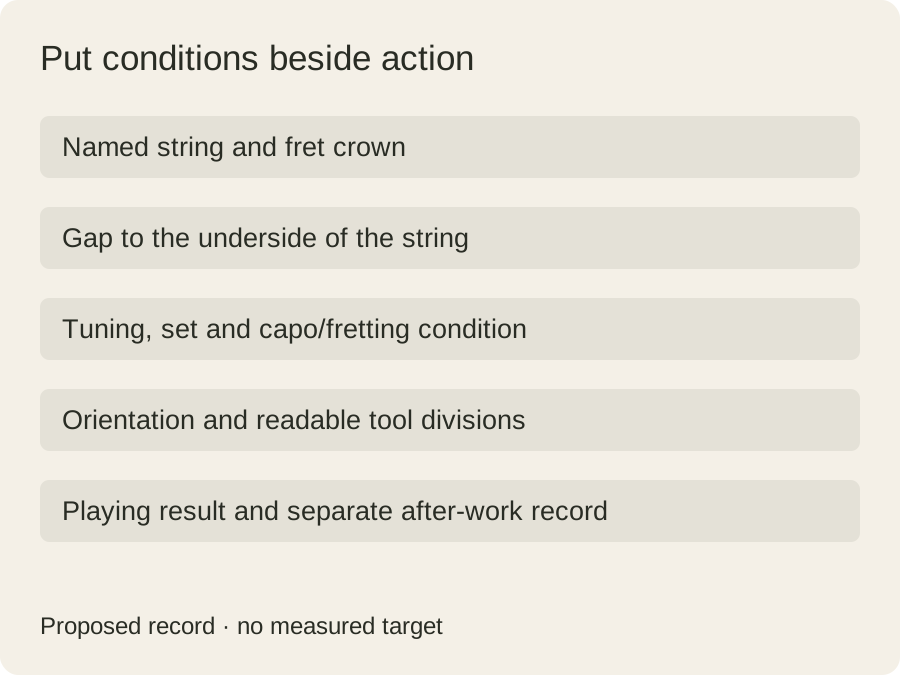
The table is a hypothetical record, not a recommended setting. It illustrates a sixth-string reading of about 2.0 mm at the 12th fret using a gauge with 0.1 mm divisions. It reports no real guitar, measurement uncertainty or successful playing result.
| Field | Record example or requirement |
|---|---|
| Unit | Identify the actual guitar and bridge |
| Strings/tuning | Exact set; standard E–A–D–G–B–E in this example |
| Method | 12th-fret crown to underside of open sixth string |
| Condition | Normal playing orientation; no capo or fretting |
| Reading/tool | Illustrative 2.0 mm; gauge divisions 0.1 mm |
| Playing result | Record attack, notes, bends and signal path; no assumed pass |
If the fret, string condition, tuning or method changes, start a distinct record. Keep an unexpected before-work observation. A difference below the tool’s useful readable resolution is not a demonstrated improvement. The record supports assessment; it does not certify the instrument.
Keep the surrounding setup in view
Relief, nut-slot height, fret condition, bridge/saddle, neck geometry and strings can affect what you observe. A rod changes relief; it is not a universal string-height control. The same overall action reading can accompany different local problems.
On an acoustic, available saddle height and neck/top condition need assessment before material is removed. Cutting, filing and structural work are not ordinary measurement steps. Confirm model-specific limits with a suitable technician, particularly for unexplained gaps, movement, unusual adjustment resistance or exhausted range.
A setup change may require intonation and, where applicable, pickup-clearance checks. The Fender action discussion describes that interaction. It does not establish that an unknown fault can be repaired by lowering a saddle.
Sources: Fender: action measurement and clearance trade-off; Fender: model-specific setup conditions and measurement locations
Choose around the playing result
Lower action reduces travel to the fret and leaves less clearance for vibration; higher action changes the opposite trade-off. Fender describes this balance. The acceptable result depends on actual strings, tuning, fret condition, attack and listening path.
Try the required chords, notes, bends or slide work at a suitable level. Record where noise occurs and whether it affects the intended output. A slide requirement or strong attack may favour different clearance. Do not choose a guitar or service target solely by the smallest number.
Record a symptom before assigning a cause
Write whether an issue occurs open, on a particular note, in a region or across much of the neck. Repeat under known conditions and distinguish mechanical noise from an intermittent signal or other rattle. Use the fret-buzz guide for a symptom map.
A high reading, buzz or sharp fretted note does not by itself identify a nut, fret, rod or structural repair. Stop the trial if it is uncomfortable or the function is uncertain. Seek appropriate technical assessment rather than changing several parts to hide the observation.
Keep observations and authorized work separate
Preserve original strings, tuning, readings, symptoms and relevant conditions before requesting service. Follow the actual maker’s procedure or have a competent technician plan the work. Do not use this article as a universal rod-turn or saddle-cutting instruction.
After authorized changes, record the exact work, retune and recheck affected and connected functions using stated methods. Keep both results. A change of strings or tuning may require a new setup assessment; it does not make a previous reading directly comparable.
For a purchase, use the unit inspection record and check the actual guitar. One prepared sample does not establish every instrument’s setup. Store intake has a separate receiving workflow. Choose a setting that serves your music within the instrument’s condition and adjustment limits.
Frequently asked questions
Must every action measurement use the 12th fret?
No. Different procedures specify different locations. Record the string, fret and conditions and compare only matching methods.
Is 2.0 mm a recommended action here?
No. It is one hypothetical reading used to show a record. No real guitar or playing result was tested, and no universal target is supplied.
Can a high reading tell me which part to adjust?
No. Readings and symptoms need the surrounding setup and an appropriate assessment. Preserve the original result and authorized-work record.
How this guide was prepared
We checked Fender’s action discussion and factory setup procedure, including their differing fret references and model/string conditions. The 2.0 mm/0.1 mm record is hypothetical and not a target or certified measurement. We measured no guitar, calibrated no gauge, diagnosed no fault and performed no adjustment or repair. The schematic defines contact points, not actual scale or clearance.
Documentation checked .
Clarified differing measurement locations and conditions, retained the accurate gap diagram, added a contextual record and removed the universal lowest-action objective and unsupported repair conclusions.