
The short answer
00 and concert are not two globally standardized guitar sizes. Martin calls its 0 body Concert and its 00 body Grand Concert; other makers use their own naming systems. The body name helps identify a family, while outline, depth, scale and neck details describe different aspects of playing feel. Use those distinctions to understand a guitar without expecting its label to predict comfort or sound.
A guitarist might describe an acoustic as “a small concert body” while its specification calls it 00. Both descriptions may be reasonable within the maker’s terminology. The confusion begins when the names are treated as fixed dimensions across every brand.
For a player, understanding the terms is useful beyond choosing an instrument. It helps explain why two apparently similar guitars sit differently against the body, why a compact acoustic can retain a familiar fretting stretch, and why a recording cannot be identified by its size label alone.
What matters most
- Interpret 00 and concert within the maker’s naming system.
- Body outline, depth, scale and neck shape describe different playing variables.
- Use an actual phrase and playing position to explore the instrument.
- Describe the instrument and conditions behind a sound or comfort observation.
How 00 and concert names relate
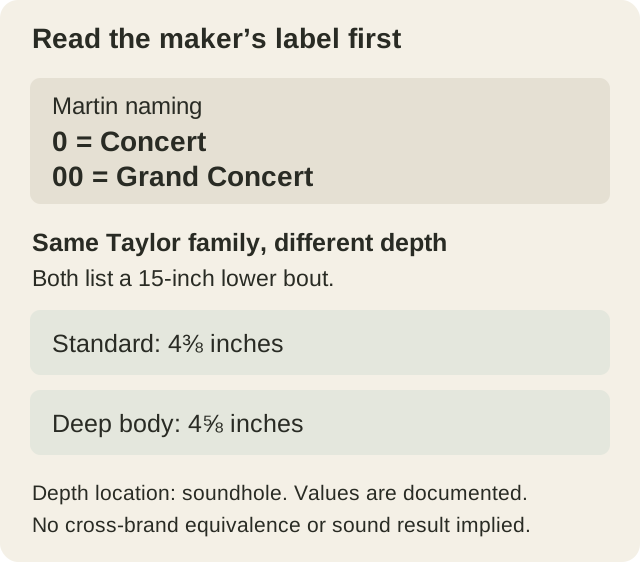
Martin’s guide to Concert and Grand Concert bodies maps 0 to Concert and 00 to Grand Concert. Within that system, the names refer to different body families. Outside it, “concert” needs the maker’s own definition.
A comparison of two Martin body families therefore asks a different question from a comparison between a Martin 00 and another maker’s concert-labelled design. In the second case, start with the dimensions and construction of the actual instruments. A shared word does not establish a shared outline.
| Name | Meaning supported here | What it leaves open |
|---|---|---|
| Martin 0 / Concert | A body family in Martin’s system | The particular model’s neck, setup and sound |
| Martin 00 / Grand Concert | Another family in that system | Scale and depth of the exact model |
| Another maker’s Concert or Grand Concert | That maker’s designation | Whether it resembles a Martin family dimensionally |
Think of the name as an address in a maker’s catalogue. It directs you to a group of designs. The specifications then explain the particular guitar, and playing it reveals how that instrument responds to your technique.
Body size, depth and scale describe different things
Lower-bout width describes the body around its widest section. Body length describes another part of the outline. Depth describes how far the front and back sit apart at a stated measuring location. These measurements concern the object resting against the player.
Scale length is separate from the body name. Keep the maker’s published scale figure distinct from a fret-layout reference and from each open string’s actual nut-to-saddle speaking length after compensation. StewMac’s saddle-placement example distinguishes the fret reference from the compensated string contact distances. The current Martin 00-15M specification, for example, lists a 25.4-inch scale. A 00 label therefore does not establish a short scale.
Even one named body family can have different depths. Taylor’s Grand Concert page gives both its standard and deep-body versions a 15-inch lower bout, but lists soundhole depths of 4⅜ and 4⅝ inches respectively. These are manufacturer values for those Taylor designs, not our measurements.
Neck width and shape add further distinctions. The distance between strings affects where the fingers land, while the profile concerns the shape held by the hand. A smaller body can change your picking-arm position without providing more room between strings or a shorter fretting stretch.
Sources: StewMac: Fret reference and compensated saddle placement
What a compact body changes in your playing position
When seated, the guitar is supported by the body, the leg or a playing support, and the hands. Its outline and depth help determine where the soundboard and neck settle. The most useful observation is how your normal posture accommodates that particular instrument.
Try a familiar passage before changing your usual position. Notice whether the picking shoulder stays relaxed, whether the forearm reaches the strings comfortably and whether the instrument remains stable. If you habitually hold the neck high or use a support, include that arrangement in the observation.
Now move between a simple chord and a phrase that needs a larger fretting stretch. If the body feels easier to hold but the stretch remains familiar, those observations can coexist. They concern different dimensions of the instrument.
Standing playing creates another relationship. A strap changes how the instrument is supported and where it hangs. An acoustic that settles comfortably on your leg may occupy a different position when standing. Explore the posture in which you actually make music rather than assigning comfort to a category name.
Players vary in reach, technique and preferred support. There is no body label that establishes an ideal fit for every smaller or larger person. A useful description is specific: the guitar’s depth changes this player’s arm position in this posture.
What can the body name tell you about sound?
It identifies a design family, but it cannot supply the sound of an individual guitar. Construction, strings, setup, playing technique and the listening environment also matter. Descriptions such as “focused” or “warm” need a musical and recording context to be useful.
Explore response with a phrase you can repeat comfortably. Begin with a light touch, then play the accompaniment at your normal strength. Listen to whether you hear the melody, bass movement and chord notes in the balance you want.
For fingerstyle, try an independent bass note under a short melody. For strumming, try a verse pattern followed by the strongest section of the song. These exercises ask different musical questions; an instrument that suits one passage need not give every player the same preferred result.
Keep a simple distinction between an observation and its explanation. “This passage sounds clearer to me on this guitar” is an observation under stated conditions. “All concert bodies are clearer” is a much larger claim that the observation does not establish.
If you compare recordings, keep the microphone and player position reasonably consistent and listen at similar playback levels. A change in microphone distance or volume may alter your impression. A recording through a pickup describes that amplified path, which should be considered separately from the unamplified sound.
Explore the guitar through a musical task
A short musical exercise can make the dimension terms easier to understand. Use an existing instrument or an instrument you have permission to play; there is no need to turn the exercise into a shopping session.
| Musical task | Observe | Interpret with care |
|---|---|---|
| A quiet fingerpicked phrase | Your touch, note balance and the body’s position | The result belongs to this instrument and playing approach |
| A familiar chord stretch | Fretting reach, string spacing and pressure | Body width does not establish neck dimensions |
| A regular accompaniment with rests | Arm position, stability and release of notes | A successful posture need not work for another player |
| The same phrase recorded twice | Changes in touch, microphone position and playback level | The recording conditions can affect the comparison |
Choose one question for the session. If you are exploring picking-arm comfort, pay attention to the body and support before making a tone judgment. If you are studying a particular musical texture, use the phrase and listening conditions that expose it.
Write a brief note afterward: the position used, the passage played and what changed. This turns an abstract claim about a “small guitar” into a description you can repeat or discuss with a teacher.
Two players can notice different things
Consider two hypothetical players discussing the same compact acoustic. The first enjoys the way the body sits close to the torso during seated accompaniment. The second is interested in a difficult first-position chord and notices that the fretting stretch remains substantial.
Neither observation invalidates the other. The first concerns body support and arm position. The second concerns the string and fret layout, technique and setup. A body-size name cannot combine those experiences into one universal comfort rating.
The same applies to musical response. One player may use quiet fingerpicking while another uses a strong rhythmic part. To understand their descriptions, ask what they played, how the instrument was supported and whether they heard it acoustically or through electronics.
These are teaching examples, not reports of a test. Their purpose is to show how a more specific question produces a more useful explanation.
Where the simple size comparison stops
Sometimes the question is really about the neck. A player may use “concert size” as shorthand for an instrument that felt easier, even though its neck profile, strings or setup supplied much of that impression. Separating the details helps avoid assigning every difference to the body.
A modified or older instrument can also differ from a current specification. When discussing one, identify the version and what is fitted to it. The maker’s current dimensions remain useful background, but they do not prove that every previous instrument is identical.
If persistent discomfort is the concern, changing support position or technique may be part of the discussion with a teacher. A smaller body is one physical variable, not an explanation for every playing difficulty. Likewise, a size label cannot diagnose a setup problem.
For broader body families, Dreadnought vs Grand Auditorium vs OM adds context. For the fretting-hand questions, continue with guitar scale length explained and guitar nut width.
Understand the guitar beyond the label
Body names make guitar designs easier to discuss once their context is clear. Use the name to locate the family, dimensions to understand the physical design, and music to explore how the instrument works in your hands. That gives the terms a useful role without asking them to predict everything.
Frequently asked questions
Does 00 mean concert?
In Martin’s system, 0 is Concert and 00 is Grand Concert. Outside that system, use the maker’s definition rather than assuming a universal equivalence.
Does a smaller body mean a shorter scale?
No. Body and scale are separate specifications. The 00-15M example above illustrates a compact body with a 25.4-inch scale.
Is a concert body only for fingerstyle?
The label does not impose a technique. Explore fingerpicking, strumming or the other parts you play on the actual instrument, with its construction and setup considered.
Can I identify a 00 guitar from its recorded sound?
A recording alone is not reliable identification. Strings, technique, instrument construction, microphone position and processing can all be part of what you hear.
How this guide was prepared
This AI-assisted documentation review checked Martin’s 0/00 naming guide and current 00-15M scale specification, Taylor’s standard and deep-body Grand Concert dimensions at its stated soundhole location, and StewMac’s fret-reference and compensated saddle-placement example. The manufacturer values are published specifications, not our measurements. We checked the existing name/depth graphic against those values. Playing exercises are editorial suggestions and the two player examples are hypothetical; no guitar was held, measured, recorded or sound-tested and no human expert review was performed.
Documentation checked .
Clarified the distinction between published scale, fret-layout reference and compensated speaking length; rechecked the named body-size examples and their graphic.