The decision in brief
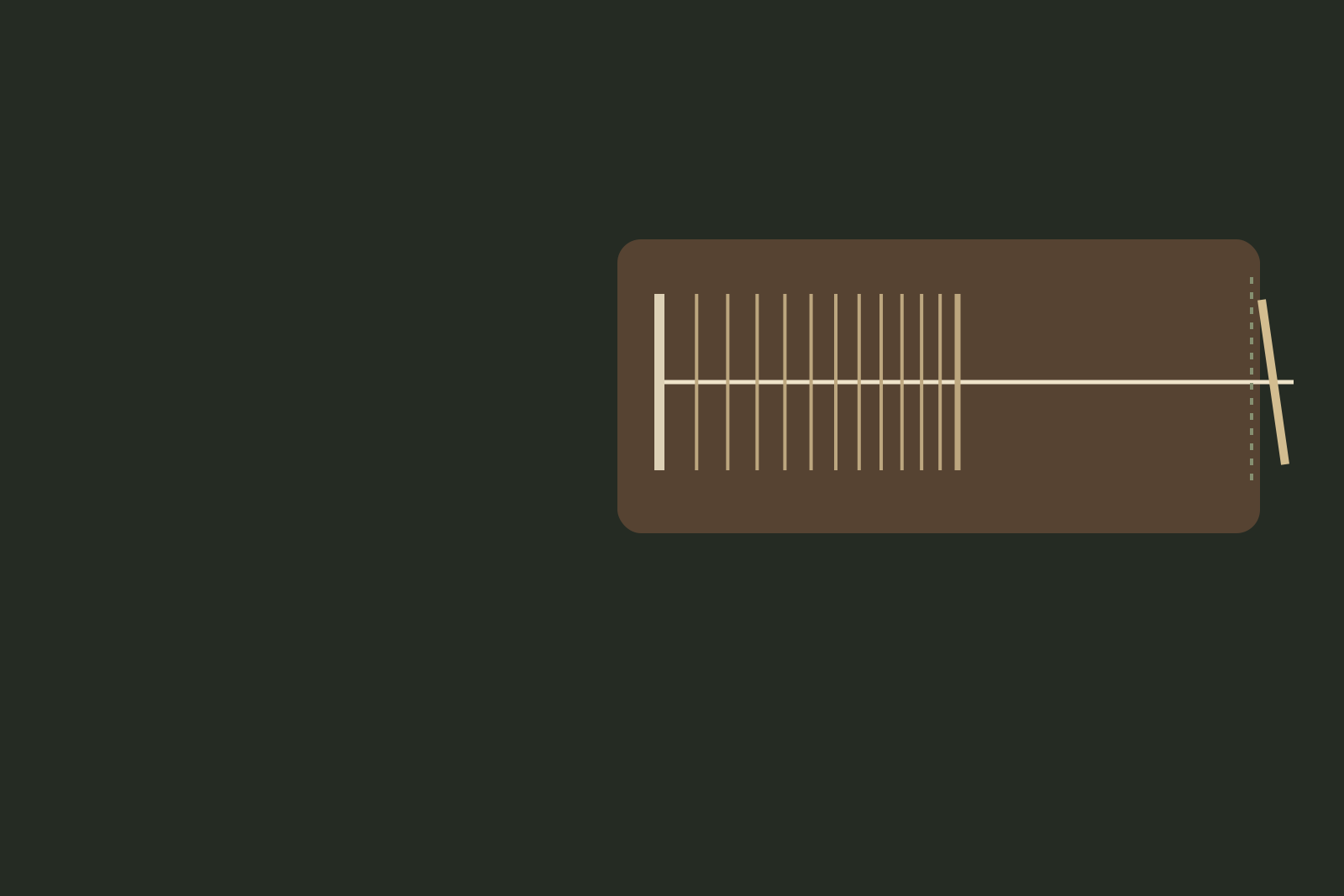
Guitar scale length is the nominal reference for fret placement and open-string length. On a conventional twelve-tone equal-tempered guitar with an uncompensated nut, measure along a string path from the nut’s contact edge to the crown of the 12th fret and double it. Individual saddle compensation is separate. Longer reference scales spread the frets farther apart and require more ideal string tension at the same string and pitch; tuning, strings, neck shape and setup still affect feel. Use the maker’s measurement method for compensated nuts, zero frets or other special layouts, and compare multiscale strings individually.
What matters most
- On a conventional equal-tempered layout with an uncompensated nut, double the nut-to-12th-fret distance; use the maker’s reference method for special layouts.
- Keep the full string specification and tuning comparable when judging scale-related feel.
- Check reach and setup together; a shorter scale does not guarantee comfortable playing.
Define scale length precisely
Scale length is the nominal reference length used to lay out the frets. The actual speaking length of an open string runs between its contact points at the nut and saddle. Individual saddle compensation can make that length different from the nominal figure. Neither number is the total length of the guitar or headstock.
A model specification such as 25.5 inches describes a design reference. Verify the exact model, and keep nominal scale and individual compensated string lengths in separate fields. StewMac’s measurement and bridge-placement example shows why the distinction matters.
Sources: StewMac: nut-to-12th-fret measurement and saddle compensation
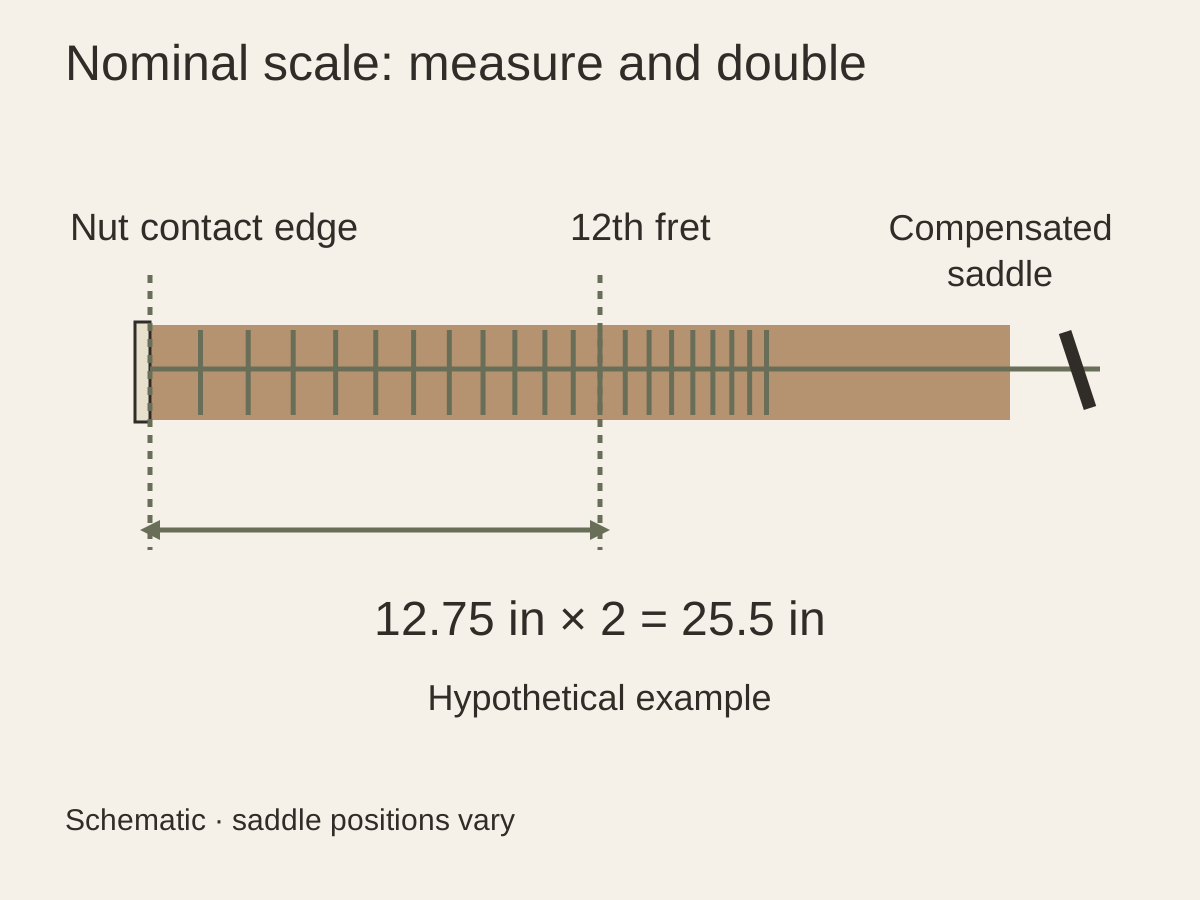
Measure from the nut to the 12th fret, then double it
For a conventional twelve-tone equal-tempered layout with an uncompensated nut, use the contact edge facing the first fret and the crown of the 12th fret. Measure along the selected string path rather than an arbitrary line across the neck.
- Position a suitable ruler without scratching the finish or forcing the string aside.
- Identify the nut’s string contact edge, not the back of the nut blank.
- Read to the centre of the 12th fret crown.
- Double that distance and compare it with the model’s nominal specification.
- Record tool resolution, reference points and units. Record each compensated saddle distance separately if needed.
Compensated nuts, zero frets and unusual fret layouts need the maker’s stated reference points. On a multiscale instrument, examine each string’s documented scale and measurement path. A single centreline value does not describe all its strings.
Sources: StewMac: nut-to-12th-fret measurement and saddle compensation
A worked scale measurement and its limits
In a hypothetical example, nut contact edge to 12th-fret crown is 12.75 inches. Doubling gives a nominal 25.5-inch scale, equivalent to 647.70 mm using the exact conversion 1 inch = 25.4 mm. These are arithmetic values, not measurements of a guitar in our possession.
Align the ruler with the measurement path and read perpendicular to its markings. Do not add decimal places beyond the tool’s resolution. If a result differs from the specification, repeat it and confirm the model and reference method before inferring a fault.
| Record | Purpose |
|---|---|
| Nut-to-12th distance, unit and tool resolution | Makes the doubling check repeatable |
| Nominal model scale and exact version | Separates design from saddle compensation |
| Full string specification and tuning | Keeps the tension comparison meaningful |
| Action, relief, nut width and neck profile | Records other contributors to playing feel |
A shared “10–46” package label does not establish identical string construction. Read the string-gauge guide for set notation and tension context.
Sources: StewMac: nut-to-12th-fret measurement and saddle compensation; NIST: the international inch equals exactly 25.4 mm
Understand the relationship between scale and string tension
In the ideal string model, tension varies with the square of speaking length when frequency and mass per unit length stay constant. Using nominal lengths as reference inputs gives T₂/T₁ = (25.5/24.75)² ≈ 1.062, or about 6.2% more ideal tension. Individual compensation and real-string behaviour are outside this simple comparison.
This is not a measurement of fretting force, bending resistance or perceived stiffness. Changes in gauge, core and wrap construction, tuning, action and bridge geometry can change the complete result. Compare the actual string specification, and describe a playing preference as a preference for those instruments under the recorded conditions.
Sources: D’Addario: string unit weight, length, pitch and tension (January 2026)
Connect scale length with fret spacing and reach
For an ideal twelve-tone equal-tempered fret layout, the distance from the nut reference to fret n is dₙ = L(1 − 2−n/12). An octave divides the reference length in half; the 12th fret is at L/2. Adding a 23rd or 24th fret extends the layout without changing L.
| Nominal scale | Metric equivalent | Calculated nut-to-first-fret distance |
|---|---|---|
| 24.75 in | 628.65 mm | 35.28 mm |
| 25.5 in | 647.70 mm | 36.35 mm |
The first-fret difference is about 1.07 mm, rounded to two decimal places. These ideal calculations exclude nut compensation and are not fret-cutting tolerances or a claim about hand comfort. Try your own first-position stretches and position shifts; width, profile and playing posture also matter.
Sources: UNSW Physics: octaves and equal-tempered semitone ratios; D’Addario: string unit weight, length, pitch and tension (January 2026); NIST: the international inch equals exactly 25.4 mm
Read scale length with strings, tuning and construction
| Change | Ideal tendency with the stated conditions | Also check |
|---|---|---|
| Longer reference scale | Wider fret spacing; more tension at the same string and pitch | Reach, strings and setup |
| Shorter reference scale | Closer fret spacing; less tension at the same string and pitch | Intonation, strings and setup |
| Greater mass per unit length | More tension at the same speaking length and pitch | Complete string construction and compatibility |
| Lower pitch | Less tension for the same string and speaking length | Gauge, relief and intonation |
Multiscale instruments use different design lengths across their strings. Compare their angled fret layout and actual reach through playing, and use the maker’s string-by-string specifications.
Sources: D’Addario: string unit weight, length, pitch and tension (January 2026)
Know when a scale-related change requires setup
Changing strings or tuning can affect relief, action, nut behaviour, intonation and the balance of a floating bridge. Fender’s setup guidance explicitly depends on factory string gauges; it is an example of why an existing setup cannot be copied without checking the intended strings. Follow the current instructions for the exact instrument.
A normal setup changes compensation rather than the designed fret layout. Stabilize strings, tuning, relief and action before checking intonation. Compare the open note or octave harmonic with the gently fretted 12th-fret note using a tuner; follow the bridge maker’s adjustment method or ask a technician. A mismatched replacement neck or incorrectly placed bridge cannot be corrected by treating the truss rod as a scale-length adjustment.
Sources: Fender Support: factory-gauge assumptions and setup adjustments
Choose a scale for the intended application
Use scale as one filter for the musical task. A shorter reference length reduces ideal fret spacing and tension for the same string and pitch, but it does not guarantee comfortable reach or easier bends. Longer or baritone designs can be useful for lower tunings when strings, compatibility and setup suit the target pitch.
Keep guitar and bass comparisons in their own instrument families. Body position, balance, nut width, neck profile and the passages you play can change your preference. A single measurement cannot assign the right instrument to a hand size.
Compare scale lengths with a controlled playing test
- Use comparable string specifications and condition where practical.
- Confirm the same tuning and a stable setup.
- Record nominal scale, nut width, profile, radius, fretwork, relief and action.
- Try comfortable first-position stretches and barre chords.
- Compare bends and vibrato at a level suitable for you.
- Check low-string attack and intonation across the neck.
- Record the musical task, result and any variables you could not hold constant.
This is a suggested comparison method. If bodies, pickups or bridges also differ, use the trial to choose between those complete guitars. It does not isolate scale as the cause of every audible or tactile difference.
Avoid common scale-length mistakes
Keep nominal scale separate from total guitar length and compensated saddle measurements. Fret count does not determine scale. A shorter scale does not solve every comfort issue, and a longer one does not guarantee better low-tuned tone. Apply the doubled-12th-fret method only to the layout and reference points it describes.
Conclusion: use scale length as a system measurement
Verify the model’s nominal scale, use an appropriate reference method and record the complete playing conditions. The measurement explains fret spacing and helps with tension comparisons; the actual guitar, strings, posture and setup determine your choice. Read our action guide and nut-width guide when the remaining question is pressure or lateral spacing.
Frequently asked questions
How do you measure guitar scale length?
For a conventional equal-tempered layout with an uncompensated nut, measure along a string path from the nut’s contact edge to the 12th-fret crown and double it. Use the maker’s reference method for compensated nuts, zero frets, multiscale or other special layouts.
Does a shorter scale make guitar easier?
It generally reduces tension and fret spacing at the same string and tuning, but neck shape, nut width, action and technique still determine comfort.
Is 25.5 inches better than 24.75 inches?
Neither is universally better. At the same string and pitch, the longer reference length needs more ideal tension and spreads the frets farther apart. Actual reach and bending feel depend on the complete instrument and setup.
Do 24 frets mean a longer scale?
No. Fret count and scale length are independent, and 22- and 24-fret instruments can use the same scale.
Does scale length affect intonation?
It determines fret placement, while saddle compensation fine-tunes each string. Correct strings and setup are required for accurate intonation.
How this guide was prepared
We checked StewMac’s reference-point and compensation example, D’Addario’s ideal tension relation, UNSW Physics’ equal-tempered pitch ratios, NIST’s inch conversion and Fender’s factory-gauge setup qualification. The 12.75-inch example, tension ratio and fret positions are editor calculations under explicitly stated ideal assumptions, not measurements of an instrument. The playing comparison is a method readers can use; we did not install strings, compare guitars, measure bending force or verify a particular compensated-nut or multiscale model.
Documentation checked .
Clarified nominal scale, measurement references and special-layout limits; added sourced ideal calculations; replaced the inaccurate hero; corrected existing translations and added a specific method statement.
Sources and further reading
- StewMac: nut-to-12th-fret measurement and saddle compensation
- D’Addario: string unit weight, length, pitch and tension (January 2026)
- UNSW Physics: octaves and equal-tempered semitone ratios
- NIST: the international inch equals exactly 25.4 mm
- Fender Support: factory-gauge assumptions and setup adjustments