
The decision in brief
Use Grand Concert and Grand Auditorium as maker-specific body names, then compare the actual dimensions. In Taylor’s published examples, the standard Grand Concert has a narrower, shorter and shallower body with a shorter scale than the Grand Auditorium. The deep-body Grand Concert shares the listed Grand Auditorium depth, so the name alone does not settle reach or comfort. Try body fit and fretting reach separately before judging sound.
Keep the maker with the body name
This comparison uses Taylor’s Grand Concert and Grand Auditorium descriptions. Their dimensions are useful concrete examples. They do not define every guitar sold under similar names, and they do not make a Taylor model a recommendation for every player.
Identify the full model, version and intended string system. A shared family word does not establish the same neck joint, construction, cutaway or electronics. The 00 and Concert explanation shows why one maker’s naming system cannot be silently transferred to another.
Read body length, width, depth and scale separately
The lower bout is the wide lower part of the body below the waist. Keep that body measurement separate from neck width and string spacing.
| Published measurement | Standard Grand Concert | Grand Auditorium |
|---|---|---|
| Body length | 19½ in | 20 in |
| Lower-bout width | 15 in | 16 in |
| Depth at soundhole | 4⅜ in | 4⅝ in |
| Nominal string scale | 24⅞ in | 25½ in |
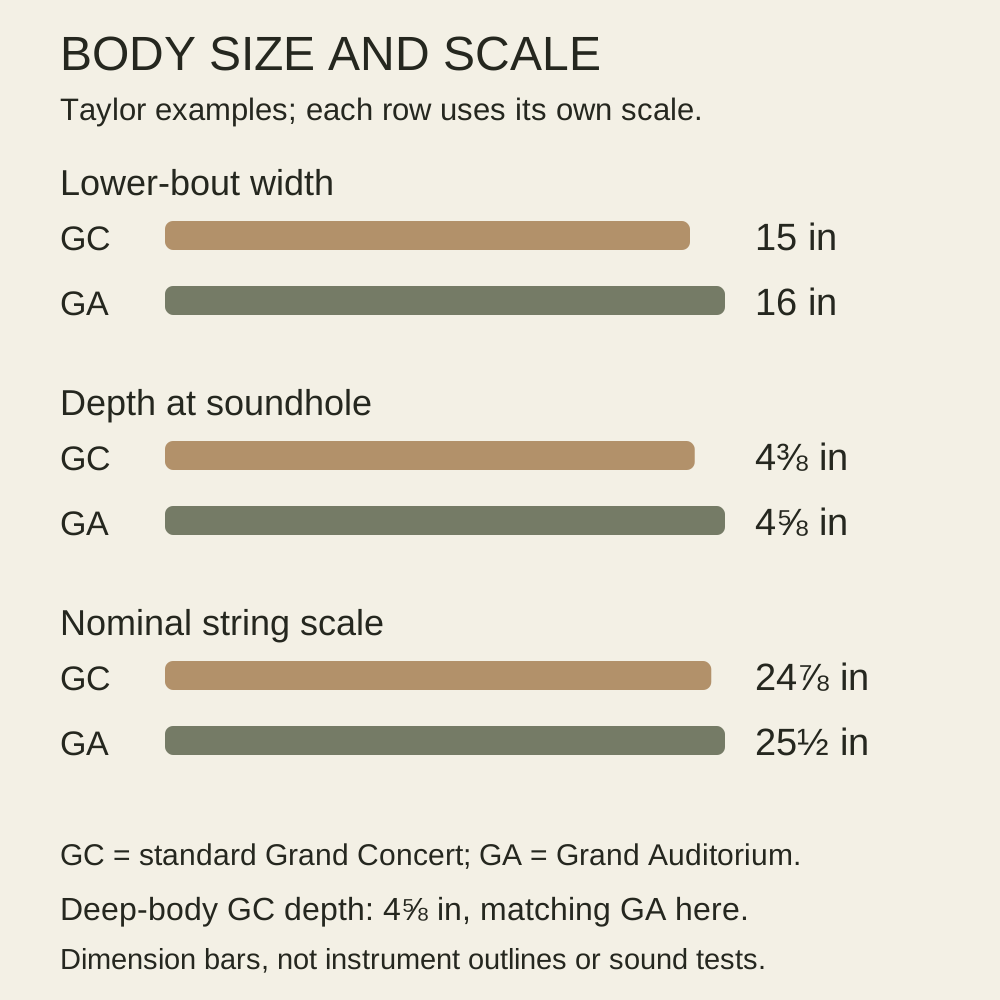
In these examples, the Grand Auditorium is ½ inch longer at the body, 1 inch wider at the lower bout and ¼ inch deeper at the stated soundhole location. Its nominal scale is ⅝ inch longer. These are differences between published values, not measured tolerances or a prediction of how a player will feel.
Body length describes the body; scale describes the fret-layout reference. They must not be added into one “guitar size” score. Nut width, string spacing and neck profile need separate fields. Use the nut-width guide when the concern is space between the fingers.
Sources: Taylor Grand Concert: standard and deep-body dimensions; Taylor Grand Auditorium: body dimensions and nominal scale
A deep-body Grand Concert changes the depth comparison
Taylor also lists a deep-body Grand Concert. Its 15-inch lower bout and 19½-inch body length match the standard Grand Concert entries, while its 4⅝-inch soundhole depth matches the Grand Auditorium value above. The listed scale remains 24⅞ inches.
That example prevents a blanket claim that every Grand Concert is shallower than a Grand Auditorium. Confirm which version a listing describes. A photograph or an abbreviated GC label may not supply that detail.
The depth comparison also needs the same measuring location. A maximum depth measured near the tail is not automatically interchangeable with the soundhole-depth values used here. Retain the maker’s reference point when requesting dimensions for another guitar.
Sources: Taylor Grand Concert: standard and deep-body dimensions; Taylor Grand Auditorium: body dimensions and nominal scale
Make two different fit observations
First observe the body in your normal seated position, then with a strap if relevant. Notice the lower bout against your picking arm, how the waist rests and where the neck settles. A narrower example may be worth trying when reaching around the body is the problem, but it does not guarantee comfortable posture.
Next play a familiar first-position chord and a passage that needs your normal stretch. Record fretting reach separately from the body observation. The shorter listed scale changes the fret layout, while nut spacing, neck shape, strings and setup can also affect this task.
The scale-length guide explains the reference dimension. It cannot replace holding the guitar. A smaller lower bout does not establish narrower string spacing, and a successful short trial cannot promise long-session comfort.
Use sound descriptions to choose a listening task
Body-name descriptions such as focused, balanced or versatile are starting questions for a comparison. They do not establish which individual guitar will suit your accompaniment or recording. Avoid turning a catalogue description into an acoustic measurement.
Play a quiet phrase with independent bass and melody, then the strongest accompaniment you use. Listen for the balance you need and whether your technique can control it. Keep strings, tuning, pick and room conditions in the record. Two complete guitars with different tops, bracing or setups do not isolate body shape.
If recording, preserve microphone position as closely as possible and compare at similar playback level. If amplification is part of the job, assess that route separately. The acoustic-pickup guide covers the installed system; the top-construction comparison addresses a different variable.
Choose from the actual version and playing result
| Record before the trial | Add your observation |
|---|---|
| Maker, model and standard/deep-body version | Body support and picking-arm reach |
| Body dimensions with reference locations | Seated and standing position |
| Scale, nut spacing, strings and setup | Fretting reach and note control |
| Passage and acoustic/recorded/amplified route | Useful response and unresolved differences |
Shortlist the version whose dimensions address your physical question, then compare the actual musical response. When a body fits but the neck does not, keep that distinction and try another model. When both fit, let the part and listening conditions guide the preference.
The Dreadnought, Grand Auditorium and OM comparison widens the body-family shortlist. For the complete personal buying process, continue with how to choose an acoustic guitar.
How this guide was prepared
We checked Taylor’s Grand Concert and Grand Auditorium shape pages on October 27, 2026. Dimensions are manufacturer descriptions at the stated locations, not our measurements or an industry sizing standard. Differences in the table and diagram are simple editorial arithmetic. The deep-body entry is kept separate. Fit and listening tasks are proposed guidance; no guitars were held, played, measured or acoustically tested, and no human specialist review is claimed.
Documentation checked .