The decision in brief
Use a shielded instrument cable for a conventional guitar-to-pedal or guitar-to-amplifier input connection. Use a dedicated speaker cable from an amplifier's speaker output to a passive cabinet, with the cable and cabinet load approved for that amplifier. Both cable types can have quarter-inch TS plugs, so matching connectors do not establish suitability. Read the socket labels and manuals, power the amplifier off before changing speaker connections, and confirm the required load before powering it again. Effects sends, line outputs, headphones and powered speaker inputs require their own connection checks.
What matters most
- Identify the source output and destination input before choosing a cable.
- A matching quarter-inch plug does not identify the cable's intended use.
- Cabinet impedance and cable suitability are separate checks.
- Treat line, effects-loop and headphone sockets according to their own manuals.
Identify both sockets before choosing a cable
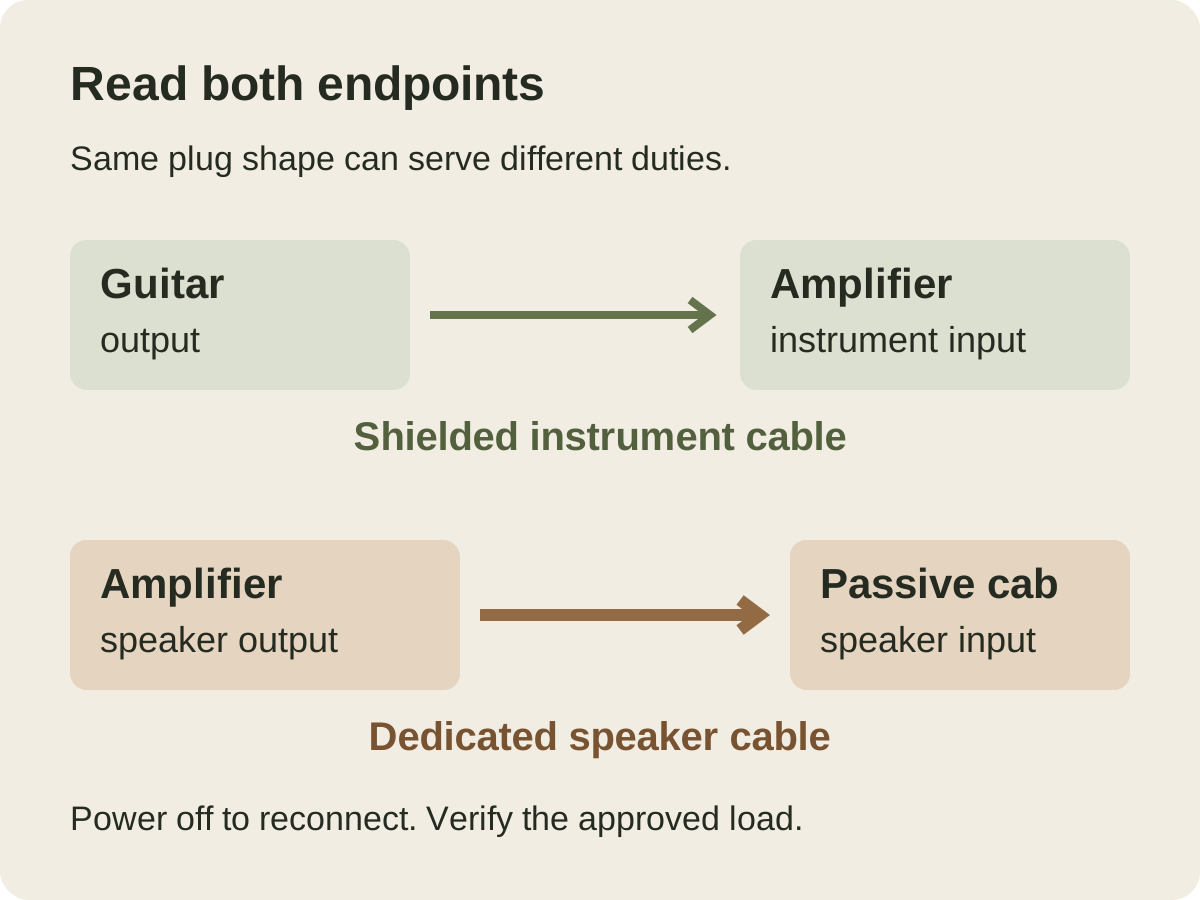
Start at the source. Is the cable leaving a guitar output, a pedal output, an effects send, a line output or a speaker output? Then read the destination label. An amplifier input and a passive cabinet input may accept similar-looking plugs while receiving very different signals. Write the connection as two named endpoints instead of asking which loose cable looks thick enough.
In a conventional electric-guitar rig, the instrument output feeds pedals or an amplifier input. The power amplifier's speaker output feeds a suitable passive loudspeaker cabinet. Orange's connection guidance specifies dedicated speaker cable for that second route and a compatible cabinet load. Keep those two requirements separate: an appropriate cable cannot correct an incompatible cabinet arrangement.
Switch the amplifier off before changing its speaker connections and follow its operating procedure. If a label is obscured, the manual is missing or an output's function is uncertain, identify it before powering the rig. Socket position, plug diameter and the last owner's cable choice are insufficient evidence.
Sources: Orange: Speaker connections, cable and load guidance
Compare the cable's electrical job
| Question | Conventional instrument cable | Dedicated speaker cable |
|---|---|---|
| Typical guitar-rig route | Guitar to pedal or amplifier input | Power-amplifier speaker output to passive cabinet |
| Main construction requirement | A shielded low-level signal connection | Conductors suitable for the speaker output's power and run |
| Common connector possibility | Quarter-inch TS | Quarter-inch TS or an approved speaker connector |
| Useful evidence | Product category and shielding specification | Product category, conductor specification and equipment instructions |
A common unbalanced instrument cable uses an insulated signal conductor with a surrounding shield that also supplies the return connection. Shielding helps protect the low-level signal from interference. A conventional speaker cable uses conductors selected to carry the amplifier's output to the loudspeaker. Its ordinary purpose does not require the instrument cable's shielding arrangement. Hosa describes these different duties in its construction guide.
Individual products may add layers or use different connectors. Read the maker's specification to identify a particular lead. Cutting open a cable is unnecessary, and one product's cross-section does not establish how another is built.
Sources: Hosa: Instrument shielding and speaker cable construction
Why the same TS plug can be misleading
A quarter-inch TS connector has a tip and sleeve contact. That describes the connector arrangement, not the cable's conductor size, shielding or power suitability. A shop can sell both instrument and speaker leads with those connectors. A straight plug on one and a right-angle plug on another does not settle the category either.
Look for a legible jacket marking, a retained package or a traceable product code. Compare it with the manufacturer's listing. Mark identified cables so the speaker lead remains recognizable in a rehearsal bag. Keep any unknown cable out of the amplifier-to-cabinet route until its suitability is established. A continuity check alone would not certify its power handling, conductor size or condition.
A TRS connector adds a ring contact, but it also does not prove a particular use. Equipment may employ TRS for balanced audio, stereo headphones, switching or another defined purpose. An adapter that makes a plug fit cannot establish compatible signals or wiring. Use the connection instructions for both devices and the specific cable.
Do not test an unknown lead by turning up the amplifier
An instrument lead is not an acceptable substitute for the dedicated speaker cable specified for an amp-to-cabinet connection. The speaker route has a power-carrying requirement that a guitar lead's familiar connector does not establish. An incorrectly chosen or faulty lead can put the equipment at risk. Hearing sound at low level is not evidence that the connection is suitable.
Using an ordinary unshielded speaker lead in a low-level guitar route can introduce interference. That is a different problem from choosing a cable for speaker output duty. If a guitar signal is noisy, begin with a known, suitable instrument cable and the simplest supported input path. Compare one connection at a time rather than moving unknown leads around the rig.
If a cable becomes unusually warm, a connection is intermittent or a new fault appears, stop using the rig and arrange a qualified check. Do not continue a high-volume demonstration to see whether the fault clears. This article concerns external connection choices; internal amplifier work needs the appropriate service expertise.
Check cabinet load as a separate decision
Find the amplifier's permitted speaker-load arrangements and the cabinet's stated impedance. Follow the exact output labeling, selector instructions and approved combination. A printed wattage figure does not answer the impedance question, and a suitable impedance does not by itself establish every aspect of power handling.
Orange's general FAQ tells users to connect an appropriate load before operating a valve amplifier. Apply the specific manual for your amplifier, including any documented internal load or load-box operation. Do not generalize one manufacturer's safe operating mode to a different head. Standby behavior also needs the maker's instructions; it is not a universal permission to change live speaker connections.
For multiple cabinets, use the documented output arrangement and resulting total load. Do not guess whether sockets are wired in series or parallel. A cabinet link output and an amplifier's additional socket can require different interpretation. If the manual does not establish the proposed combination, resolve that question with the maker or a competent technician before connection.
Sources: Orange: Speaker connections, cable and load guidance
Choose length and conductor specification for the actual run
For the speaker route, record the required length, connector type and cable specification the equipment maker recommends. Extra cable resistance becomes more relevant with unsuitable conductors or unnecessarily long runs. There is no universal wire-gauge number that this guide can prescribe for every output, cabinet and distance.
For the instrument route, use a practical length that allows movement without a taut lead. In a passive pickup system, the cable's capacitance can interact with the signal path and influence the result. A buffered or powered source changes that context. Test the complete rig if the tonal difference matters; a low capacitance claim does not replace secure plugs, effective shielding and intact strain relief.
Keep the physical route manageable. Prevent a cabinet move from pulling on the amplifier socket, and allow cable length for the real placement of the head and cabinet. A thicker outer jacket is not a measurement of the copper inside. Select from documented specifications and usable routing, not visual bulk or premium packaging.
Sources: Orange: Speaker connections, cable and load guidance; Hosa: Instrument shielding and speaker cable construction
An effects send or line output is not a speaker output
An effects loop carries a signal intended for compatible processing equipment, not for directly powering a passive speaker. Its level and connection type depend on the amplifier. Check the send and return instructions against the receiving pedal or processor. Our looper guide explains how placement affects what is recorded; the cable choice still follows the supported endpoints.
A line output, DI output or headphone output has its own destination requirements. A powered speaker contains amplification and accepts its specified input signal. Do not connect an amplifier's speaker output to a powered speaker's ordinary line input. Likewise, a passive cabinet does not become active because its input resembles a line-level socket.
A load box, attenuator or amplifier with a documented cabinet-free mode needs its exact routing instructions. Establish whether a socket is an input, a speaker output, a through connection or a line output. Similar labels across devices are not enough to copy a diagram. Keep every load-dependent connection in the documented configuration.
Sources: Orange: Speaker connections, cable and load guidance
Make a cable record that another player can follow
Prepare the rig with the amplifier off. Record the head and cabinet models, selected output and load arrangement, speaker cable code and connection length. Identify the guitar and pedal leads separately. A small label such as “speaker: head to cabinet” can prevent an identified lead from being mixed with visually similar patch or instrument cables.
Inspect plugs, jackets and strain relief without dismantling them. Confirm that connectors seat correctly and that the cabinet has the intended input. Then follow the amplifier's power-up sequence. Start at a manageable listening level and check the ordinary playing path. A successful sound check confirms operation in that moment; it does not prove the unseen construction of an unknown cable.
Retain a suitable spare for each required category. If the speaker lead fails, use an identified replacement that meets the same connection requirements. Do not borrow whichever quarter-inch cable happens to be nearest. For a borrowed head or cabinet, redo the endpoint and load check even if your normal cables are already labeled.
Worked example: two quarter-inch routes in one rig
Imagine a rehearsal rig with a guitar, an amplifier head and a passive cabinet. The amplifier's front socket is labeled instrument input; its rear socket is labeled speaker output. The cabinet has a compatible quarter-inch input. Two loose leads fit every socket, but only one has a verified speaker-cable product code.
With the amplifier off, first confirm the head's approved cabinet arrangement and the cabinet's impedance. Use the identified speaker lead for the speaker-output-to-cabinet route only if its specification meets the equipment requirements. For guitar-to-front-input, identify a suitable shielded instrument lead. The second loose lead remains unused until its product category and condition are established. Its ability to fit both sockets does not answer either question.
Now suppose the cabinet is replaced by a powered monitor with a line input. The previous rear speaker-output route no longer describes a supported connection to that input. Consult the head's line or DI output instructions and the monitor's input requirements, while maintaining any load the head still needs. If those manuals do not provide the desired arrangement, obtain the missing connection explanation before power-up.
This is a hypothetical routing example, not a demonstration on named equipment. It shows the order of the decision: identify both endpoints, confirm the load where required, and select a documented cable. No cable label can authorize a connection the devices do not support.
When the advice changes: combos, acoustic rigs and stereo systems
A combo may have an internal speaker connection, an extension output or both. Keep its original connection as instructed and verify what adding a cabinet does to the load. Do not treat the internal cable as an available general-purpose lead. The socket label and model manual control the decision.
For an acoustic guitar feeding a powered speaker or mixer, trace the pickup or preamp output and the receiving input. The system may require an instrument input, DI or supported line connection. It is not an amp-head-to-passive-cabinet route merely because a loudspeaker is involved.
For stereo systems or several power-amplifier channels, map each channel separately. Document the load and cable for every speaker output. A Y adapter or an unverified link can change the electrical arrangement. Seek a model-specific explanation when the desired routing goes beyond the examples the manuals approve.
Conclusion: choose from endpoints and documented duty
Before connecting a loose cable, answer four questions: which output does it leave, which input receives it, what signal or power must it carry, and what specification establishes that it can do the job? For an amplifier speaker output, add the cabinet-load check. Those answers are more useful than a shared connector or a successful low-volume experiment.
Keep the instrument and speaker paths identifiable in the kit you actually use. Follow the equipment's connection and operating procedures each time a head, cabinet or special device changes. Once the route is established, the active and passive bass guide can help with the separate question of controls and input-level behavior.
Frequently asked questions
Can I use a guitar cable from an amplifier head to a cabinet?
Use the dedicated speaker cable specified for that route. A conventional guitar instrument lead does not establish suitability for speaker output duty, even when the plugs fit. Confirm the amplifier's approved cabinet load as well.
How can I tell a speaker cable from an instrument cable?
Check the jacket marking, product code, package and manufacturer specification. Connector shape, outer thickness and a low-volume sound test do not reliably establish the cable category or suitability.
Can both types have quarter-inch TS plugs?
Yes. The tip-and-sleeve connector arrangement does not identify conductor size, shielding or power suitability. Choose the cable category from the two endpoints and the equipment instructions.
Does an effects loop need speaker cable?
An effects send and return are signal connections, not speaker-power connections. Use the cable and signal level supported by the amplifier and processing device manuals.
Can a valve amplifier run without a cabinet?
Only use a cabinet-free arrangement explicitly supported by the exact amplifier and any load device. Follow its load and operating instructions. A cable change or standby setting alone does not establish a safe unloaded mode.
How this guide was prepared
This guide compares Orange’s external speaker-connection and load guidance, Hosa’s instrument/speaker cable construction explanation and Neutrik’s connector definitions. It applies those documents to a conventional guitar-input path and amplifier-to-passive-cabinet path. The routing diagrams, connection record and hypothetical rehearsal example are editorial explanations. We did not inspect cable samples, measure electrical performance or approve any unidentified amplifier, load device or cable. Follow the exact equipment manuals for connection and operating limits.
Documentation checked .
Added nearby connector and cable-duty references and specified the documentary scope, exact-equipment limits and unperformed tests.