Start here
Coil splitting changes which coils contribute to the signal. In a conventional full split, one humbucker coil remains active. Coil tapping selects a connection partway through a winding. A push-pull knob can control either function or a different circuit, so identify the exact pickup and switching diagram before deciding what the switch does.
Identify the pickup and the control
Write down the guitar version, pickup model and switch position. Look for a manufacturer diagram or control description that names the function. A pull-up volume knob could split a pickup, select a tap, change a series connection or control another feature. Check the control description against the wiring diagram, including what each pushed and pulled position selects.
Ask which coil or winding section remains connected. If the description only promises a “single-coil sound,” keep the function unconfirmed until the maker or a technician identifies it. A change in loudness or brightness can help you describe what you hear, but several circuits can produce those changes.
The humbucker guide explains the underlying construction. Here the aim is to identify an installed switch or a documented option before comparing it.
Sources: Seymour Duncan on winding taps; Seymour Duncan on splitting, tapping and parallel operation
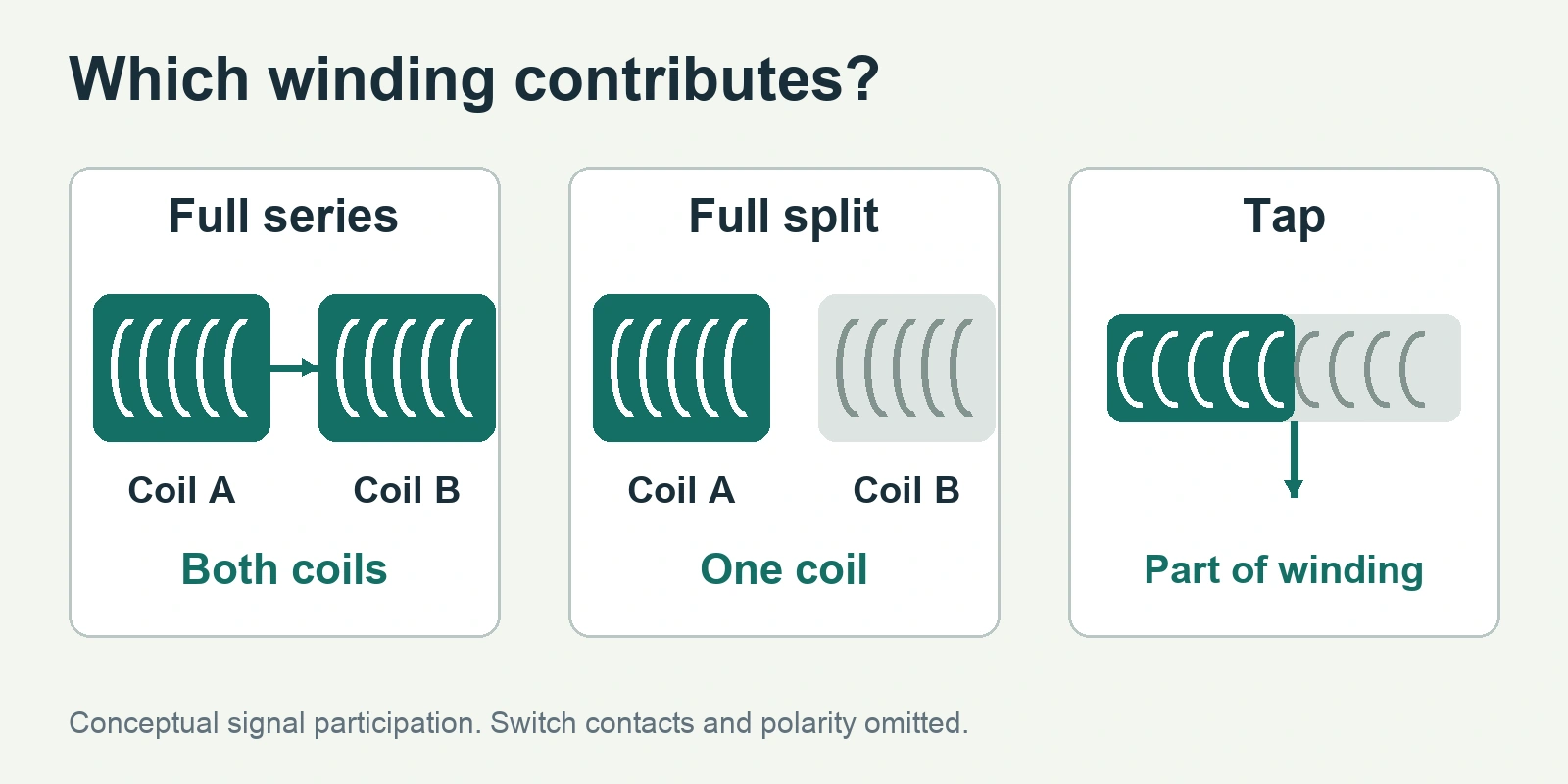
Compare the active winding paths
| Mode | Basic signal participation | What to verify |
|---|---|---|
| Full humbucker in series | Both coils, connected successively | The intended coil relationship and the actual wiring |
| Conventional full split used alone | One coil remains active | Which coil remains and the expected loss of paired hum rejection |
| Coil tap | A connection selects part of a winding | The pickup was built with the required tap connection |
| Humbucker in parallel | Both coils remain connected through parallel branches | Correct coil relationships and the mode’s actual response |
A tap needs a connection brought out from within the winding. Adding a switch alone cannot create that connection in a pickup that lacks it. Seymour Duncan discusses taps on single-coil pickups and also describes tapped humbuckers. Check how the named model implements the feature.
Parallel operation keeps both humbucker coils in use. A conventional full split used by itself usually loses that pickup’s paired hum rejection. A partial split or a split combined with another pickup needs separate documentation. Hiss and other interference also have causes beyond the pickup’s hum-cancelling arrangement.
For a closer comparison of the two-coil modes, read series versus parallel humbucker wiring.
Sources: Seymour Duncan on winding taps; Seymour Duncan on splitting, tapping and parallel operation
Listen for the change you want to use
Decide what you want the switch to do during a part. Perhaps a rhythm passage needs a different attack, or you want a lower level entering an overdriven amp. A tone that sounds good alone also has to work when you switch in the middle of the music.
Use the same guitar, pickup position, cable and amp settings for a first pass. Record a chord, a short line and a pause in each documented mode. Keep the amplifier input settings fixed so the recording captures the actual level and drive change. Note whether the transition helps the part.
For a second pass, compare playback at similar listening volume. That lets you consider tonal preference alongside the original switching behaviour. Changing guitar volume or amplifier input gain during the take changes the drive condition, so record it as a separate experiment.
Use descriptions you can repeat, such as clearer inner notes, a larger level drop or more audible hum during the pause. A split coil’s dimensions, magnets, position and loading still belong to its original pickup design. Confirm the result on the guitar rather than assuming it will duplicate a particular separate single-coil pickup.
Sources: Seymour Duncan on splitting, tapping and parallel operation
Check the requirements before a modification
Have the diagram for the exact pickup, switch and guitar controls checked before buying parts. For a conventional humbucker split, access to the coil junction is needed. Four-conductor versions commonly provide access to both coils. Wire colours and switch contact arrangements vary between makers.
For tapping, establish that the pickup has the required winding connection. For a push-pull replacement pot, also check electrical value, shaft fit, cavity depth and clearance. An attractive control label does not settle those installation questions.
If the existing full and switched sounds already serve the part, keep that finding with the record. A pickup-layout comparison can help when the wider guitar choice is still open.
Sources: Seymour Duncan on winding taps; Seymour Duncan on splitting, tapping and parallel operation
Keep a switching and listening record
| Record | Write down |
|---|---|
| Identity | Guitar version, pickup model, physical position and control |
| Function | Maker diagram and which coils or winding connection are active |
| Fixed-input pass | Switching level, amp response and playing passage |
| Similar-volume playback | Attack, note balance and preference |
| Uncertainty | Unconfirmed wiring, noise conditions or installation questions |
Download the blank pickup switching record (English CSV). These fields are proposed owner observations. Keep unknown wiring marked unknown until it is identified.
If the remaining question is the balance between neck and bridge positions, record their existing settings before using the pickup-height measurement guide.
How this guide was prepared
We checked Seymour Duncan’s explanations of winding taps, full splitting and parallel operation. We used those definitions to build a control-identification table and a proposed two-pass listening record. The conceptual diagram omits switching contacts, polarity and wire colours. It is for identifying modes, rather than carrying out a wiring modification.
Documentation checked .