The decision in brief
Jumbo frets generally suggest a larger crown than medium jumbo, but the names do not define one width and height across manufacturers. Compare the exact crown dimensions and the finished frets on the guitar. Height affects clearance above the fingerboard and how your touch feels; width and crown shape affect the surface your fingers cross. A comfortable choice also depends on strings, action, fret condition and your normal grip.
A guitar described as medium jumbo can feel quite different from another with the same label. Start with the maker and profile number, then check height and width separately.
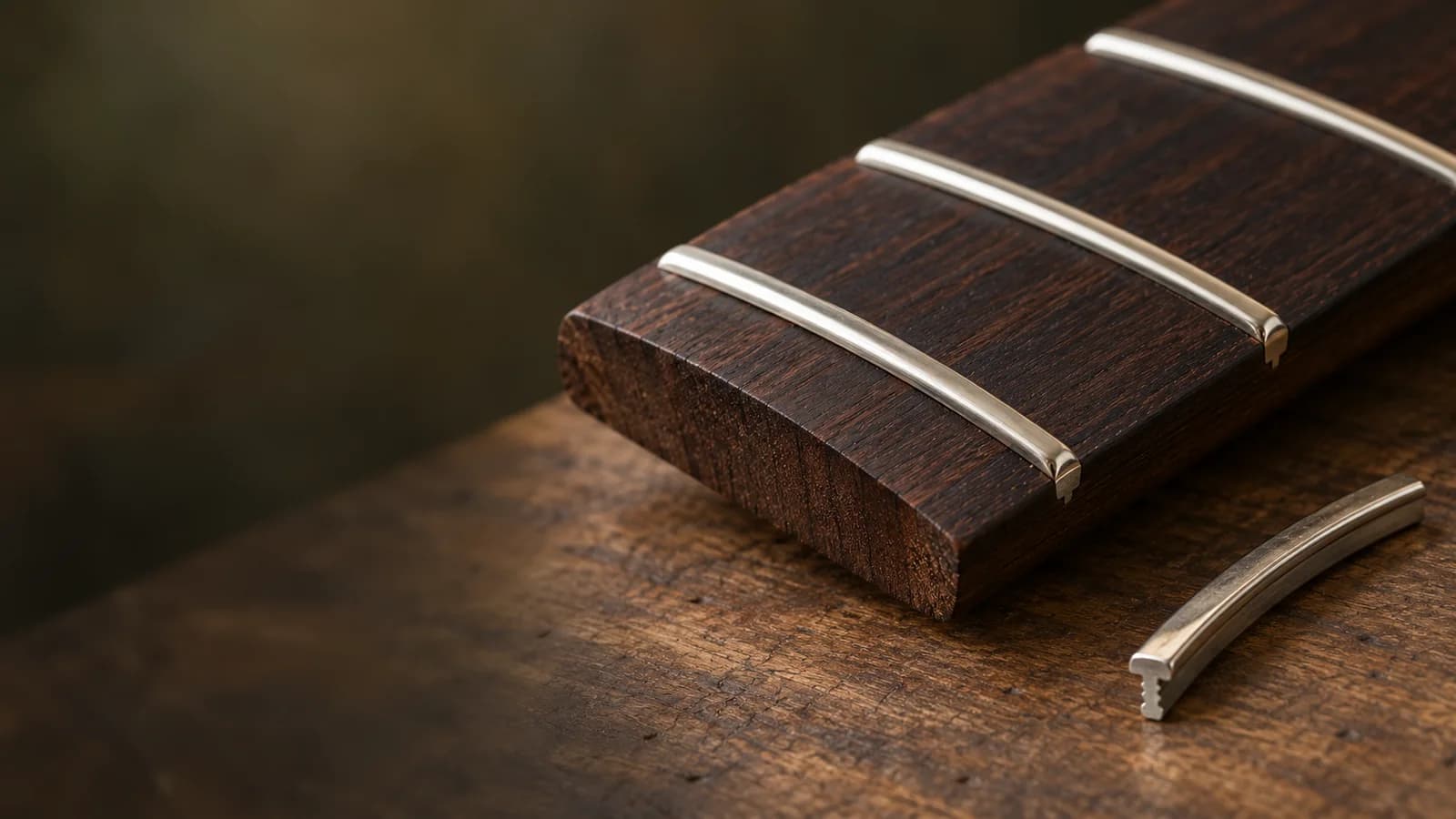
Hero is an AI-generated editorial illustration, not a measured fret-size reference.
Identify the two crown dimensions
The crown is the raised part of the fret that the string contacts. Crown width runs across that metal strip in a side-on section; crown height runs from its underside at the tang junction to the top. The tang is the narrower part seated in the fingerboard slot. Including the tang gives a different height.
Fret size also differs from the number of frets and their spacing. A guitar can have 22 or 24 frets with either large or small crowns. The 22-vs-24-fret comparison explains the separate question of playable range.
StewMac’s measurement guide defines the crown and tang reference points. A loose-wire specification describes that profile before installation and finishing.
Sources: StewMac: crown measurements, pressure, wear and fret shape
Compare named profiles instead of treating labels as standards
Fender’s support table calls its 6150 example medium jumbo and lists a 0.103-inch width and 0.046-inch height. Dunlop’s own 6150 product page uses the word Jumbo. Its linked chart lists different nominal figures for that number. Keep the manufacturer and document with a specification instead of transferring a size number between sources.
| Maker and profile | Crown width, inches | Crown height, inches |
|---|---|---|
| Dunlop 6150 | 0.100 | 0.044 |
| Dunlop 6100 | 0.110 | 0.055 |
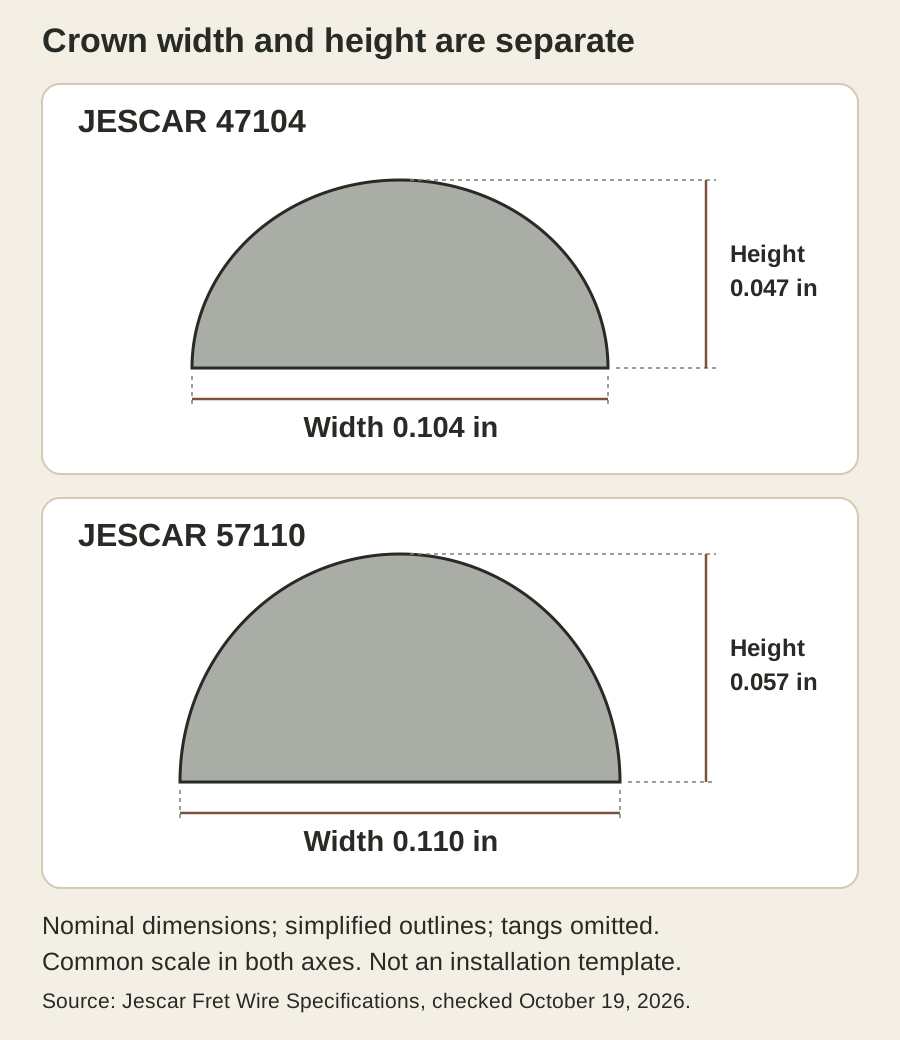
| Jescar 47104 | 0.104 | 0.047 |
| Jescar 57110 | 0.110 | 0.057 |
The Dunlop figures come from crown-width column B and crown-height column E in its wire chart, revised March 14, 2019. The Jescar figures come from the explicitly labelled crown width-and-height rows in its specification table. These are nominal loose-wire figures, not measurements of finished guitars.
Width and height can vary independently. Jescar 55090 is 0.090 inches wide and 0.055 inches high: narrower than 47104, yet taller. Treat that as a dimensional comparison, not a prediction that either one will feel better.
Sources: Fender Support: its medium-jumbo label and stated dimensions; Dunlop: official 6150 Jumbo product name and linked wire chart; Dunlop: Accu-Fret wire chart, revised March 14, 2019; Jescar: fret wire specifications, crown width and height
Use height to understand clearance and pressure
A taller crown raises the fretted string farther above the fingerboard. That can give a player more clearance from the board during bends and vibrato. A player who expects to feel the board under the fingertip may prefer a lower finished crown.
Extra pressure can also stretch a string behind the fret and raise its pitch. StewMac describes this pressure sensitivity with taller frets. The effect depends on the string, setup and touch; a jumbo label does not establish that a guitar will play sharp.
Fret height and action describe different distances. Action is the clearance from the fret top to the underside of the string at a specified position. A taller fret does not automatically mean higher measured action. Our action measurement guide explains those reference points.
Sources: StewMac: crown measurements, pressure, wear and fret shape
Assess width together with the finished crown shape
A broad piece of wire still needs a rounded crown. The full width of the metal is different from the narrow area supporting the string at the crown top. Wider wire alone does not establish inaccurate intonation.
When changing positions, notice the actual transitions across the frets. Rough surfaces, a poorly shaped crown or fret ends can distract from a size comparison. StewMac’s fretwork explanation distinguishes levelling the tops from crowning them back to a rounded shape. A smooth slide on one guitar is evidence about that complete instrument and its condition, not a test of width alone.
Sources: StewMac: levelling removes material and crowning restores the rounded tops
Check the installed condition, especially on a used guitar
Installation, levelling, crowning and later wear affect the frets you play. Levelling removes metal; wear can leave local grooves and flatten the contact surface. The original profile number cannot tell you the present height of every fret.
For a used guitar, ask where remaining fret height was checked and whether there are grooves, flat tops or previous levelling. Keep the position and condition with any measurement; the original wire specification cannot substitute for it. A technician can assess whether the frets can be serviced at the intended setup. A taller starting profile does not promise a fixed number of future levelling jobs; that depends on the wear, remaining material and neck condition.
If planning a refret, give the technician the exact guitar and your preferred finished feel. Crown dimensions are only part of the job. Tang and slot fit, seating and the required finished setup need an instrument-specific assessment.
Sources: StewMac: crown measurements, pressure, wear and fret shape; StewMac: levelling removes material and crowning restores the rounded tops
Try a repeatable comparison with your normal touch
The following is a suggested observation routine. It does not report a completed playing test or isolate fret size as the cause of a difference between two guitars.
- Tune the guitar and record the string set, fret condition and available setup information. Note differences in scale length, radius and neck shape between candidates.
- On the same string and fret, start with enough pressure for a clean note. Compare that with your normal grip using a tuner and steady picking, then release and repeat. Keep the starting tuning stable. A repeatable rise with extra pressure is an observation about your touch on that guitar; it does not identify fret size as the sole cause.
- Play familiar chord grips. Record whether the fretted notes remain consistent when you ease excess pressure.
- If bends and vibrato are part of your playing, repeat the same passage. Notice board contact, control and any choking note. Stop if the movement is uncomfortable.
- Slide through a familiar position change and check the transitions over the crowns. Keep roughness or a local fault separate from your preference for the overall fret size.
A choking bend also involves the fret-top geometry and clearance. The fingerboard-radius guide explains that separate variable. Changing guitars usually changes several variables at once, so keep your conclusion attached to the instruments you tried.
Choose the finished feel you can use
A player who likes clearance from the fingerboard may prefer a taller crown after trying it with a controlled touch. Someone who prefers closer board contact may choose a lower crown. A medium-jumbo guitar can suit demanding lead work, and a jumbo guitar can suit chord playing; the label does not assign a skill level or genre.
Record the exact maker/profile, width, height and present condition alongside the passage you played. Choose the guitar that lets you fret cleanly, control pitch and move comfortably at a suitable setup. If a problem remains repeatable, have the actual instrument assessed before treating a different fret size as the repair.
How this guide was prepared
We compared Dunlop’s official product naming and its linked 2019 wire chart, Jescar’s crown specifications, Fender’s own size labels and StewMac’s fret measurement and fretwork explanations on October 19, 2026. Numbers are manufacturer documentation, not measurements of finished guitars. The crown diagram is an original simplified drawing with both dimensions set from the cited Jescar inch values; it is not a manufacturing profile or installation template. The playing routine is proposed guidance, not a trial we conducted. We performed no fret measurement, playing test, refret or human expert review. AI assistance supported research comparison, drafting and diagram construction.
Documentation checked .
Sources and further reading
- Dunlop: Accu-Fret wire chart, revised March 14, 2019
- Dunlop: official 6150 Jumbo product name and linked wire chart
- Jescar: fret wire specifications, crown width and height
- Fender Support: its medium-jumbo label and stated dimensions
- StewMac: crown measurements, pressure, wear and fret shape
- StewMac: levelling removes material and crowning restores the rounded tops