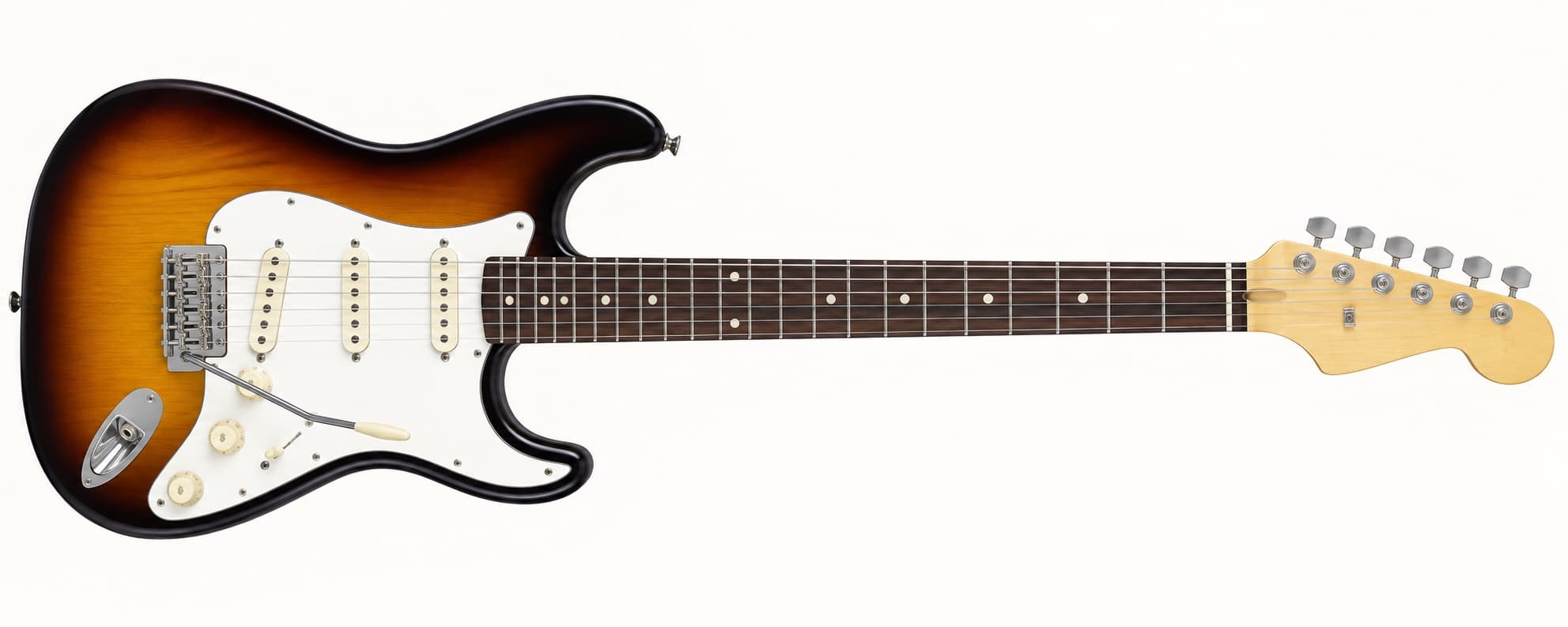
The decision in brief
A 24-fret guitar adds two semitones above a 22-fret instrument, reaching two octaves on each string from the open note. Choose 24 frets when that upper range and access are regularly used. Choose 22 when the familiar layout, neck-pickup location or available model fits better. Fret count does not determine scale length, fret size, neck profile or setup quality, so compare those separately.
What two additional frets actually add
Each fret raises a string by one semitone. Moving from 22 to 24 frets therefore adds two semitones at the top of each string. On the high E string in standard tuning, the 24th fret is E, two octaves above the open string; the 22nd fret is D. Players who compose or improvise around that top E may value direct access. Players whose parts stay below the 22nd fret gain no automatic advantage.
Fender's fret overview notes that guitars commonly fall between 19 and 24 frets, while model specifications show examples at 21, 22 and 24. The numbers describe range, not quality. Fret material, size, leveling and access can matter more to daily playability.
Check whether the highest frets are practically reachable. A specification can list 24 while a bulky heel or shallow cutaway makes the last positions awkward. Sit and stand with the instrument, because strap height and hand angle change the result.
For the high E string in standard tuning, the final notes are D at fret 22, D-sharp/E-flat at fret 23 and E at fret 24. The interval follows the one-semitone-per-fret convention. Alternate tuning changes the note names, while the two added semitone positions remain.
Sources: Fender: frets and semitone intervals
Separate fret count from scale length
Nominal scale length describes the intended vibrating string length and fixes the fret-spacing pattern. A compensated saddle can sit slightly beyond that nominal endpoint. Fret count is a separate specification: PRS’s product catalog lists the S2 Standard 22 Satin and S2 Standard 24 Satin with a 25-inch scale on page 13. These are documented specification examples; their neck profiles also differ, and this guide does not claim current availability or a matched tone test. Check the exact model and year when comparing guitars.
| Specification | What it describes | Do not confuse it with |
|---|---|---|
| Fret count | Number of playable fret positions | Scale length |
| Nominal scale length | The design length that sets fret spacing; compensated saddles may sit beyond the nominal endpoint | Total guitar length or each compensated string’s actual speaking length |
| Fret size | Fretwire width and height | Number of frets |
| Neck profile | Back contour and thickness | Fingerboard radius |
When two guitars feel different, record scale, strings, tuning, neck profile, radius, fret size, action and relief before blaming fret count. Those factors often explain the sensation more directly.
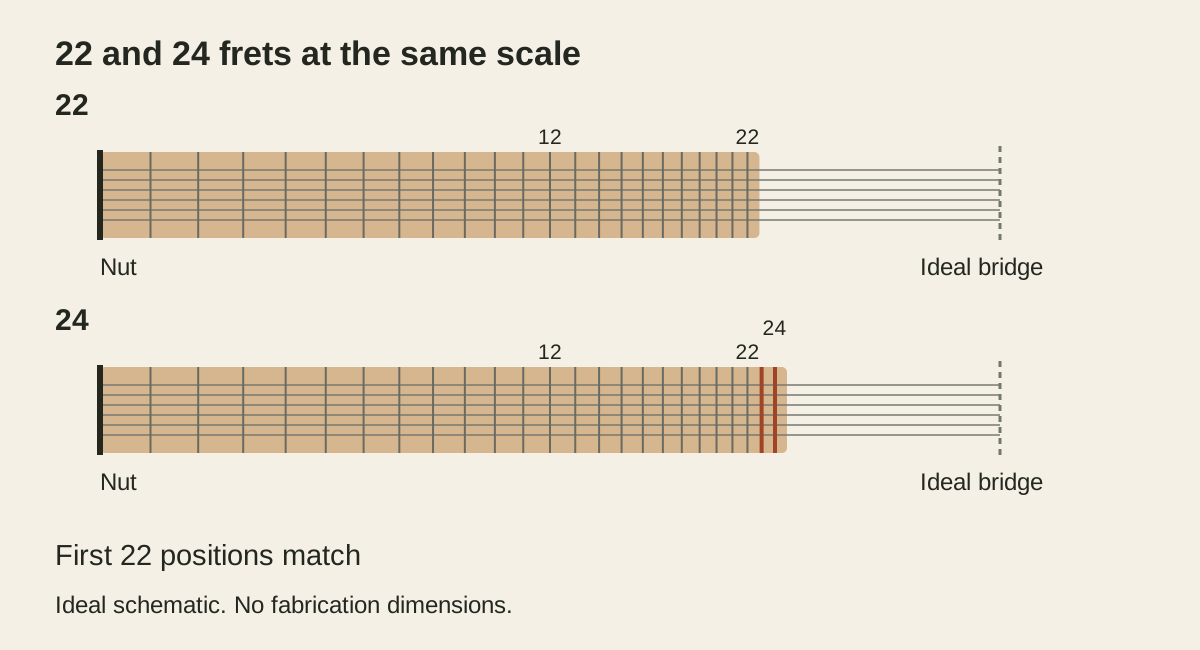
For an ideal twelve-tone equal-tempered layout, the distance from the nut to fret n is x = L × (1 − 2^(−n/12)). With a hypothetical nominal scale L = 635 mm (25 inches), fret 22 lies about 456.8 mm from the nut and fret 24 at 476.25 mm. The last two positions extend the fretted span by about 19.4 mm. This is arithmetic, not a measurement of a finished neck, a compensated saddle position or a cutting plan.
Sources: PRS: product catalog, S2 Standard 22/24 Satin, p. 13; PRS: scale length and fret placement; StewMac: fret-position calculation and measurement endpoints; Taylor Wood&Steel, Summer 2015, p. 13: scale length before compensation
Understand why fret count can change neck-pickup placement
At a fixed nominal scale, adding the last two fret positions occupies more space toward the bridge. A design can place its neck pickup closer to the bridge to accommodate that space, or change the body joint and other geometry. Inspect the actual pickup-to-bridge distance and model layout; fret count alone does not establish where a pickup sits.
This is not a universal rule for every body and scale. Builders can change body joint, pickup size and routing. Pickup winding, height and electronics may outweigh the position difference. Compare the actual layouts rather than claiming that every 22-fret neck pickup sounds warmer.
When comparing your own candidates, record the visible pickup layout first. A statement such as “this neck pickup is closer to the bridge” needs the actual instruments or reliable model drawings. A listening conclusion also needs the same passages, amplifier settings and conditions. No pickup-tone comparison was performed for this guide.
Evaluate upper-fret access as a complete geometry problem
Body cutaway depth, lower-horn shape, neck heel, joint location, neck angle and strap position all influence access. A carefully contoured 22-fret guitar may feel easier above the 17th fret than a poorly shaped 24-fret model. The player's thumb position and technique also matter.
Play a one-octave pattern that crosses the 17th through highest frets on every string. Check whether the wrist must bend sharply, whether the palm collides with the heel and whether bends can be controlled without the hand slipping off the body. Test both seated and standing.
Extra positions also reduce the visual distance between the final markers and body. Players moving from 22 to 24 should spend time recalibrating landmarks rather than assuming the neck is incorrectly proportioned.
Check setup and fretwork before choosing by number
The last frets expose leveling and action issues because the string clearance is small and the body joint can complicate neck behavior. Play every note with the same attack, then repeat bends at the highest positions. Note choking, dead spots, sharp fret ends and inconsistent sustain.
Relief, action, saddle radius and fret condition interact. Do not lower action simply to make a 24-fret guitar feel faster without checking the manufacturer's method and the player's attack. A qualified technician can separate adjustable setup from high-fret or neck-angle problems.
Fret count also affects service work only indirectly. More frets mean more surfaces to level and dress, but fret material, installation and access around the body joint determine the actual task.
Match fret count to repertoire and instrument role
Players using extended solos, tapping, modern lead arrangements or written parts that reach the top E may prefer 24 frets. A 22-fret model can suit players who rarely enter that register or who prioritize a particular neck-pickup placement, traditional design or model availability.
Do not choose 24 as a future-proof specification without testing comfort. Extra capability is useful only if the guitar's overall neck, bridge, pickups and balance fit the player. Likewise, a player should not reject 24 frets because a genre is considered traditional.
Choose a passage you already play, or one you intend to learn, that reaches the highest register. Try it on both candidates. If you can play the required notes comfortably on either guitar, let the overall neck fit, setup and sound guide the decision.
Use a repeatable in-store comparison
- Confirm tuning, string gauge and scale length.
- Record neck profile, radius, fret size and measured setup.
- Play identical chord and single-note passages below the 12th fret.
- Repeat a lead passage from the 15th fret to the highest available note.
- Test full-step bends at high positions and listen for choking.
- Compare neck-pickup sounds at matched amplifier level.
- Evaluate seated and standing access.
The lower-register pass prevents the extra frets from dominating the decision. The upper-register pass reveals whether the range is actually accessible. Record the complete-guitar result rather than presenting fret count as the only cause.
Avoid four common fret-count myths
“Twenty-four frets mean a longer scale.” The specifications are independent. “More frets are always better.” They add range, not automatic quality. “Twenty-two frets cannot play modern music.” Repertoire and arrangement decide the requirement. “Fret count alone changes tone.” Pickup position, neck construction, scale, strings and electronics all remain involved.
Use the number to ask better questions: Do I need the notes? Can I reach them? Does the pickup layout suit me? Is the setup consistent at the body joint? Those questions lead to a defensible choice.
Conclusion: choose usable range, not the larger number
Twenty-four frets provide two additional semitones and can change how the fingerboard and neck pickup fit the body. Twenty-two frets provide slightly less range and may preserve a familiar geometry. Neither specification defines quality or scale length.
Compare access, setup, pickup position and the player's real repertoire. If the last two frets are used and comfortable, 24 is practical. If they are irrelevant and another guitar fits better, 22 is the clearer choice.
Frequently asked questions
Do 24-fret guitars have a longer scale?
Not necessarily. Fret count and scale length are separate specifications, and 22- and 24-fret guitars can share the same scale.
What notes do the 23rd and 24th frets add?
They add two semitones above the 22nd fret on every string. On the high E string in standard tuning, the 24th fret is E.
Does a 24-fret guitar move the neck pickup?
It can, because the fingerboard occupies more space toward the bridge, but pickup placement depends on the complete design. Compare the actual layouts.
Are 24-fret guitars harder to play?
Not inherently. Scale length, neck shape, fret size, setup and body access usually matter more.
Should a beginner choose 22 or 24 frets?
Choose the guitar that is comfortable, well set up and suitable for the intended music. Either fret count can work for a beginner.
How this guide was prepared
Fender explains the semitone convention, while PRS supplies scale-length guidance and historical equal-scale 22/24-fret examples. The note sequence and fret-position calculation are editorial derivations for standard tuning and an ideal equal-tempered layout. The tryout steps are suggested methods; no matched-guitar playability or pickup-tone test was conducted. The diagram is a schematic, not a construction plan. The current table distinguishes nominal scale from compensated speaking length. AI-assisted source and language checks used the Fender note explanation, PRS scale guidance and 2025 catalog page 13, StewMac fret-calculator instructions, and Taylor’s Summer 2015 definition before compensation. These documentation checks do not constitute a hands-on or human expert review.
Documentation checked .
Clarifies nominal scale and saddle compensation in the comparison table and confines horizontal scrolling to that table; the existing note sequence, example, diagrams and playing conditions are retained.