The decision in brief
Fingerboard radius describes the curve across the playing surface: at the same width, a smaller radius is rounder and a larger radius is flatter. It is separate from neck-back profile and lengthwise relief. A flatter surface can help bending clearance at a suitable setup, but radius alone cannot predict comfort or cure a choking note. Compare the exact guitar, fret condition, strings, action and the chords or bends you actually use.
What a fingerboard-radius number actually measures
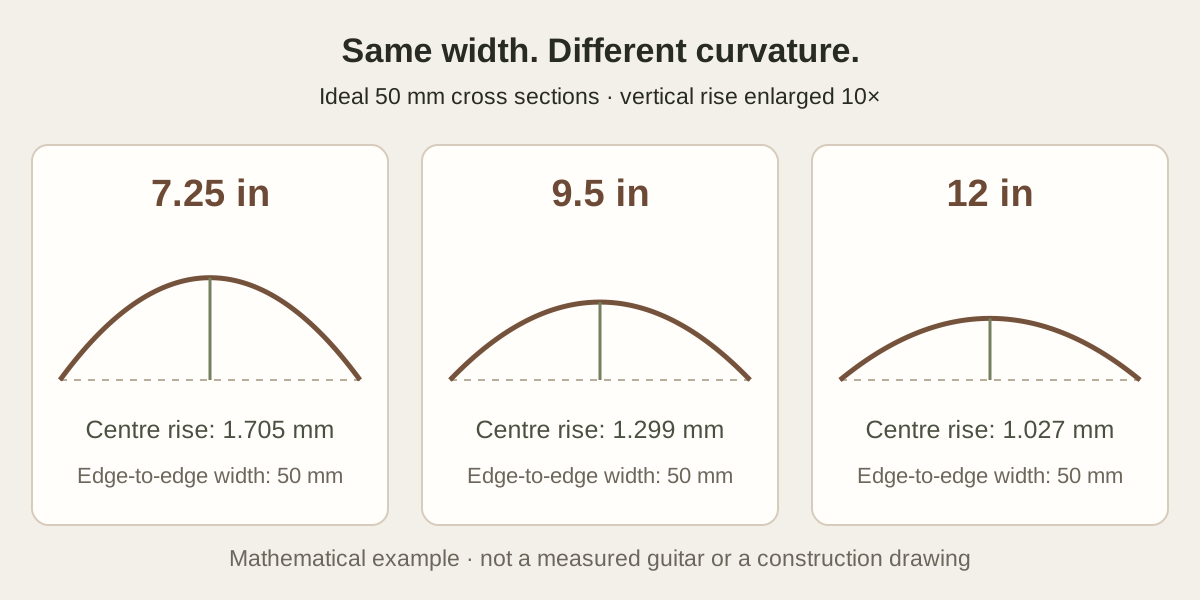
Imagine a circle and a short arc across the width of the fingerboard. Its radius is the distance from the circle centre to that arc. The number is a circle radius, not the board width, neck depth or the length of the guitar. At equal widths, a 7.25-inch radius curves more than a 9.5-inch or 12-inch radius.
Fender Support distinguishes this surface measurement from the back contour called neck profile. Relief is a separate, lengthwise curve. A guitar can therefore have a rounder fingerboard, a shallow neck back and a particular amount of relief at the same time. See the neck-profile guide for the hand-facing contour.
Sources: Fender Support: radius describes the fingerboard, profile describes the neck back
Read the specification and the measurement correctly
Keep the exact model, units and measurement location with the specification. A gauge against the board surface does not necessarily describe the present fret-top surface after wear or levelling. Identify what was checked, at which fret and with what tool; a product photograph cannot establish the value.
| Measurement | Reference to record | Separate question |
|---|---|---|
| Fingerboard radius | Crosswise surface and position along the neck | How curved is this surface? |
| Neck profile/depth | Back contour; depth at a named fret and stated front reference | What does the hand hold? |
| Nut width | Width at the nut | Measure the outer-string span separately |
| Relief | Lengthwise clearance under the maker’s method | How does the neck curve along its length? |
| Action | String-to-fret clearance at a stated fret | How high are the strings here? |
For a used instrument, ask about replacement necks, refrets and levelling. The original catalogue identifies a design; it does not certify the current fret condition.
Sources: Fender Support: radius describes the fingerboard, profile describes the neck back; Fender Support: factory-string assumptions and model-specific setup references
How radius can affect chords and bends
Fender and Warmoth describe rounder surfaces as a chording preference for some players and flatter ones as useful for bends. Treat that as a reason to try the task. It does not assign a radius to a hand size, genre or skill level.
During a bend, the string moves across the fret tops and needs clearance along its sounding length. A rounder surface can constrain that clearance at low action. A note that chokes still needs investigation of the particular string, bend, fret level, relief and saddle setting. Raising action may change the symptom without identifying the cause.
Try the chord grips and bends you need, using your normal touch. Record the result on that complete guitar. Changing radius alone does not establish what caused a difference when fret size, neck shape or setup also changed.
Sources: Fender: circle geometry and compound-radius examples; Warmoth: constant and compound fingerboard-radius definitions
Compare common examples without making a ranking
The examples 7.25, 9.5 and 12 inches describe increasing flatness at a fixed width. They are geometry examples, not a current inventory survey or a ranking of guitars. Fender’s radius article includes catalogue counts explicitly tied to summer 2014; those counts are not evidence of today’s range.
A hypothetical circular cross section makes the size of the curve more concrete. Take a straight edge-to-edge width w = 50 mm. Its centre rises above the edge-to-edge chord by h = R − √(R² − (w/2)²). Using the exact conversion 1 inch = 25.4 mm gives:
| Radius R | Calculated centre rise h for w = 50 mm |
|---|---|
| 7.25 in = 184.15 mm | 1.705 mm |
| 9.5 in = 241.30 mm | 1.299 mm |
| 12 in = 304.80 mm | 1.027 mm |
These are ideal calculations rounded to 0.001 mm, not measurements, manufacturing tolerances, string heights or comfort scores. The diagram enlarges the vertical direction so the difference is visible. A different width changes the rise even when the radius stays the same.
Sources: Fender: circle geometry and compound-radius examples; NIST: one inch is exactly 25.4 mm
What compound radius changes
A constant-radius board uses the same nominal crosswise radius along its length. A compound design changes radius along the neck, commonly from rounder near the nut to flatter toward the body. Read a range such as 9.5 to 14 inches with its maker’s stated endpoints. It is not a pair of widths or an abrupt step at one fret.
Warmoth documents this gradual transition in its own compound designs. Its claims about speed and comfort are maker descriptions, not results from a playing trial here. Do not infer the intermediate radius, fret-top geometry or a required bridge setting from the two endpoint numbers alone. Confirm the exact neck and bridge combination with the maker or technician.
Sources: Warmoth: constant and compound fingerboard-radius definitions
Keep radius separate from relief, frets and action
Record tuning, complete string set, fret condition, relief and action before assigning a difficult passage to radius. Use the same reference fret and string when comparing action. Fender’s setup page distinguishes an eighth-fret relief check from a seventeenth-fret electric string-height check and conditions its figures on factory strings and model. Those references are examples, not universal targets.
Individual saddle heights must suit the instrument and player. A radius gauge at the bridge is not a substitute for checking actual clearances and notes, particularly with a compound surface. Follow the exact model’s procedure; do not reshape frets or turn a truss rod to change the built-in crosswise curve.
Sources: Fender Support: factory-string assumptions and model-specific setup references
Use a repeatable in-store comparison
- Choose passages you actually use: a low-position grip, a position change and a suitable bend if bends are part of your playing.
- Tune each guitar and record strings, action, fret condition, profile, width and nominal radius. Note unmatched variables.
- Play in your usual posture and strap position. Stop if a passage is uncomfortable.
- Record which note, grip or movement differed. For a choking bend, record string, fret, target pitch and normal attack.
- Repeat after a pause or reverse the guitar order. Keep the preference attached to those instruments and conditions.
This is a proposed observation routine, not a trial we conducted or a validated comfort test. For example, a hypothetical player may prefer one guitar’s barre grip but find that its upper-register bend dies early. That is a reason to inspect the setup and fret clearance, not proof that its radius is wrong.
What to request when the guitar cannot be held
When buying remotely, request the exact model/version, constant or compound radius, endpoint locations, profile, nut width, actual string spacing, fret dimensions and known setup. Compare these with an instrument you already know. Check the actual return and setup arrangements rather than assuming a radius label predicts fit.
| Personal record | Write down |
|---|---|
| Instrument | Model/version; specification source and date |
| Geometry | Radius and locations; profile; width and string span |
| Condition | Strings, tuning, frets, relief and action if known |
| Playing task | Passage; posture; preference or repeatable symptom |
| Next question | Missing measurement, setup inspection or further trial |
Routine setup does not turn one built-in radius or back profile into another. If the instrument needs irreversible fret or neck work, obtain an instrument-specific assessment before purchasing it as a simple setup project.
Conclusion: treat radius as a useful dimension, not a verdict
Use radius to describe curvature and organise a comparison. Keep it separate from profile, width, relief and action. Prefer the guitar that supports your actual tasks under a suitable setup, with any remaining symptoms documented. Our scale-length guide explains the separate issues of fret spacing and reference string length.
Frequently asked questions
Is a 12-inch fingerboard radius better than 9.5 inches?
Twelve inches is flatter at the same width. Whether you prefer it depends on the complete neck, fretwork, setup and your playing tasks; the number alone does not rank guitars.
Does fingerboard radius describe the back of the neck?
No. Radius describes the crosswise playing surface. Profile describes the neck back, and relief describes lengthwise curvature.
Can a rounder fingerboard contribute to choking bends?
Yes, clearance during a bend can be more restricted at some low-action setups. Record the affected string, fret and bend, then inspect fret level, relief and saddle setting before assigning the cause to radius alone.
Can I confirm radius from a photo or bridge gauge?
A photo cannot reliably confirm it. A bridge gauge checks a different location from the board or fret tops; identify the surface and reference used, and use the maker’s method for the actual instrument.
How this guide was prepared
We read Fender’s radius definition, dated example discussion and factory-string setup qualifications, Warmoth’s constant/compound definitions and NIST’s exact inch conversion. Centre-rise values are our ideal circle calculation for a hypothetical 50 mm width, rounded to 0.001 mm; the new schematic enlarges vertical rise tenfold. The passage record is proposed guidance. We measured, played, levelled or adjusted no guitar and performed no human technical, ergonomic or medical review. AI assistance was used for source comparison, arithmetic and language review. Existing guitar illustrations do not document actual test instruments.
Documentation checked .
Separated radius, profile, width and relief; removed stale catalogue framing; added a reproducible circle calculation and player observation record; replaced arbitrary curves with an explicitly scaled schematic; qualified setup and image claims.
Sources and further reading
- Fender Support: radius describes the fingerboard, profile describes the neck back
- Fender: circle geometry and compound-radius examples
- Fender Support: factory-string assumptions and model-specific setup references
- Warmoth: constant and compound fingerboard-radius definitions
- NIST: one inch is exactly 25.4 mm