
The decision in brief
Stainless steel frets are an option when wear resistance is a priority, but compare the finished fretwork as carefully as the alloy. Nickel silver can remain a sensible choice on a guitar that plays well or for an appropriate repair. Match crown dimensions, surface finish, fret condition and setup before judging feel or tone. A material label alone cannot predict service life or whether your guitar needs a refret.
Treat hardness and wear statements as scoped evidence
Nickel silver is a copper-rich alloy containing nickel and zinc, with no silver in the alloy. The Canadian Conservation Institute uses this definition when distinguishing copper alloys. The name does not identify a pure nickel fret or the wrap material of a guitar string; check the fret-wire maker’s specific alloy description.
Jescar offers nickel silver and stainless steel fret wire and describes its stainless alloy as harder and more wear resistant. That is the manufacturer’s material claim. It does not establish how many years a particular player’s frets will last.
Warmoth gives a more specific documentation example: HV 170 for its nickel/silver wire and HV 300 ±20 for its stainless wire. HV identifies the Vickers hardness scale. These figures apply to the materials Warmoth describes; do not transfer them to every alloy or divide them to predict a wear-life multiplier.
Playing history, strings, contact conditions and installed fretwork remain relevant. There is no service-life number in this guide because we have no matched long-term wear test to support one. Choose a wear-resistance requirement without turning it into a guarantee.
Sources: Canadian Conservation Institute: nickel silver is a copper–nickel–zinc alloy without silver; Jescar: stated alloy properties and wear-resistance claims; Warmoth: its fret materials, hardness figures and finishing scope
Keep alloy separate from crown size
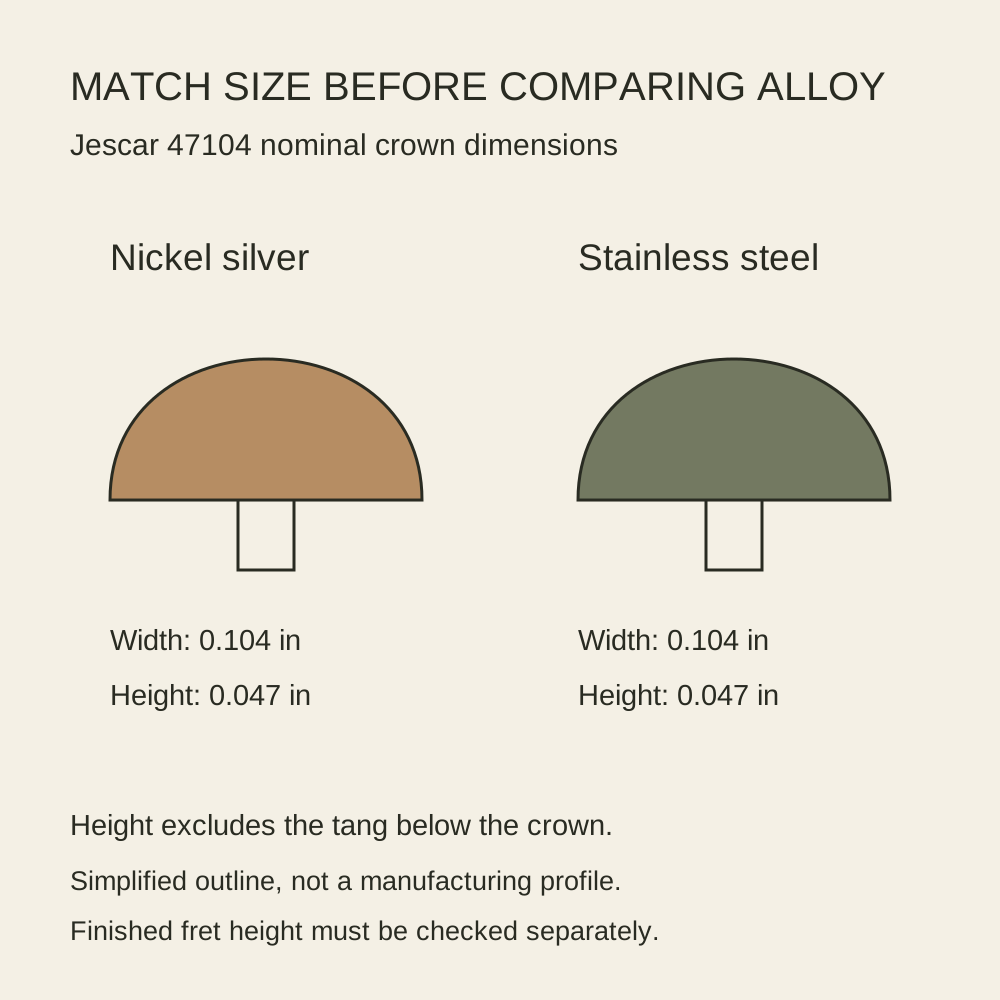
Jescar’s 47104 table lists the same nominal crown width and height for nickel silver and stainless steel: 0.104 × 0.047 inches. The alloy can change without selecting a larger fret. Conversely, a size change can affect the comparison even when both guitars use the same alloy.
| Jescar example | Crown width | Crown height |
|---|---|---|
| 47104, nickel silver | 0.104 in | 0.047 in |
| 47104, stainless steel | 0.104 in | 0.047 in |
Those figures describe loose wire. Installation, levelling, crowning and wear affect what remains above the fingerboard. Ask about the finished height and shape when comparing an existing guitar or planning a refret. The Jumbo and Medium Jumbo comparison explains crown dimensions without treating those names as universal standards.
Sources: Jescar: matched 47104 crown dimensions in two alloys
Judge the finished surface and the complete guitar
Try a familiar bend, vibrato movement and position shift on clean, competently finished examples. Record roughness, uneven transitions or a local choking note separately from your preference for the material. A polished nickel-silver fret and a worn or unfinished stainless fret would not isolate alloy as the cause of feel.
StewMac distinguishes levelling the fret tops from restoring rounded crowns. Warmoth also explains the limits of its replacement-neck finishing: its installed frets do not automatically include final levelling. Use the actual instrument’s condition, rather than assuming a material label means all fretwork is complete.
Keep strings, action, fret dimensions and neck geometry with the comparison. The action guide and radius guide cover separate measurements. Smooth movement is a useful observation; it does not demonstrate a universal alloy advantage.
Sources: StewMac: levelling, crowning and fretwork assessment; Warmoth: its fret materials, hardness figures and finishing scope
Do not infer a fixed tone or string life
Warmoth states that there is no discernible tonal difference between its two fret materials. Its page does not provide a controlled comparison method. Treat the statement as manufacturer guidance, with that evidence limit attached.
A refret may change crown height, contact shape, setup and string condition together. A before-and-after recording of that complete job cannot identify alloy alone as the cause of a sound change. If a tonal claim matters to your purchase, ask what was held constant and what evidence supports it.
The documents checked here also do not establish a universal comparative string-life result. Avoid promises that stainless frets always destroy strings or never affect their wear. Keep the fret alloy distinct from the wrap material discussed in our nickel and stainless string comparison. Those are two different component decisions.
Sources: Warmoth: its fret materials, hardness figures and finishing scope
Decide whether the existing frets need work
Record visible grooves, flattened crowns, rough spots and the exact positions where playing becomes difficult. Play with normal pressure and a stable tuning reference. A symptom by itself does not establish whether the answer is setup, local fretwork or replacement.
A technician can assess seating, remaining crown height, neck condition and the material that would have to be removed. Levelling and crowning are different operations; a refret is not automatically required merely because a newer guitar advertises stainless steel.
| Record | Question for the technician |
|---|---|
| Location of visible wear or playing symptom | Is it local, repeated or part of broader fretwork? |
| Current strings, tuning and setup | Which conditions need to be preserved? |
| Remaining crown and proposed finished size | Can the present frets be serviced appropriately? |
| Desired result | Is the goal repair, a size change, wear resistance or a combination? |
Use the fret-buzz guide to describe a symptom clearly. It does not turn that observation into a diagnosis.
Sources: StewMac: levelling, crowning and fretwork assessment
Choose the guitar or refret by the completed result
For a new guitar, judge clean notes, comfortable movement and the whole setup before choosing by alloy. Stainless steel may fit a wear-resistance priority; a well-finished nickel-silver instrument may already meet the playing requirement.
For a refret, ask for an instrument-specific assessment and an itemized proposal. State the desired finished crown dimensions and whether the job includes levelling, crowning, polishing and the final setup. Ask what nut, binding or finish work the particular instrument may need. Material price alone does not describe the completed job.
Keep the required repair separate from optional changes. If the existing guitar works and your only motivation is an unverified tone or lifespan promise, compare suitable instruments first. Use the setup guide to agree on the final string set, tuning and playing checks.
How this guide was prepared
We checked Jescar’s alloy description and 47104 product table, Warmoth’s fret-options page and StewMac’s fretwork explanation on October 26, 2026. Hardness numbers and wear statements are identified as manufacturer documentation, not our wear measurements. The matched-profile diagram uses Jescar’s nominal crown dimensions without claiming to reproduce a production profile. The comparison and technician record are proposed editorial methods. No guitars were refretted, played, measured or tested for wear, string life or tone, and no human specialist review is claimed. On November 1, 2026, we checked the Canadian Conservation Institute’s definition of nickel silver for the added alloy explanation. This source identifies the alloy family; it does not establish a composition percentage for every fret wire or a wear result. Earlier Jescar, Warmoth and StewMac checks retain their October 26 scope. No material analysis or wear test was performed for this addition.
Documentation checked .
Defined nickel silver using a conservation-science source while preserving the separate decisions about fret alloy, crown size and strings.
Sources and further reading
- Jescar: stated alloy properties and wear-resistance claims
- Jescar: matched 47104 crown dimensions in two alloys
- Warmoth: its fret materials, hardness figures and finishing scope
- StewMac: levelling, crowning and fretwork assessment
- Canadian Conservation Institute: nickel silver is a copper–nickel–zinc alloy without silver