
The decision in brief
A mini humbucker uses a smaller housing than a conventional full-size humbucker, but size alone cannot establish its output, brightness or fit. Compare the exact pickup designs and wiring, then the guitar and rig where you will use them. For a replacement, confirm the cavity, mounting, depth and connections before judging sound. A mini humbucker is still a humbucker; “mini” does not mean one coil.
What matters most
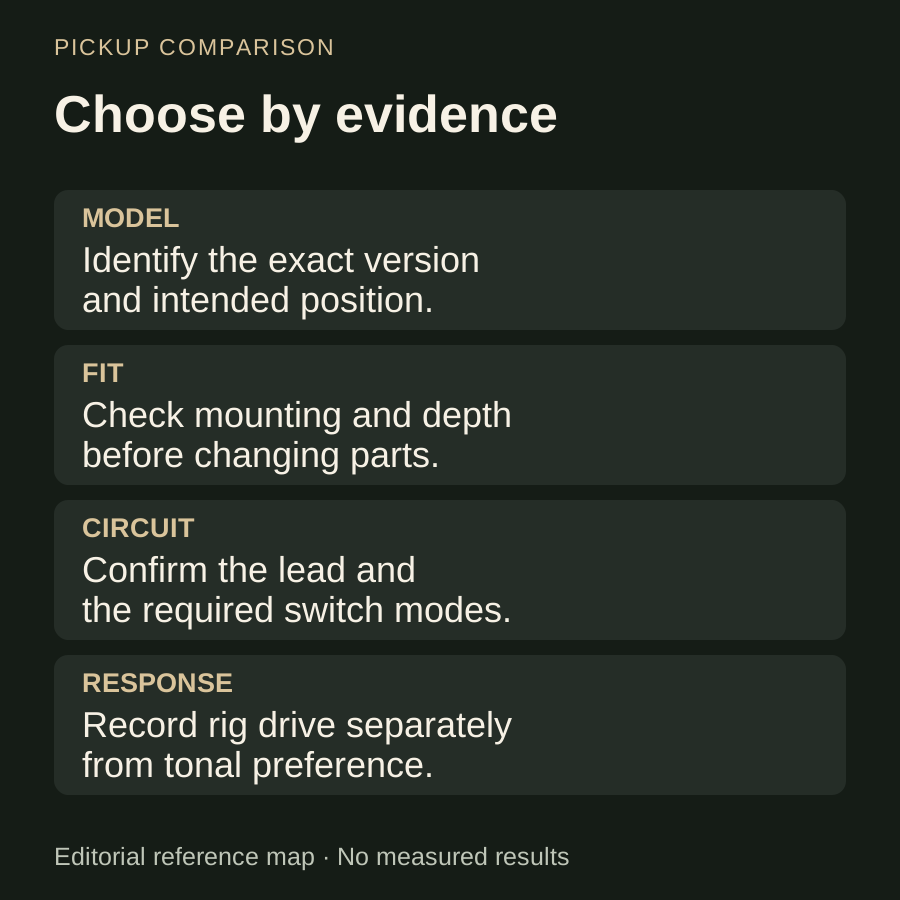
- Identify the exact model and version before comparing labels.
- Confirm the complete mechanical and electrical fit.
- Record rig drive separately from listening preference.
Start with the exact pickup models
“Mini” describes a compact humbucker format. It does not describe one universal internal design. Seymour Duncan’s overview discusses several mini-humbucker variations, including Firebird-style examples and hotter versions. A small metal cover is therefore an incomplete specification.
| Question | Mini format | Full-size format |
|---|---|---|
| Housing | Compact format; read the exact drawing | Larger conventional format; covered and uncovered versions exist |
| Construction | Confirm the named design and active coil mode | Confirm the named design and active coil mode |
| Sound | Judge the complete model and circuit | Judge the complete model and circuit |
| Replacement | Requires its own mounting and clearance check | Requires its own mounting and clearance check |
Start a shortlist with the manufacturer, model, intended position and version. A familiar name may cover different leads, spacing or mounting. Our humbucker guide explains the separate questions of series, parallel and split operation.
Sources: Seymour Duncan: mini-humbucker variations (updated October 2022); Seymour Duncan: ’59 model, versions and wiring options; Yamaha: conventional two-coil humbucker construction
Use sound descriptions as a starting hypothesis
Mini humbuckers are often described as bright or focused, while full-size designs are often associated with a fuller sound. Treat those descriptions as prompts for listening. They do not establish how two particular pickups will compare. Seymour Duncan’s own mini range includes different designs and outputs.
Pick two musical tasks: perhaps a clean chord where you need clear note separation and a driven single-note phrase. Write down which response you want to change. “More clear during this chord” is more useful than expecting a smaller housing to improve every sound.
Keep DC resistance out of a loudness ranking. DiMarzio explains that it is not a direct indicator of tone or output. Different wire and winding designs make a simple kΩ comparison unreliable. A larger number is not evidence that one format is better.
Sources: Seymour Duncan: mini-humbucker variations (updated October 2022); DiMarzio: why DC resistance is not a tone or output rating
Resolve the physical fit before buying parts
Compare the guitar’s actual cavity and mounting arrangement with the candidate pickup’s current dimensional drawing. Check the pickup body, mounting tabs, screw locations, ring or pickguard, available depth and the range of height adjustment. Confirm string alignment across the sensing area as well.
Seymour Duncan specifies a Firebird-style mounting ring and 3-48 mounting screw for its Vintage Mini Humbucker. That is a requirement for this named product, not a promise that every mini fits every P-90 opening or that every full-size cavity accepts the same adapter.
An adapter ring may solve the visible opening while leaving depth, screw anchoring or adjustment unresolved. Obtain a written fit assessment before routing or drilling. If preserving the instrument matters, ask what can be reversed and keep the original parts.
Sources: Seymour Duncan: Vintage Mini Humbucker construction, mounting and lead
Check the lead and the sounds the switch must provide
Physical fit does not settle electrical compatibility. The Vintage Mini Humbucker page specifies a braided single-conductor lead. The ’59 page describes single-conductor and four-conductor options. Order the actual version required by the intended circuit.
A normal full coil split needs access to the appropriate coil connections. Do not assume a braided single-conductor version provides that access. Wire colours and connector pinouts also need the exact manufacturer diagram. Have a technician assess an unfamiliar circuit instead of opening the pickup to look for extra wires.
Write the desired switch modes beside the proposed pickup version: ordinary paired-coil operation, series/parallel, split or a combination with another pickup. Confirm that the complete circuit can supply them. The pickup-description guide helps separate sensing, coils, power and switching.
Sources: Seymour Duncan: Vintage Mini Humbucker construction, mounting and lead; Seymour Duncan: ’59 model, versions and wiring options
Separate rig drive from tonal preference
This is a proposed comparison, not a listening test performed for this article.
- Record each guitar, exact pickup and position, active mode, strings, controls and setup. Note differences you cannot match.
- Use the same cable, amp channel, input settings and listening output. Play the same clean phrase, then a driven phrase as a separate condition.
- With the input settings fixed, note selector balance and how hard the pickup drives the rig. Keep recording levels below clipping.
- For a preference comparison, adjust recorded playback volume to a similar listening level. Record the adjustment; changing amp input gain would change the drive condition.
- Listen to the attack, chord separation, sustained notes and pauses. State which passage improved and which trade-off remained.
Different guitars, positions or circuits make this a comparison of complete instruments. It cannot isolate pickup size. A shop demonstration can still answer whether the sound is useful to you.
Keep a replacement decision record
| Record | What to resolve |
|---|---|
| Musical need | The missing sound, passage and required switch mode |
| Physical fit | Drawing, cavity, ring, mounting, depth and height travel |
| Circuit | Exact lead/version, controls and approved wiring diagram |
| Listening | Fixed-input response, similar-volume preference and unmatched variables |
If the current pickup works but a particular sound is missing, choose a candidate with a documented route to that sound and verified fit. If the symptom is intermittent output or a faulty selector, diagnose it before replacing a working pickup. A change of housing size cannot establish the cause of an electrical fault.
For a different question—single-coil character versus paired-coil hum rejection—continue to the single-coil and humbucker comparison.
Frequently asked questions
Can a mini humbucker replace a full-size humbucker without modification?
Sometimes an appropriate mounting arrangement is available, but verify the cavity, ring or pickguard, screw anchoring, depth, adjustment and circuit. An adapter does not establish the complete fit.
Is a Firebird pickup the same as every mini humbucker?
No. Mini-humbucker terminology includes different designs, and makers may use the names differently. Read the exact model’s construction, mounting and wiring rather than identifying it from its cover.
How this guide was prepared
We compared Seymour Duncan’s Vintage Mini Humbucker and ’59 documentation, its older mini-humbucker overview, and DiMarzio’s DC-resistance explanation. Named models illustrate mounting and wiring differences, not all products in either size. The fit checklist and listening sequence are proposed editorial tools. We installed, measured or auditioned no pickups; the diagrams are conceptual and no human expert review is claimed.
Documentation checked .