Start here
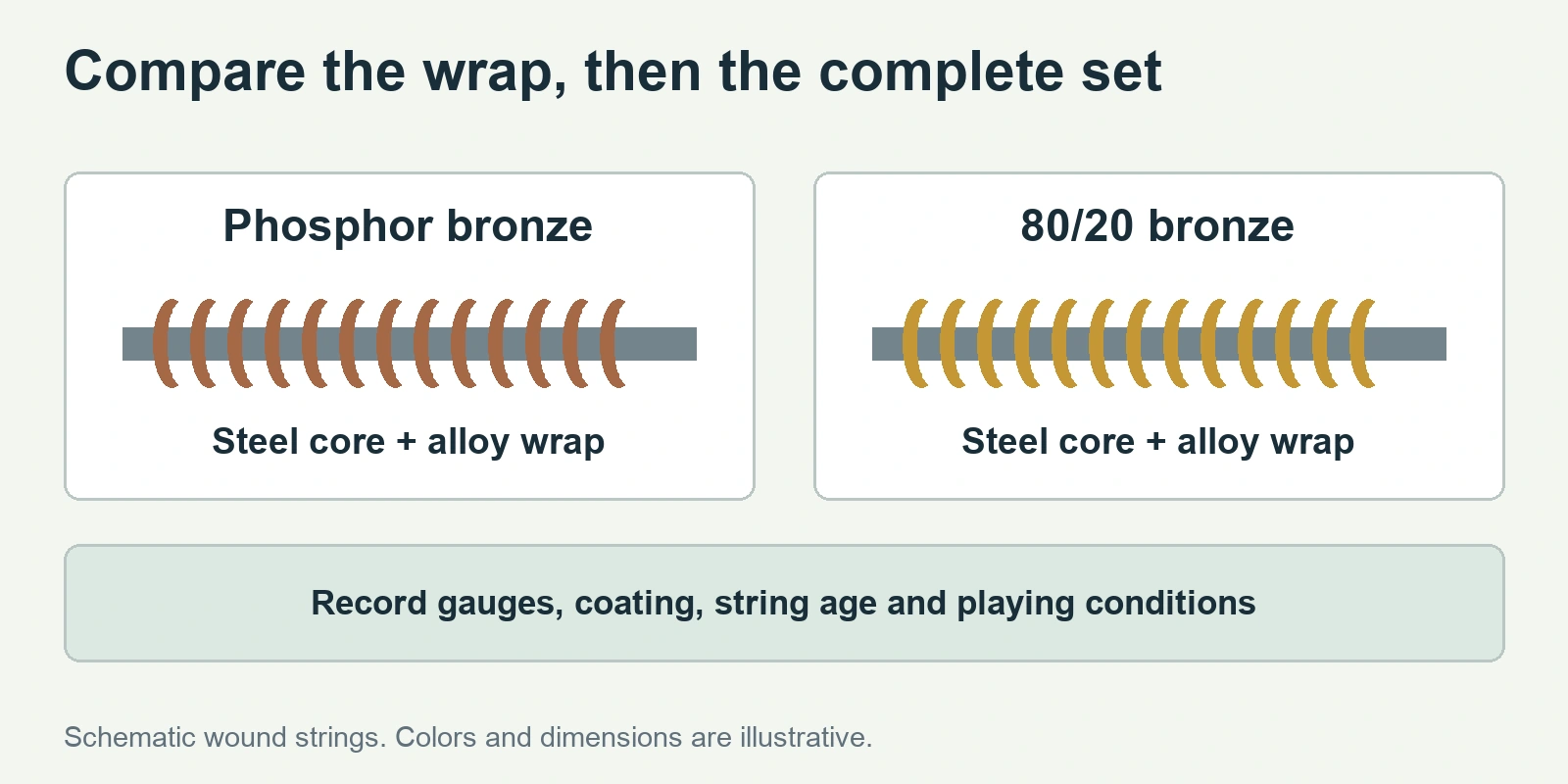
Phosphor bronze and 80/20 bronze name the wrap alloy on wound steel-string acoustic strings. Choose between exact sets after checking the complete gauges, coating and construction. D’Addario describes its 80/20 range as bright and its phosphor-bronze range as warm and balanced. Those manufacturer descriptions are a starting point; your guitar, playing part and string age determine which result you prefer.
Read the wrap label on a steel-string set
First confirm that the guitar is designed for the proposed steel-string acoustic set. This comparison concerns conventional phosphor-bronze and 80/20-bronze sets for that system. A classical guitar specified for nylon strings needs its appropriate string family.
D’Addario describes its wound acoustic strings in terms of a steel core and an alloy wrap wire. The alloy labels identify that wrap. The plain upper strings need their own specification; the alloy name on the packet does not mean every string is a solid piece of that material.
Check the exact product family as well as the alloy. A coated set, an alternative core design or a different winding treatment adds another construction change. For the wider selection process, read the acoustic-string guide.
Sources: D’Addario Acoustic Alloys: manufacturer descriptions of wrap materials; D’Addario EJ16: wrap, coating, construction and individual string chart; D’Addario EJ11 family: wrap, coating, construction and individual string chart
Use tone descriptions to choose a first trial
D’Addario presents its 80/20 strings as bright and its phosphor-bronze strings as warm and balanced. These are the maker’s descriptions of its ranges. They can help you decide which pack to try first, but they are not a measurement of the result on your instrument.
Name the change you want in a musical passage. Perhaps the wound-string attack needs more definition in strummed chords, or a picked accompaniment should sit more comfortably under a voice. Record that task before choosing a label.
A preference in one recording is also tied to the pick, attack, microphone and listening level. If a new set is compared with a heavily used set of the other alloy, the difference includes string condition. Keep that limitation attached to the conclusion.
Sources: D’Addario Acoustic Alloys: manufacturer descriptions of wrap materials
Compare the complete packages
| Listed feature | EJ16 family | EJ11 family |
|---|---|---|
| Wound-string wrap | Phosphor bronze | 80/20 bronze |
| Nominal gauges, strings 1–6, inches | .012 / .016 / .024 / .032 / .042 / .053 | .012 / .016 / .024 / .032 / .042 / .053 |
| Listed coating | Uncoated | Uncoated |
| Listed winding | Round wound | Round wound |
| Listed core for wound strings | Hexagonal high-carbon steel | Hexagonal high-carbon steel |
This example aligns the nominal gauges, coating category and broad construction description. The official EJ11 page currently displays an EJ11-3D multipack; its string chart identifies the constituent 12–53 set. Pack quantity is separate from string specification.
Matching diameter labels still does not establish identical internal dimensions, tension or feel. The two official charts list different tensions for their wound strings; those chart values do not establish the tension on your guitar. Keep their charts with the exact set, and avoid interpreting “light” as a complete specification. The string-gauge guide explains why the individual sizes matter.
If one candidate has a coating and the other does not, identify the question as a comparison of those complete products. Use the coating comparison when that is the change you need to understand.
Sources: D’Addario EJ16: wrap, coating, construction and individual string chart; D’Addario EJ11 family: wrap, coating, construction and individual string chart
Make a listening record with fewer changing variables
Use the same guitar, tuning, pick and short passage for each set. Keep the recording position, input gain and processing fixed. Record the full model and all six gauges before installation, then retune as the strings settle. Before recording, check tuning stability, unwanted buzz and feel under your usual attack.
Capture both a strummed passage and a picked passage that matter to your playing. Note the time since fitting and the approximate playing hours. Compare recordings at similar playback loudness, and write specific observations such as the wound-string attack or balance between the bass and melody.
With one guitar, the two sets are compared sequentially. Your playing and room conditions may vary between sessions. Record those differences. A second guitar introduces its own differences, so swapping to a different instrument does not create a controlled alloy comparison.
If a change produces unexpected buzzing or uncomfortable feel, record that separately from the tonal preference. Recheck the string specification and installation before assuming the alloy caused it. The restringing guide covers the installation record.
Track string age before deciding what to buy again
| Record | What it helps distinguish |
|---|---|
| Exact pack and gauges | Alloy label from the complete product |
| Coating and construction | Additional design changes |
| Fit date and playing hours | A fresh-set impression from later use |
| Fixed passage and recording setup | String preference from recording variation |
| Reason for replacement | Tone preference, corrosion, feel or damage |
| Choice for the next set | A repeatable preference and remaining uncertainty |
Download the blank acoustic-alloy comparison record (English CSV). Revisit the same passage later in the set’s life and record when you would actually replace it.
Different players have different replacement points. Keep your own reason and playing hours instead of assigning either alloy a fixed lifespan. If the first trial gives the attack, feel and useful service period you want, that is a practical reason to buy that exact set again. If the result is unclear, repeat the comparison with the conditions better matched.
How this guide was prepared
We checked D’Addario’s acoustic-alloy explanation and the EJ16 and EJ11 product specifications and individual string charts. We used those two uncoated 12–53 families as a documented comparison example, then designed a sequential listening and ageing record. Matching nominal gauges does not prove identical construction, tension or response.
Documentation checked .