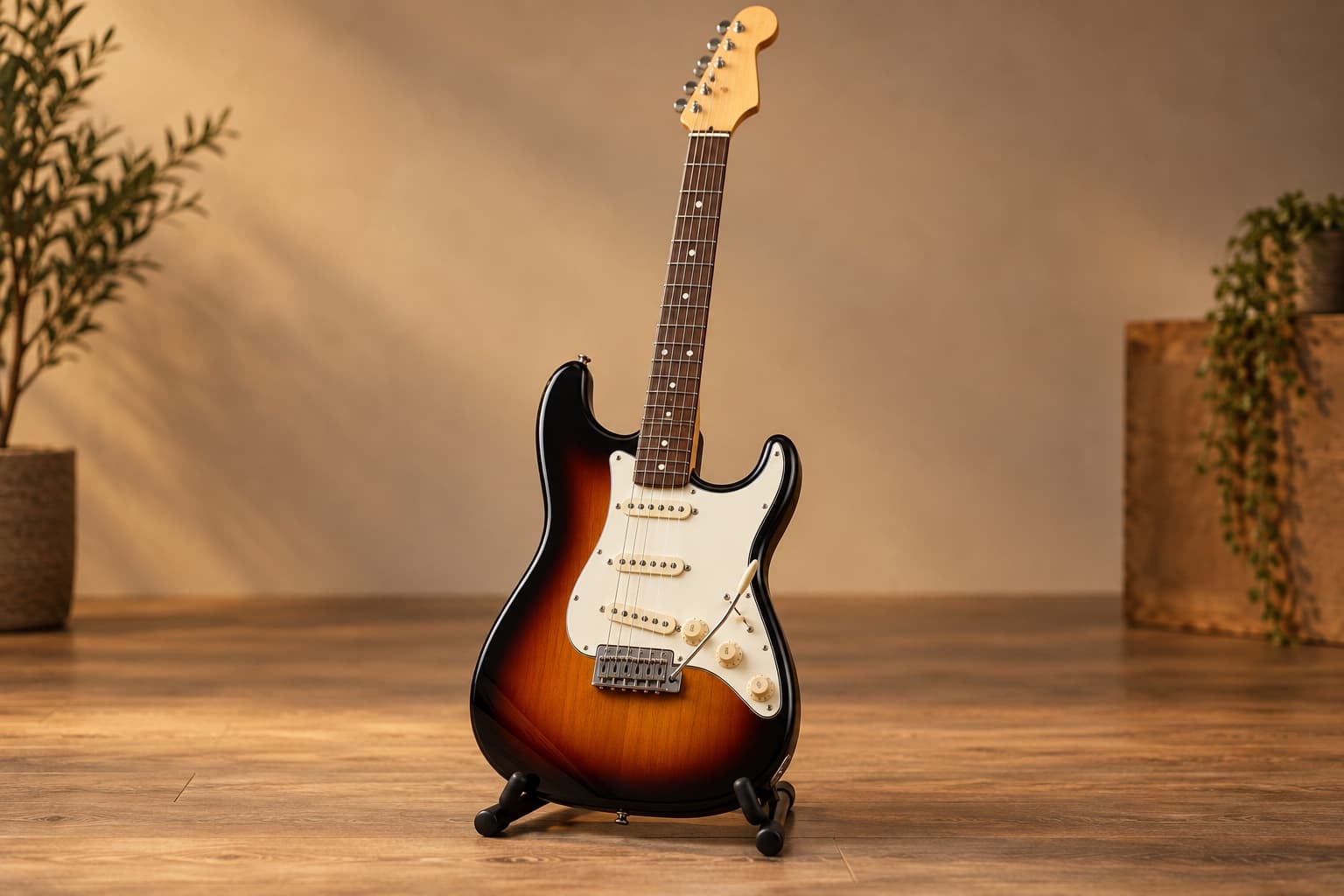
The decision in brief
Choose a guitar for smaller hands by trying the music and positions you need on the actual instrument. Compare scale, string spacing, neck depth/profile, body fit, strings and setup together. A shorter scale changes fret spacing and ideal string tension under stated conditions; it does not guarantee comfort. Keep a record of what helps, what differs between candidates and what still needs checking. Hand size or age alone does not select a model.
Define your music and fitting task
Choose the instrument family around the music, sound and learning requirements: electric, steel-string acoustic, nylon-string or bass. Then identify the actual task, such as first-position chords, bends or an arpeggio. Ask a teacher about curriculum-specific size, strings and technique where relevant.
An age or fraction-size label does not specify every dimension. Compare the actual player and instrument rather than assigning one size to every child or adult. This is a proposed personal comparison, not a ranking based on measured hands.
Separate scale geometry from a comfort claim
For a conventional equal-tempered guitar with an uncompensated nut, nominal scale is twice the nut contact edge to the 12th-fret crown along a string path. StewMac’s example separates this reference from saddle compensation. Use model instructions for special nuts, zero frets and multiscale layouts. See the scale guide.
UNSW’s ideal flexible-string relation gives tension proportional to the square of vibrating length when frequency and mass per unit length are held constant. In a hypothetical comparison, 24/25.5 = 0.941: the reference length is about 5.9% shorter. Its ideal tension ratio is (24/25.5)² = 0.886, about 11.4% lower. Both lengths are in inches. For this ideal calculation only, assume vibrating length equals the stated reference and ignore compensation. These rounded calculations are not measured guitars, recommended sizes or a prediction of fretting effort.
Conventional fret intervals scale with their nominal reference length, but actual reach also depends on neck position, body and posture. Matching gauge labels does not necessarily match string construction or linear density. Try the same comfortable passage; do not infer fit from the calculation.
Sources: StewMac, 2013: nominal scale and separate saddle compensation; UNSW Music Acoustics: ideal-string length, frequency and linear density
Compare the complete neck
Nut width is not outer-string spacing. Compare both, plus depth at named positions, shoulders, profile and taper. A narrower neck can reduce transverse span while leaving less room between strings; this trade-off needs a real playing task.
Try the same easy chord and position change without forced stretching. Note contact with adjacent strings and where the thumb can move. Thin or C/V/U labels do not guarantee a result. Use the nut-width and neck-profile guides for separate measurements.
Check body position as well as the fretting hand
Taylor’s comfort discussion distinguishes holding the body from neck playability. Treat it as maker guidance, not proof that one brand or body fits everybody. Observe lower-bout width, depth, waist, contours, balance and the position of the neck in your usual sitting or standing use.
Use a suitable chair, permitted support or strap and compare the same task. Record what changes when the instrument’s position changes. A compact body does not establish a short scale, and a short scale does not establish an easy picking-arm position.
Sources: Taylor, 2017: body comfort and factors affecting playability
Record setup before judging the dimensions
Ask for the actual strings and intended tuning. Action changes the distance to fret a note; Fender describes the clearance trade-off. Persistent buzz or unusually difficult first-position notes needs assessment, not an assumption that the neck is unsuitable or that a cheap adjustment will fix it.
Check only with permission. Let a suitable technician assess nut, frets, relief, bridge and available adjustment when needed. A change in strings or tuning changes the comparison. Confirm model-approved string family and set; do not experiment by substituting steel and nylon systems. The action guide explains the recording method.
Use a repeatable personal trial
Agree the demo and a suitable listening path. Try only comfortable movements; stop if the trial causes discomfort and seek appropriate individual guidance. Do not force a stretch to demonstrate fit or assume practice will remove a current problem.
- Identify the unit, strings, tuning and any setup just performed.
- Use the same chair/support or strap position and short musical task.
- Compare first-position reach, neck grip and picking-arm position.
- Try another candidate and write down all significant differences.
- Record the preferred compromise, unfinished checks and next action.
There is no fixed duration that proves fit. Changing one feature where possible makes a comparison easier to interpret; candidates with several differences cannot establish a single cause.
Use the record to make or defer the purchase
Compare current model dimensions with an instrument you have actually tried. Ask for the measurement method, exact version, strings, condition and available service. Photos do not prove comfort or complete setup condition. Check the actual seller’s delivery and return/exchange terms; this guide verifies no current price or universal return right.
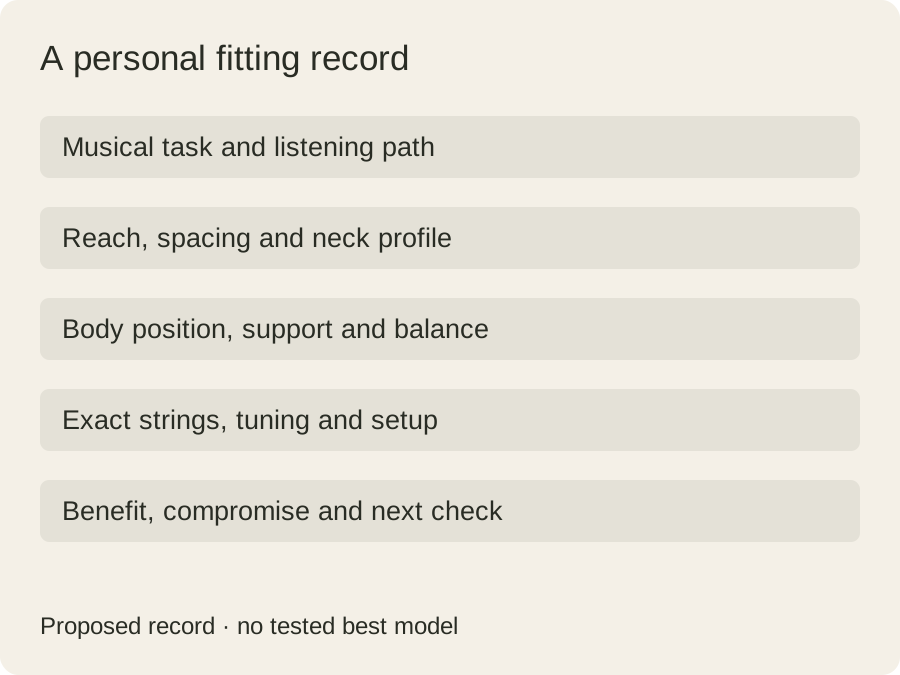
Use the record below. If the required task remains uncomfortable or important details are missing, try another instrument or request suitable assistance before deciding. Keep musical suitability and acceptable condition as requirements, not scores that can be cancelled by a low price.
| Record | What to compare | What remains uncertain |
|---|---|---|
| Musical task | Family, technique and listening path | Untested tasks |
| Reach and grip | Scale, spacing, neck depth/profile and position | Several dimensions may differ |
| Body and support | Width/depth, waist, balance and normal posture | A size label is incomplete |
| Strings and setup | Exact set, tuning, action and service needed | A symptom is not a diagnosis |
| Decision | Observed benefit, compromise and written terms | Unresolved fit or condition |
Frequently asked questions
Is there one best scale for small hands?
No. Shorter reference scales change fret spacing; ideal tension depends on actual string length, pitch and linear density. Compare your task on the complete guitar.
Is the narrowest neck always easiest?
No. Width, actual string spacing, depth, shoulders and setup affect different parts of the task. Record the particular benefit and compromise.
Can a setup change a guitar’s size?
It may change playing conditions on a suitable instrument, but it does not change nominal scale or body dimensions. Assessment is needed before assuming a symptom is adjustable.
How this guide was prepared
We checked StewMac’s 2013 scale/compensation example, UNSW’s ideal-string relation, Taylor’s 2017 comfort discussion and Fender’s action explanation. The 24/25.5 ratios are hypothetical calculations rounded to three decimals and one decimal percent; no guitar or hand was measured. The fitting record is proposed. We tested no player, posture, model, setup or clinical outcome, and verified no current price or seller terms.
Documentation checked .
Added scale and tension conditions with a hypothetical calculation, removed universal fit rankings and fixed trial duration, and added a personal comparison record with accurate image descriptions.