Start with the question
A sus2 chord contains root, second and fifth; a sus4 contains root, fourth and fifth. In these basic forms the third is absent, so neither states a major or minor third by itself. On guitar, verify the sounding notes rather than naming a chord from a similar-looking grip. Compare D, Dsus2 and Dsus4 on strings 4 through 1 to hear the one changed chord tone.
What matters most
- Sus2 uses 1–2–5; sus4 uses 1–4–5.
- Check intended strings and notes in the stated tuning.
- The surrounding parts can change the combined harmony.
Compare the tones before choosing the grip
Fender’s chord explanation replaces the third with the second for sus2 and with the fourth for sus4. In root-relative shorthand, the basic note sets are 1–2–5 and 1–4–5. The numbers refer to scale degrees above the root, not fret numbers, finger numbers or a count of sounding strings.
For D, the major triad contains D–F♯–A. Dsus2 contains D–E–A; Dsus4 contains D–G–A. In both suspended sets the F♯ is absent. Start from those note inventories when checking a shape or arranging with another instrument.
A sus2 is not simply a two-note chord, and sus4 does not mean fret 4. Doubling a chord tone in another octave does not add a third. The power-chord/barre comparison covers why chord content and fretting technique must be described separately.
Sources: Fender: sus2 and sus4 chord formulas
Verify three D-family shapes in E standard
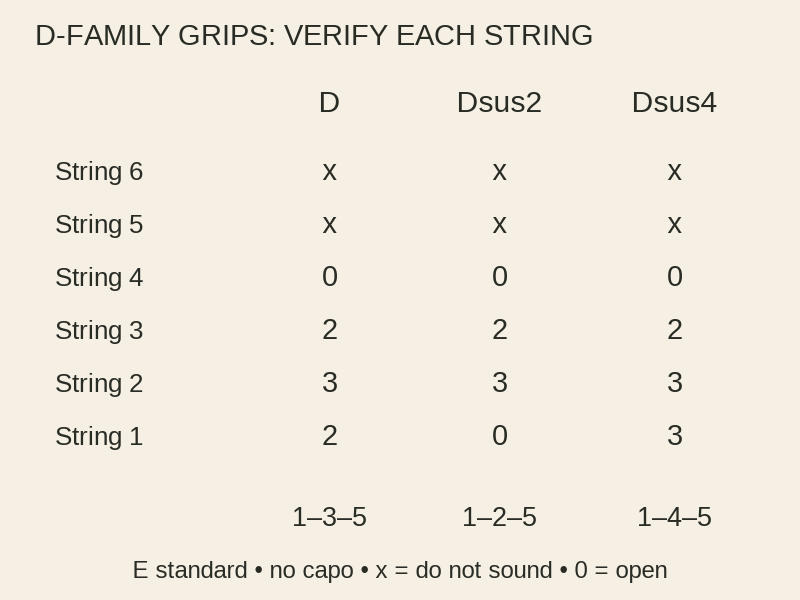
Use E A D G B E, no capo, reading strings from 6 to 1. In these grip records, x means that the string should not sound and 0 means open. This x is not a separate percussive muted-note event. Sound only strings 4 through 1.
| Chord | Frets: 6 / 5 / 4 / 3 / 2 / 1 | Notes, low to high | Formula |
|---|---|---|---|
| D | x / x / 0 / 2 / 3 / 2 | D3–A3–D4–F♯4 | 1–5–1–3 |
| Dsus2 | x / x / 0 / 2 / 3 / 0 | D3–A3–D4–E4 | 1–5–1–2 |
| Dsus4 | x / x / 0 / 2 / 3 / 3 | D3–A3–D4–G4 | 1–5–1–4 |
The lower three sounding strings remain D3, A3 and D4. Only the note on string 1 changes: fret 2 supplies F♯4, the open string supplies E4, and fret 3 supplies G4. These pitches come from the stated tuning and fret counts; they are not measurements.
Pick the four intended strings one at a time before strumming. If a fretting finger prevents the open first string from sounding in Dsus2, the missing E changes the note inventory. If an unintended string sounds, identify its note before assuming the shape still gives the same voicing.
Move one upper note deliberately
Form the D shape comfortably, sound the intended strings and identify F♯ on string 1. Change to Dsus2 by letting that string sound open while keeping the other three notes. Return to D, then compare Dsus4 with the first-string note at fret 3. Choose a fingering that allows those changes without forcing a stretch.
Keep the guitar and sound unchanged for the first comparison. Play slowly enough to hear the changed note and to stop unwanted ringing strings. If the movement hurts or the chord will not sound clearly, pause; a teacher can help find a smaller voicing or a more suitable fingering.
Try the notes individually and then as a chord. You may prefer one colour for a particular phrase, but a preference does not alter the formula. More gain or a different picking attack can be another comparison later; adding it immediately makes the upper-note change harder to judge.
Try an original four-bar progression
Use one chord per bar of 4/4: D | Dsus4 | D | Dsus2. Start with one downstroke on beat 1 and let the intended chord ring for the rest of the bar. Keep strings 6 and 5 quiet. Repeat the four bars only at a pulse where the changes remain comfortable.
Then compare D | Dsus4 | D | D. The last bar now has F♯ rather than E on string 1. Keep the rhythm and picking pattern the same so you can judge that specific difference. Finally stop on Dsus2 instead of returning to D and decide whether that ending suits the phrase you want.
The progression is an original note-and-grip exercise. It does not establish that a suspended chord must always resolve to a major chord, or that one ending is universally more complete. Write down the notes and the musical context when discussing the result.
Check what the rest of the arrangement supplies
The guitar’s suspended grip does not tell you every note sounding in an ensemble. If another part sustains F♯ while you play Dsus2, the combined note collection is D–E–F♯–A, rather than only the three tones of the basic suspended formula. That inventory is a direct consequence of adding the stated notes; listen to the actual arrangement before choosing its chord label.
Likewise, a chord symbol cannot tell you one mandatory guitar grip. Another position may provide the same note classes with a different bass note or doubling. Check the requested harmony and the part’s register separately, using lead and rhythm roles when several instruments share the material.
Keep a record of tuning, frets, intended strings, sounding notes and the progression. If you change tuning or use a capo, derive the pitches again. The tab guide helps keep the written fret record separate from the rhythm. A recognisable shape is a starting point; the note inventory explains what it actually contributes.
Download the blank English record (CSV). The sheet contains no completed observations or site test results.
How this guide was prepared
Fender’s sus2/sus4 formulas were checked, then the D-family shapes were independently derived string by string from E A D G B E. The common notes, changed upper note and root-relative intervals were recalculated. The suggested rhythm and progression are editorial exercises; perceived preference and arrangement effects remain for the reader to evaluate.
Documentation checked .