The decision in brief
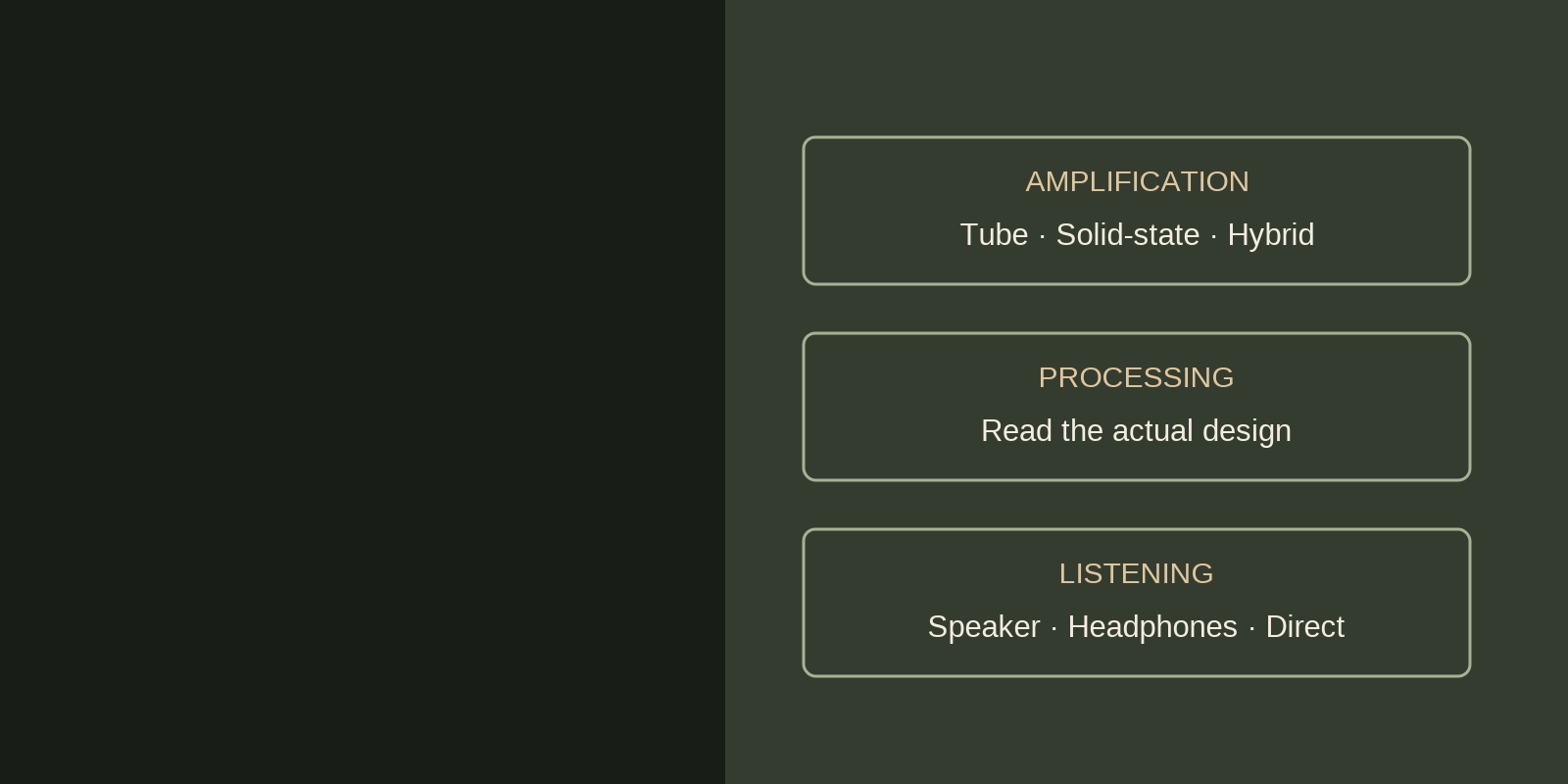
Tube and solid-state describe amplification technology, not a reliable ranking of tone. Choose the actual model that gives the clean and driven response you need at your playing level, with suitable monitoring and service arrangements. For a hybrid, identify which stages use tubes; for a modeling amp, identify the processing and listening outputs separately. Neither a technology label nor the watt rating establishes whether the amp will work for your room or band.
Read the technology label before assigning it a sound
A tube, also called a valve, is an amplification device. Solid-state amplification uses semiconductor circuitry. Hybrid designs combine technologies; the useful question is where each operates. Orange’s Micro Terror, for example, has an ECC83/12AX7 valve preamp and a solid-state output stage. A visible tube would not establish that its power stage also uses tubes.
| Label | What to identify | What remains open |
|---|---|---|
| Tube / valve | The documented preamp and power-stage design | Useful volume range, voicing and available outputs |
| Solid-state | The actual amplification and processing design | Whether the signal processing is analogue, digital or mixed |
| Hybrid | Which stages use each technology | How the complete amp behaves in the intended setup |
| Modeling | What is modeled and how the result reaches the listener | Number of sounds, controls and recording features |
For the digital modeling discussed here, processing is used to emulate amplifier sounds. Fender’s Tone Master Deluxe Reverb combines digital modeling with a Class D power amp. That is a documented combination, not evidence that every solid-state amp is a modeler. Its resemblance to the original tube model is Fender’s tonal claim, not a result established here.
Sources: Fender: amplification and digital modeling concepts; Orange Micro Terror: valve preamp and solid-state output stage; Fender Tone Master Deluxe Reverb: processing and power-stage specifications
Define the clean and driven sounds you need
Describe a playing result before comparing labels. You may need clear chords beside a drummer, a driven rhythm sound in a small room, or both through switchable settings. Clean headroom, in this practical comparison, means how much usable level remains before the sound becomes more distorted than your part allows. It is not a universal pass mark.
Do not assume that a solid-state channel stays clean at every setting. The Crush 35RT manual explicitly says its clean channel can produce overdrive as its volume increases. Conversely, owning a tube amp does not mean that you must drive it into distortion. Try the required sound on the exact channel and speaker arrangement.
If a pedal supplies your drive, assess the amplifier with that pedal as a separate condition. The overdrive guide explains why input drive and listening level deserve separate checks. A clean-only trial cannot settle whether the whole rig produces the gain sound you want.
Sources: Orange Crush 35RT manual, August 2025: clean and dirty channel controls, page3
Check the operating level rather than matching knob positions
Write down the quietest and loudest situations the amp must serve. A home demonstration does not establish clean rehearsal capability, and a loud shop demonstration does not establish comfortable low-level adjustment. Mark an untested situation as unknown.
Look for controls that help meet those requirements, then confirm how they work. Fender lists full power and five reduced-power settings for the Tone Master Deluxe Reverb. The useful fact is that this specific amp offers those settings; the solid-state or modeling label alone would not tell you that. A power selector and a master-volume control also need their own operating instructions.
Matching the numbers on two Volume knobs does not create equal listening conditions. Nor does an output-power rating establish the sound level you will hear from different complete amps. Keep the exact speaker or cabinet, room position, channel and controls in the record. The amp-system overview covers the separate power-rating and listening-route basics.
Sources: Fender Tone Master Deluxe Reverb: model-specific power selector
Separate the requirements trial from the preference comparison
The following is a proposed comparison routine, not a test performed for this article. Use permission, appropriate listening levels and the makers’ approved connections. Keep each amp’s intended speaker/load arrangement intact.
- Requirements trial: let each candidate use suitable settings to meet the same task. Check the cleanest sound you need and the strongest passage you expect to play. Record whether the required sound and listening level can coexist.
- Preference comparison: compare the sounds you would actually use at similar listening levels. Use the same guitar, pickup selection and short passage, and keep your listening position as consistent as practical. Record the differences you prefer rather than attributing them immediately to tubes or transistors.
- Repeat the passages and try finding the chosen settings again. If a result is inconsistent, keep that uncertainty in the record rather than awarding a winner.
Changing amplifier models usually also changes voicing, speakers, gain structure or other conditions. Even an enjoyable, repeatable preference therefore concerns those complete setups. Similar perceived volume is a useful listening check, not a calibrated sound-pressure match. Stop if the demonstration requires an unsuitable room level.
| Record for each candidate | Your observation |
|---|---|
| Identity | Model, channel, processing mode, speaker or cabinet, and documented technology |
| Requirements trial | Task, actual setting and whether the required clean or driven result was usable |
| Preference comparison | Passage, pickup, listening position, controls and similar-level adjustment |
| Limits | Different speakers, unknown band result, uncertain level match or untested output |
| Decision | Meets the task; needs another demonstration; or fails a stated requirement |
Check monitoring and ownership requirements separately
A technology label does not specify a headphone, recording or effects-loop connection. For example, the Tone Master Deluxe Reverb specification identifies its USB connection for firmware updates and its balanced XLR output for cabinet-simulated line output. Do not infer USB audio recording from the socket. Check the exact model and firmware documentation.
Try the monitoring route that matters to you, rather than assuming a room-speaker preference carries over to headphones or a direct feed. For direct recording, the DI routing guide separates instrument, mic and line connections. An effects loop is another model-specific requirement; use the pedal-order guide’s loop explanation when checking one.
For ownership, record the actual transport demands, power supply, service route and any software needed for essential functions. Ask about tube replacement and adjustment requirements for the exact tube or hybrid design. Keep unknown service costs and intervals unknown. Absence of tubes does not establish that every repair is simple or that an amp will need no service.
Fender says its amplifiers typically are not user-serviceable, and the Crush 35RT manual directs internal servicing to qualified personnel. Do not open an amp as part of this comparison. Choose from the models that meet your documented needs, then use the preference record to decide which complete setup helps you play the part.
Sources: Fender Tone Master Deluxe Reverb: USB and line-output functions; Fender: amplifier technical-support and service limits; Orange Crush 35RT manual, August 2025: servicing boundary, pages1–2
How this guide was prepared
We checked Fender’s modeling-amp explanation and Tone Master Deluxe Reverb specifications, Orange’s Micro Terror and Crush 35RT descriptions, the August 2025 Crush 35RT manual and Fender’s amplifier-support guidance on November 6, 2026. Named models demonstrate documented design or feature differences; the makers’ tonal marketing is not adopted as a test result. The two-pass comparison and decision record are editorial proposals. We auditioned no amplifiers and measured no sound level, distortion, reliability, latency or running cost. Comparing complete amps cannot isolate circuit technology from speakers, voicing, settings and the room.
Documentation checked .
Sources and further reading
- Fender: amplification and digital modeling concepts
- Orange Micro Terror: valve preamp and solid-state output stage
- Fender Tone Master Deluxe Reverb: processing, power selector and output specifications
- Orange Crush 35RT manual, August 2025: controls and servicing
- Fender: amplifier technical-support and service limits