The decision in brief
The modern steel-string flat-top developed through several changes in guitar stringing, bracing, body and neck design. It shares earlier European and Spanish guitar traditions, while American makers developed their own formats. Martin’s records distinguish early Ditson-related designs, a steel-only model introduced in 1922, 1931 Dreadnought models and later neck changes. Archtop guitars form another acoustic branch. These examples give context; they are not a single worldwide invention date or proof of today’s tone.
Place X-bracing within a broader building history
The Met documents Martin’s 1833 arrival in the United States and subsequent Spanish influences. Its account includes early fan-braced instruments. Martin’s current bracing article credits its X-pattern development to the mid-nineteenth century. These accounts describe an evolving workshop tradition; they do not establish one construction for every early guitar.
Braces support the top and influence its response. An X layout alone does not establish allowable strings, structural health, loudness or a particular tone. We retain the company’s historical attribution as an attribution, without adopting its exclusive-invention or performance advertising.
Sources: The Met, Daniel Wheeldon, 2017: Spanish guitar traditions and six single strings; Martin, updated April 2026: its account of X-bracing development
Use a documented model to explain the string transition
Martin Museum identifies the 2-17, introduced in 1922, as the company’s first model offered only with steel strings. Earlier company options included gut or steel; the museum describes steel becoming its preference by the end of that decade. This is a company-specific sequence, not a worldwide changeover date.
String material, construction, tuning and length affect load and response. Do not equate every steel set with a single tension or use this history as permission to restring an old or nylon instrument with steel. Verify the actual model and condition.
Sources: Martin Museum: dated examples and company model milestones
Separate design roots from the dated Dreadnought models
Martin’s museum account connects the Ditson-related development with 1916 and displays a Ditson 111 dated 1929. It identifies the introduction of the D-18 and D-28 in 1931. A dated museum object and the origin of a design are different entries in the timeline.
The broad body became a recognizable family. Its history does not guarantee that a current Dreadnought is louder, bassier or identical in dimensions to another model. Compare actual construction, fit and a stated listening test rather than reading a performance promise into the name.
Sources: Martin Museum: dated examples and company model milestones
Treat neck access and body names separately
The museum documents a 1930 OM-45 De Luxe and dates Martin’s change to 14-fret Dreadnought necks to 1934. The first date is a documented example, not a claim that the OM was invented in 1930; the second concerns that company’s Dreadnought line. Neither dates every 14-fret guitar.
A 12- or 14-fret body joint describes where the neck meets the body, not the total fret count. Modern OM, 000, Grand Auditorium, concert and parlor names vary by maker. Check body dimensions, scale and the actual joint independently. Read the body comparison for the current buying question.
Sources: Martin Museum: dated examples and company model milestones
Include the archtop and amplified branches
The Met’s 2016 archtop essay describes carved, arched tops/backs and the Gibson L-5 introduced in 1922 for developing ensemble roles. It also documents a cutaway archtop from the late 1910s and later amplified jazz use. Cutaways and pickups therefore do not belong to one universal late flat-top stage.
For a modern acoustic-electric, assess the acoustic instrument and its actual pickup, preamp and listening system separately. A cutaway concerns access; a shallow body or pickup type alone does not guarantee feedback behaviour. New materials and systems are individual design choices, not automatic historical improvements.
Sources: The Met, Jayson Kerr Dobney, 2016: archtop instruments and ensemble roles
Read dates with their scope attached
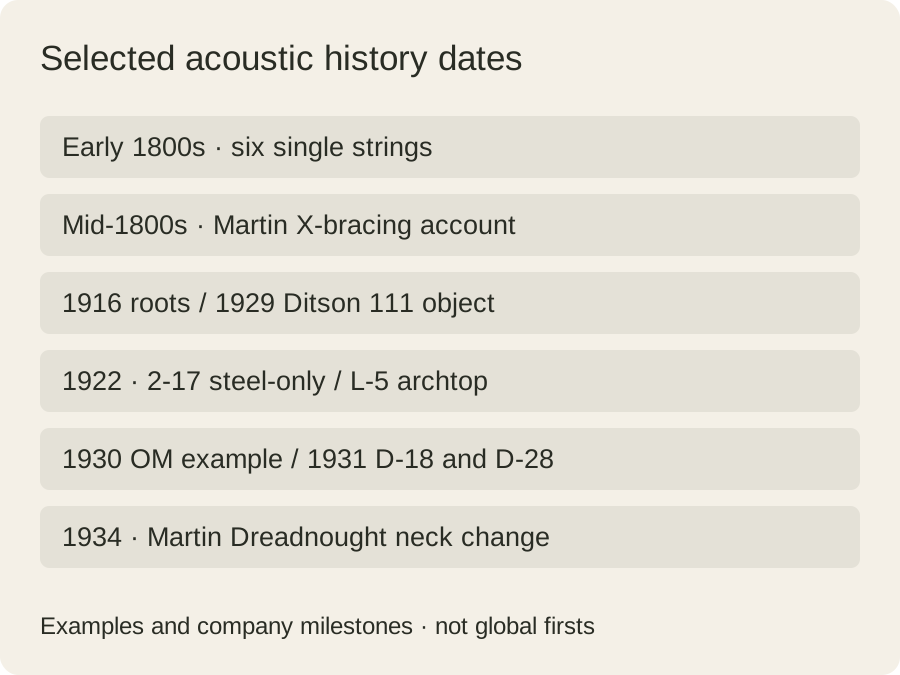
The following is a selective evidence map. It is not a complete global history or a ranking of inventions. Preserve approximate periods and the type of event when repeating a date.
| Date or period | Documented point | Scope |
|---|---|---|
| Early nineteenth century | Shift toward six single strings | The Met’s European/Spanish survey |
| Mid-nineteenth century | Martin’s account of X-bracing development | Company attribution; other patterns coexisted |
| 1916 / 1929 | Ditson-related roots / museum Ditson111 example | Design account / dated object |
| 1922 | Steel-only 2-17; separate L-5 archtop introduction | Martin model / Met archtop account |
| 1930 / 1931 | Museum OM-45 De Luxe / D-18 and D-28 introduction | Dated example / company models |
| 1934 | 14-fret neck change on Martin Dreadnoughts | That line; not every 14-fret instrument |
Use history to ask better questions about present instruments. Verify their dimensions, approved strings, internal construction and condition; listen under comparable conditions. A familiar historical name cannot supply those answers.
Sources: The Met, Daniel Wheeldon, 2017: Spanish guitar traditions and six single strings; Martin, updated April 2026: its account of X-bracing development; Martin Museum: dated examples and company model milestones; The Met, Jayson Kerr Dobney, 2016: archtop instruments and ensemble roles
Frequently asked questions
Was the acoustic guitar invented on one date?
No single date covers the different acoustic branches. A dated object, model introduction and design tradition describe different events.
Does 1930 mean the OM was invented that year?
No. This article uses Martin Museum’s 1930 OM-45 De Luxe as a dated example, not a verified first-invention or launch date.
Does a Dreadnought label guarantee more volume?
No. Historical role and body name are context. The complete build and a comparable listening test are needed to judge an actual instrument.
How this guide was prepared
We checked The Met’s 2017 Spanish-guitar and 2016 archtop essays, Martin’s bracing account updated April 2026 and its museum descriptions. Dates retain their stated role as periods, examples or company milestones. We did not inspect museum objects, consult original workshop archives, verify a first OM invention/launch date or test historical or modern acoustic output. Illustrations do not identify a historical specimen.
Documentation checked .
Distinguished dated objects from design and model milestones, added the archtop branch and a scoped chronology, and removed unsupported body/material performance and archive-photo implications.