
The decision in brief
Evaluate a bajo quinto supplier by confirming the instrument identity, documented specification, representative sample and responsibilities after delivery. A bajo quinto has ten strings in five doubled courses; it should not be treated as a generic ten-string guitar or confused with a twelve-string bajo sexto. Verify the intended tuning, octave and unison pairings, string ends, setup and any pickup system on the exact model. Then agree the order mix, acceptance process, replacement strings and service route in writing. This is an independent buyer framework, not a supplier directory or an offer of instruments.
What matters most
- Record ten strings, five courses and the exact tuning and pairing arrangement.
- Check each course as a pair and each string individually; an overall strum can conceal a problem.
- Match replacement strings and their end fittings to the actual bridge and pickup system.
- Tie sample approval, permitted substitutions, receiving checks and service responsibilities to a named model revision.
Confirm the bajo quinto identity and course map
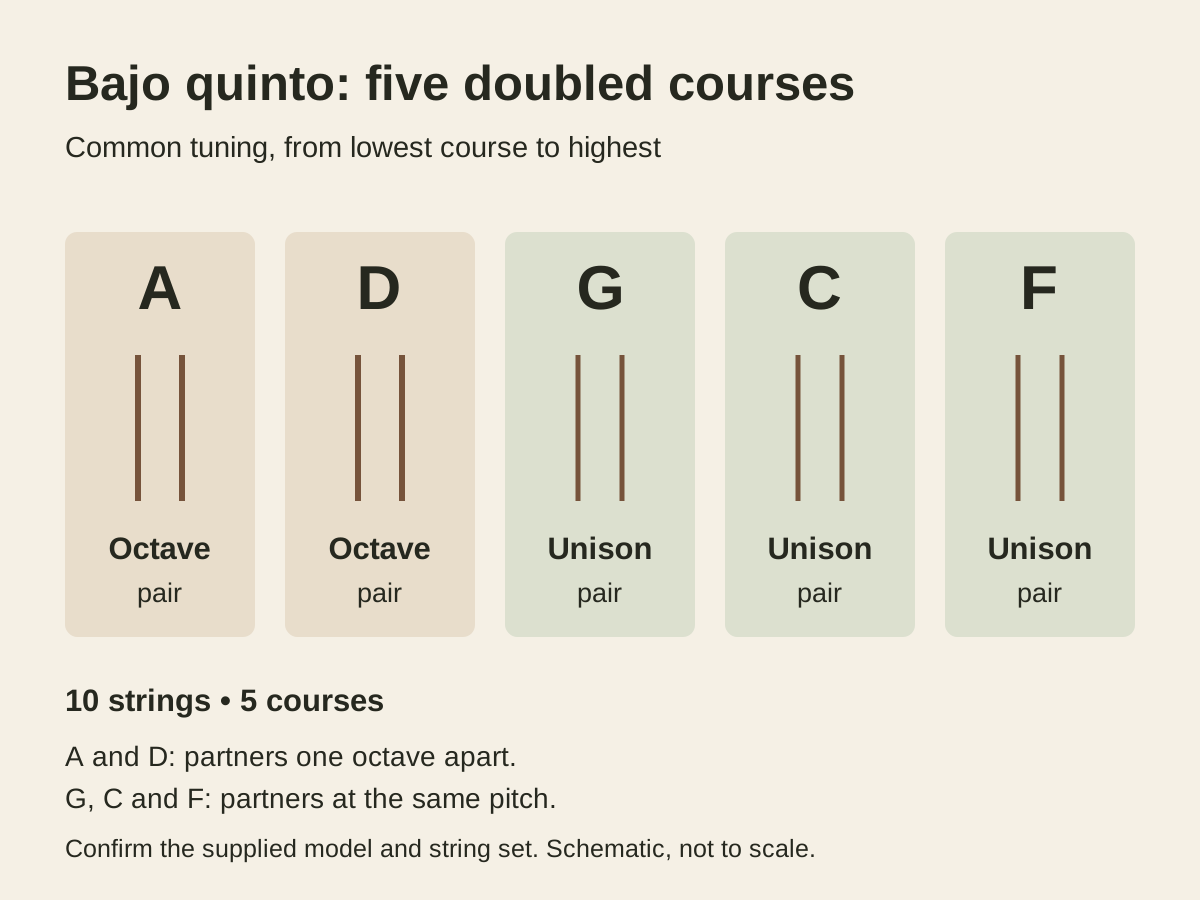
The first check is the instrument family. Taylor defines the bajo quinto as ten steel strings arranged in five doubled courses. Its documented common tuning, from the lowest course upward, is A D G C F: the A and D pairs are an octave apart, while G, C and F are unison pairs. A bajo sexto has twelve strings in six courses. Do not approve a model merely because a catalog calls it a regional ten-string instrument.
Put the course map in the buyer specification using both notes and octave relationships. A string count alone cannot distinguish every doubled-course family, nor does it establish the factory setup. If the supplier describes an alternative arrangement, request the intended pitches, approved string set and supporting instrument specification. Resolve inconsistent documents before asking the sample reviewer to judge the sound.
Use the same terminology in the purchase record, receiving sheet and store description. The receiving team should not have to infer the intended instrument from a translated product name. This is especially useful when a catalog also contains twelve-string guitars or other regional instruments. See our twelve-string acoustic guide for the separate guitar context, without treating that setup as interchangeable with a bajo quinto.
Sources: Taylor Guitars: SOMOS collection and bajo quinto definition
Request a model-specific specification with evidence fields
Use a specification sheet with three columns: supplier declaration, supporting document and sample observation. Keep unresolved items separate from approved items. A glossy photograph can show appearance, but it does not establish internal construction, exact dimensions or the setup delivered to your shop. Ask for information attached to the model and revision being considered.
| Specification block | Record | Verify or clarify |
|---|---|---|
| Identity and strings | Ten strings, five courses, pitches, pairings, exact set | Installed arrangement and replacement compatibility |
| Construction | Top, back, sides, neck, joint and finish descriptions | Which claims are documented versus visually observable |
| Geometry | Scale, nut width, course spacing, body and case dimensions | Units, reference points and measurement method |
| Setup | Declared tuning and model-specific setup targets | Actual sample readings and playability |
| Electronics | Pickup type, controls, output and power if applicable | Manual, signal behavior and service access |
| Support | Spare strings, parts and service contact | Named responsibilities and actual ordering route |
Do not turn a supplier statement into a verified fact simply by moving it into your own spreadsheet. Preserve the source and identify which reviewer confirmed each observable feature. The retail specification guide provides a broader method for keeping unlike measurements comparable.
Agree what the sample represents before reviewing it
Record the sample's model code, revision, serial or other identifier where supplied, installed strings and setup state. Ask whether it represents the proposed production configuration, a showroom example or a specially prepared sample. A strong sample can show that one instrument meets your requirements; it does not establish the consistency of an entire future batch.
Before approval, identify which attributes must remain fixed: string set, bridge arrangement, tuning, declared materials, electronics and included protection. If substitutions are possible, agree how they will be disclosed and reviewed. A replacement pickup or string set can affect the evaluation even when the model name stays the same. Photograph the sample's relevant details and attach the specification version to its review record.
Choose a reviewer who understands the intended doubled-course role and can explain observations clearly. Separate that person's playing preference from an objective mismatch with the agreed specification. A reviewer may prefer another neck feel while still finding the sample correctly built. Conversely, an attractive sound does not excuse the wrong string arrangement. Keep both findings visible so approval has a defined meaning rather than relying on a general good-quality comment.
Inspect individual strings as well as complete courses
Begin by confirming the documented tuning with a suitable tuner and the intended string map. Check each string separately, then listen to its partner and the complete course. An open chord can sound broadly convincing while concealing a partner at the wrong octave or a string that does not seat or respond correctly. Record which course and string a problem affects.
Play ordinary fretted passages in the positions the target player will use. Compare open and fretted behavior, clearance and the ease of sounding both strings within a course. Listen for unwanted rattles or a pairing that becomes distracting higher on the neck. Follow the maker's model-specific setup procedure; do not apply a six-string guitar action target or filing method automatically.
Check nut slots, saddle contact, bridge condition and tuning hardware visually without dismantling or modifying the sample. If a measurement or symptom needs specialist interpretation, refer it to a qualified technician and retain the assessment. Document the instrument as received before any work, then document the work separately. That distinction helps the buyer understand whether the delivered configuration met the requirement or needed correction to do so.
Match the replacement string set to the bridge and electronics
Ask for the installed set's exact code, individual gauges, end fittings and intended tuning. D’Addario's EJS85 is one documented example of a ten-string bajo quinto set with loop ends and stainless steel round winding, described for electromagnetic pickups. That example establishes a particular product configuration; it does not make loop ends or that wrap material a requirement for every bajo quinto.
Confirm how the proposed set attaches to the actual bridge. A ball-end product, loop-end product or another design cannot be assumed interchangeable because each contains ten strings. Ask the instrument maker about approved replacements and retain the answer with the model record. The availability of a suitable replacement set through your shop's real supply route is part of the ownership decision, not a detail to discover after a customer breaks a string.
If electronics are included, identify their sensing system and power requirements. Check the manufacturer's string recommendations and test each course through a relevant amplifier or input. Do not infer compatibility from the pickup's appearance. Record uneven response or noise with the controls and connection used, then ask for an explanation or correction rather than promising that any generic replacement string will behave the same.
Sources: D’Addario: EJS85 bajo quinto string construction and ends
Define the customer role and sample audition
Describe the player and musical task the model will serve. Is the shop evaluating an accessible first instrument, an acoustic accompaniment option or a model intended for amplified use? These are planning questions, not proof of local demand. Use your own enquiries, sales records and knowledgeable player feedback where available; do not turn online visibility into a numerical forecast.
Prepare a short audition covering the relevant accompaniment, chord changes and playing positions. Ask the reviewer to note course spacing, fretting comfort, balance and access separately from the sound. A cutaway or narrower-looking neck is useful only if it helps the intended player perform the task. Compare similarly prepared samples with the same passages and listening conditions when choosing between models.
Keep assortment distinctions specific. Two instruments with different decoration but the same practical role may overlap in a small range. A genuinely different amplified configuration or playing fit may justify another option, if the shop can support it. The range-planning guide explains how to connect each model to a clear role without inventing a universal stocking ratio or a forecast for this specialist category.
Get the order conditions and handover responsibilities in writing
Request a dated proposal for the exact model and configuration, including the proposed order quantity, permitted model mix, preparation, packaging and included accessories. Minimum quantities, lead times and customization terms vary by seller and order. This guide does not supply current market figures. Keep the supplier's quotation and your approval record linked so a later change is visible.
Clarify who prepares the instruments, who checks the course map, which documents identify the shipment and who handles a reported mismatch. Ask how the seller distinguishes production completion, dispatch and arrival estimates. An estimate is not an observed delivery event. Use the agreed commercial documents and qualified advice where necessary to establish the actual responsibilities for transport, import and damage handling.
When comparing proposals, include costs and work that the shop can substantiate: protective case or packaging, receiving inspection, documented setup needs, replacement strings and service preparation. State assumptions beside any estimate. A lower unit price does not establish the lower total operating burden, and an unspecified promise of after-sales service does not tell the receiving team what to do when an instrument fails the agreed check.
Turn sample approval into receiving and service records
Prepare the receiving sheet before the order arrives. Record the shipment and instrument identifiers, packaging condition, model revision, strings and initial tuning state. Photograph visible damage or discrepancies before adjustment. Keep an instrument with an unresolved problem separate from ready-for-display stock, and use the agreed reporting process so the supplier receives a precise description.
Repeat the identity, course pairing, basic playability and electronics checks relevant to the approved sample. Record actual observations instead of copying the sample's result onto each delivered instrument. A sampling policy for a larger order must be deliberately agreed and justified; this article does not invent a statistical acceptance level. Your receiving inspection procedure should identify who can release an instrument for sale.
Retain the approved string code, parts information and service contact in a record staff can find. Decide who can authorize setup work, arrange a replacement or communicate a care instruction to a customer. If the model changes, revise those records. Supporting a specialized instrument requires repeatable information, not merely one knowledgeable employee remembering which strings were used on the original sample.
When the advice changes: acoustic, amplified and unfamiliar markets
For an acoustic-only model, focus the audition on the actual unamplified role, physical comfort and the environment in which the customer will use it. For an amplified model, add course-to-course response, controls, required power and the intended signal path. An acoustic comparison alone cannot approve the electrical system, and an amplified demonstration cannot establish every aspect of the unplugged response.
If the shop is new to the instrument family, treat the first review as an evidence-building step. Seek qualified player feedback, confirm replacement strings and decide which service tasks the shop can support before expanding the assortment. An available supplier catalog is not evidence that a large range suits your local customers. Keep any demand assumption clearly separate from observed enquiries or transactions.
If a seller proposes an unusual tuning or string arrangement, return to the identity and specification checks. Require the intended pitches and approved setup before the reviewer changes tension or adjusts hardware. A revised bridge, pickup or string set deserves a targeted review of the affected functions. Approval of one configuration should not silently extend to every instrument carrying a related family name.
Conclusion: approve a defined instrument and support plan
A useful bajo quinto supplier evaluation produces a traceable decision. You can identify the model, explain its five-course configuration, show what the sample review established and name the unresolved items. That evidence is more valuable than a broad claim that a seller specializes in regional instruments.
- Identity: ten strings, five courses, target notes and octave or unison pairings.
- Specification: named model revision, construction declarations, geometry and measurement methods.
- Sample: representative status, string-by-string and course checks, playability and any service work.
- Replacement support: compatible string set, end fittings, electronics documentation and parts route.
- Order: approved configuration, disclosed substitutions and written delivery responsibilities.
- Receiving: inspection record, reporting method and staff authorization for display release.
Approve the next step only when the evidence needed for that step is available. A sample approval supports a defined model decision; a delivered order still needs its own checks. If a key detail remains uncertain, ask the specific model question and retain the answer. Keep the professional enquiry focused on evidence, responsibilities and the playing task, rather than treating a promotional description as the complete buying case.
Frequently asked questions
What is the difference between a bajo quinto and a bajo sexto?
A bajo quinto has ten strings in five doubled courses; a bajo sexto has twelve strings in six courses. Record the supplied model's tuning and pairings rather than identifying it only by a translated catalog name.
What tuning should a bajo quinto buyer document?
Taylor describes the common low-to-high course tuning as A D G C F, with octave pairs on A and D and unison pairs on G, C and F. Confirm the exact supplied model, intended notes and string set before adjustment.
Can any ten-string set be used on a bajo quinto?
No. Check the approved pitches, gauges, usable lengths and end fittings against the actual instrument. Pickup compatibility can also matter. A ten-string label alone does not establish a suitable replacement.
What is a normal MOQ for a bajo quinto supplier?
This guide does not establish a market-wide minimum order quantity. Request a dated proposal for the model, mix and configuration you need, and compare the documented terms and support responsibilities.
Does approving a sample prove the whole order is consistent?
No. A sample review establishes what was observed on that identified instrument. Keep the approved specification and carry out a defined receiving process on the delivered order, recording discrepancies and any required correction.
How this guide was prepared
Taylor and D’Addario documentation establish the instrument and string examples used here. The sample worksheet and retail decision process are original editorial frameworks, not reports of supplier audits, shipments or market demand. No supplier ranking, current MOQ, price or stock claim is made. The hero is an AI-assisted editorial visualization using Taylor product imagery as a structural reference, not an inspected production sample; the course diagram is schematic.