
The decision in brief
Before buying Brazilian-style cavaquinhos in bulk, confirm the four-string instrument identity, target tuning, exact model revision and approved replacement strings. Review a representative sample with a player familiar with the intended use, then decide whether staff can explain, set up and support that model. Keep acoustic and amplified configurations separate. The word Brazilian describes the intended instrument style here; it does not establish the offered unit's country of manufacture. Order quantities, current prices and local demand need evidence from your own enquiries and the seller's dated proposal.
What matters most
- Specify four single steel strings and the exact intended notes, not just a translated family name.
- Confirm string ends, gauges and the maker's approved set before tuning or service.
- Keep top construction, back and sides, neck support and electronics specific to the model.
- Choose the first range by verified customer needs and staff support capacity, without inventing a stocking ratio.
Start with the customers and the support task
Identify who is asking for the instrument and what they intend to play. A specialist player replacing a familiar cavaquinho, a student following a teacher's specification and an occasional customer attracted to a small body may need different help. Record actual enquiries and the models or functions requested. A catalog's breadth or a keyword estimate does not establish local demand.
Ask whether the shop can demonstrate the tuning, explain the string set and arrange service for the proposed model. If those tasks depend on one visiting player, decide how staff will answer an ordinary replacement-string question later. An initial order should match the evidence and support capacity you have, with room to learn from real use.
Give each proposed option a role. One might serve an acoustic use; another might meet a documented need for amplification. Different decoration alone may not justify another line in a small range. Use the range-planning guide for the general assortment process, then apply the instrument-specific checks below.
Document four single strings and the intended notes
The Brazilian-style cavaquinho addressed here uses four single steel strings. It should not be approved as a ukulele solely because the body is small and there are four tuners. String system and tuning change the playing and support task. Rouxinol lists dedicated steel cavaquinho sets; the E-51 page identifies first through fourth strings as D, B, G and D.
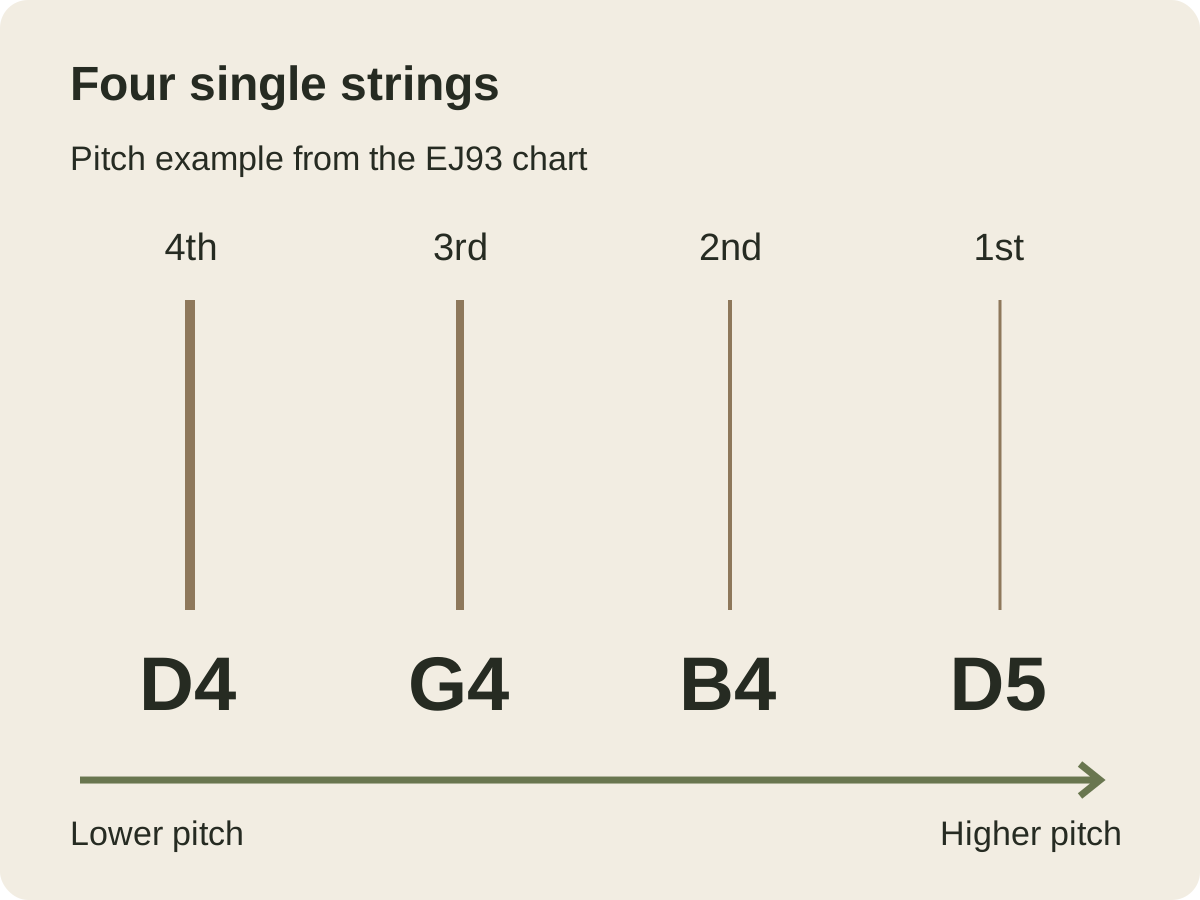
State the notes from lowest string to highest, with octave information confirmed for the exact instrument. D’Addario's EJ93 chart provides a documented D4 G4 B4 D5 example when reordered from fourth to first string. That is an ascending arrangement, not evidence for a high fourth-string reentrant setup. The product's listing also refers to Portuguese folk/braguinha use, so its pitch chart is not approval of EJ93 for every Brazilian-style model.
Request the supplied model's own tuning and approved set before adjustment. A four-string count, a related instrument-family name or a familiar chord diagram does not establish compatibility. Keep the string numbering and orientation explicit on the purchase sheet and staff card. Our ukulele guide addresses a separate family and its own tuning choices.
Sources: Rouxinol: E-51 steel cavaquinho string notes and ball ends; D’Addario: EJ93 four-string set and octave-specific pitch chart
Use a real model to see why separate fields matter
Rozini's RC07.AC.N.J listing distinguishes a solid top from laminated back and sides. Its specification gives a 340 mm scale, 30 mm nut and no truss rod, and names Rouxinol E-51 strings. Those are declarations for that listed model, not universal dimensions or construction rules for cavaquinhos. The page also notes that measurements can vary.
Keep the top, back and sides in separate construction fields. A translated phrase such as “solid wood instrument” would erase a meaningful distinction in this example. Also separate the body configuration and neck support from cosmetic wood names. Do not translate a no-truss-rod specification into a promise that the neck never needs attention or that it can be adjusted like a guitar with a rod.
Compare the offered revision with its dated documentation and sample. A product page may describe alternative fingerboard materials or mention related amplified versions, while the model being ordered has a particular configuration. Attach that configuration to the purchase record. If the seller cannot identify which version is supplied, resolve it before making the store description.
Sources: Rozini: RC07.AC.N.J acoustic cavaquinho specifications
Make replacement strings part of approval
Record the exact approved string code, individual gauges, note map, usable length and bridge-end fitting. Rouxinol's E-51 listing specifies ball ends and its own gauge sequence. D’Addario's EJ93 has a different fourth-string gauge. Similar note names therefore do not prove that the two complete sets are interchangeable on the model under review.
Confirm the instrument maker's approved replacements and the route by which your shop can obtain them. Do not substitute a generic ukulele set or a partial guitar set because both are on the shelf. A customer needs a repeatable product code and installation instructions appropriate to the bridge, not only a description such as steel strings.
Photograph the sample's bridge and installed ends, then retain the string package or specification. If the model is amplified, identify the pickup system and its string requirements as well. Compatibility with one sensing system cannot be inferred from another. Keep any proposed set change separate from the baseline sample review, and assess the required setup before approving it.
Sources: Rouxinol: E-51 steel cavaquinho string notes and ball ends; D’Addario: EJ93 four-string set and octave-specific pitch chart
Review small-neck playability with an appropriate player
Use a reviewer who can play and explain the instrument's intended role. Check tuning stability, clean fretted notes and the chord changes customers will need. A general guitar strum is a limited demonstration of a compact four-string instrument. Ask the reviewer to identify which string, fret or passage reveals a problem.
Check the nut, saddle contact, bridge attachment and tuning hardware visually without altering the sample. Play the ordinary positions individually before listening to a complete accompaniment. Record unwanted buzz, fretting effort or notes that do not speak cleanly. Keep player preference separate from an objective mismatch with the agreed specification.
Assess intonation with a suitable tuner and normal fretting pressure after confirming the intended strings and tuning. A very hard press on a compact fret layout can affect the observation. Do not assign a universal action or intonation tolerance taken from a six-string guitar. Use the maker's targets or a qualified technician's model assessment.
A neck without a truss rod needs a different service plan
The Rozini example lists no truss rod. For an offered model with that construction, staff must not promise a routine rod adjustment as the answer to neck relief or a high-action complaint. First identify the actual neck design and have an appropriate technician assess whether a problem is setup, fretwork or structural condition.
Keep the as-received observations separate from later service. If a sample needs work before its audition, record who did it and what changed. A satisfactory result after a technician's correction does not mean the instrument arrived in that state. Use the finding to decide whether the shop can support the work the proposed range may need.
A different cavaquinho model may include another neck arrangement, dimensions or string recommendation. That changes the service decision. The purpose of this check is to recognize the model's real adjustment options, not to rank every rodless instrument below every adjustable one. Construction quality and the observed condition still need their own evidence.
Sources: Rozini: RC07.AC.N.J acoustic cavaquinho specifications
Approve the amplified configuration separately
For a model with a pickup or preamp, obtain its operating instructions, power requirement and connection type. Demonstrate it through a compatible receiving input. Test individual strings as well as ordinary accompaniment and record the control positions. An acoustic audition does not approve the electronics.
Look for useful balance across the strings, manageable noise and a control range the customer can understand. If an unwanted response appears, record the string, position, input and setting before diagnosing a component. A dramatic EQ change or higher listening level can conceal a comparison rather than improve it.
Keep spare power, service access and replacement parts on the staff card where relevant. A product-family page mentioning an active option does not prove that the acoustic model on the order has electronics. Match the ordered code, actual sample and customer description. Refer to the cable connection guide when an amplifier or powered speaker input is being confused with a speaker output.
Prepare a staff card before committing to the range
| Staff question | Keep on the model card | Approval evidence |
|---|---|---|
| What instrument is this? | Style, model revision, four single strings | Maker specification and identified sample |
| How is it tuned? | String numbers, notes and octave map | Model instructions and approved set |
| Which strings can we supply? | Code, gauges, ends and ordering route | Maker compatibility confirmation |
| What can we adjust? | Neck support and technician route | Construction documentation and service assessment |
| How does it connect? | Pickup, controls, input and power where fitted | Exact electronics manual and audition notes |
| Where did it come from? | Offered unit's declared origin and seller | Order-specific documentation |
Let a staff member who did not attend the sample review use the card to answer a replacement-string question and explain the tuning. If the answer requires guessing, the handover is incomplete. This checks information availability, not the employee's specialist performance ability.
Keep the card current when the maker changes the bridge, strings, fingerboard or electronics. Archive the previous specification with the original order record. A familiar family name should not cause the shop to apply an older service instruction to an altered instrument.
Worked example: the sample sounds right but the order is not ready
Imagine a shop reviewing an acoustic four-string sample. A knowledgeable player finds its accompaniment useful, but the seller has not supplied the string code or octave-specific tuning. A staff member proposes replacing the strings from the ukulele shelf. Keep the musical observation, but pause the model approval: the replacement and tuning instructions are still missing.
Ask the instrument maker or seller for the approved complete set, end fittings and target notes for that revision. Put the response on the staff card and verify that the shop has an actual replacement supply route. Then review the sample in that documented configuration. A favorable audition cannot establish an unidentified string substitution.
Next, suppose the specification states no truss rod, while the shop's service note promises a rod adjustment for every high-action complaint. Correct that note and obtain a technician's assessment of the model's actual service options. This is another reason to pause approval, even if the acoustic sound remains satisfactory. Staff need a supported response to the problem they are promising to handle.
Once the model identity, tuning, replacement route and service plan are established, the buyer can consider the initial order alongside real customer enquiries and written terms. If the remaining issue is only an optional decorative finish, that need not be confused with a missing compatibility fact. This hypothetical case separates a playable sample from a retail-ready model without inventing sales results or a stocking quantity.
Tie the first order to the approved configuration
Ask for a dated proposal identifying model codes, configuration, permitted substitutions, included protection and the seller's delivery and service responsibilities. Current quantities and commercial terms vary; this guide does not provide a market-wide MOQ or price. Use the actual proposal rather than inventing an attractive bulk-order threshold.
Keep intended Brazilian style separate from the declared country of manufacture. Confirm the offered unit's origin in the order-specific documents. If transport, import or material documentation is needed for your market, obtain it for the actual products and use qualified advice where necessary. A species or origin assumption based only on a family name is insufficient.
On receipt, document packaging, identity and discrepancies before adjustment. Repeat the four-string, tuning, playability and electronics checks required by the approved model. Keep unresolved units separate from display-ready stock. The receiving guide covers the general recording process; the cavaquinho staff card provides the specialized checks.
When the advice changes: unfamiliar tuning or a new customer group
If the offered instrument uses another tuning or a different string system, return to its identity and maker documentation. Do not force it into the D G B D example merely to fit an existing staff card. Approval must include the exact intended pitches and compatible replacements before the sample is retuned.
For a shop introducing the family to beginners, suitable explanation and service capacity may deserve more attention than adding several cosmetic variants. For established players, a documented request for a particular neck, string response or amplified function can justify a different option. Neither group establishes a universal stock split.
If a revised model changes neck support, bridge ends or pickup system, review the affected functions again. The previous sample's approval remains evidence about its own configuration. Decide whether the new model adds a customer role the shop can explain and support before expanding the range.
Conclusion: approve the model and the support capability
A useful first-order decision leaves the shop able to identify, demonstrate and support the instrument it will sell. Confirm the four-string model, exact tuning, documented construction, approved replacements and any electronics. Keep the sample's findings attached to the configuration and name who handles a problem after arrival.
Proceed when those tasks are supported and the order reflects evidence of customer need. If the strings cannot be identified or staff would promise an adjustment the neck cannot provide, finish that work before expanding the range. The independent editorial role of this guide is to clarify the decision; it does not offer instruments, endorse a seller or forecast the category's sales.
Frequently asked questions
Is a Brazilian cavaquinho the same as a ukulele?
The Brazilian-style cavaquinho discussed here has four single steel strings and its own tuning and setup requirements. A small body and four tuners do not establish ukulele string or tuning compatibility.
What tuning should a retail buyer document?
Record the exact model's approved notes and octaves. Rouxinol's E-51 lists first to fourth as D B G D, and D’Addario's EJ93 chart provides a fourth-to-first D4 G4 B4 D5 example. Confirm compatibility with the offered instrument before tuning or substituting a set.
Do all cavaquinhos have the same scale and neck support?
No universal specification is established here. Rozini's RC07.AC.N.J lists a 340 mm scale, 30 mm nut and no truss rod; those declarations apply to that model. Check the exact offered revision and sample.
Does Brazilian-style mean the unit was made in Brazil?
The style label does not establish the origin of an offered unit. Record country of manufacture from the maker's and seller's order-specific documentation.
How many cavaquinhos should a store buy first?
Use verified customer enquiries, the model roles you can explain and the support capacity you can provide. Request the seller's current proposal. This guide does not establish a standard MOQ, stocking percentage or demand forecast.
How this guide was prepared
Rozini and string-maker documentation support the model and tuning examples. The readiness worksheet is an editorial planning tool, not evidence of market demand, inspected shipments or supplier performance. Illustrations show string-note and decision relationships without depicting a tested or endorsed instrument. No manufacturer example is a supplier recommendation.