
The decision in brief
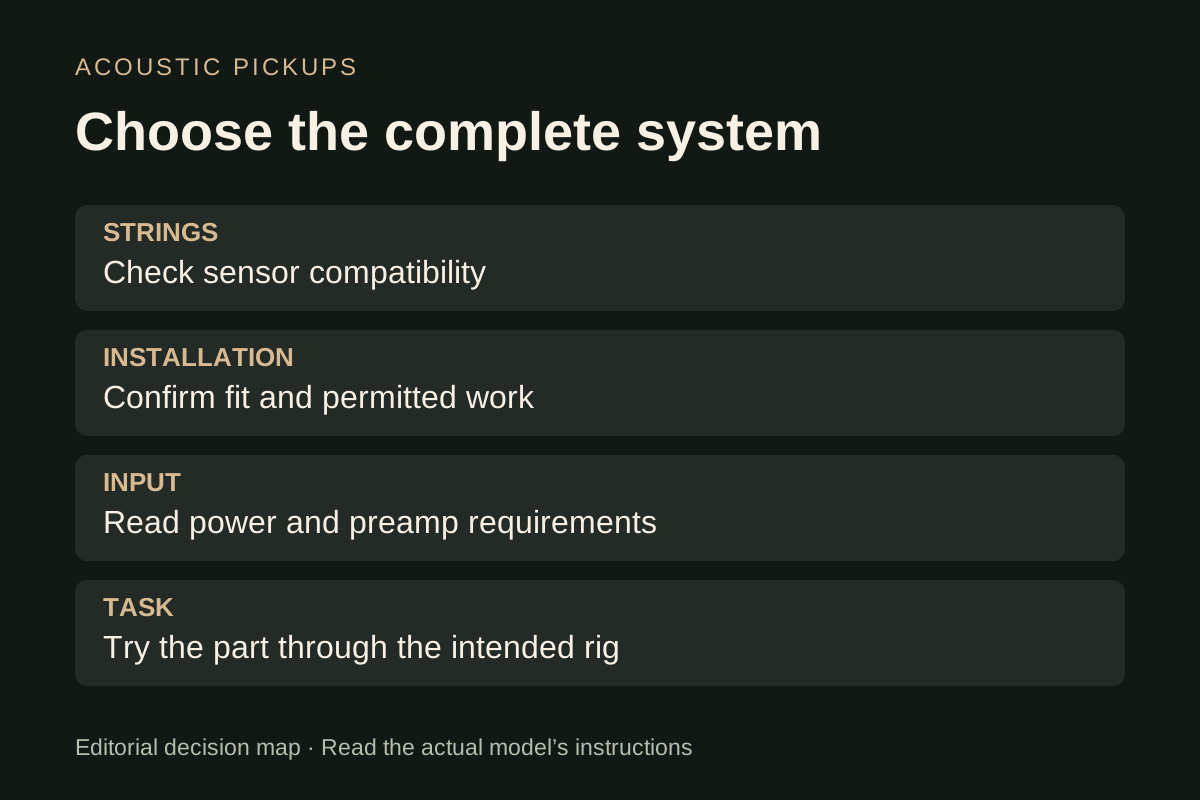
Choose an acoustic pickup system by the guitar’s strings, the permitted installation and the receiving equipment before judging sound descriptions. Compare magnetic soundhole pickups, undersaddle or soundboard transducers and any microphone blend as complete systems. Confirm power and preamp requirements, then try the intended part through the listening path you will use.
Describe the guitar and the listening task first
Write down the guitar model, string family and the actual job: home recording, a quiet amplified performance or playing with a louder group. Include any existing electronics and whether permanent modification is acceptable. An output jack is not a complete description of the system behind it.
If you mainly want a recording in a controlled space, consider whether a suitable external microphone already solves the task. If you need to move while performing, compare installed systems in the intended monitoring arrangement. These are starting questions, not a ranking of all pickups and microphones.
For the underlying terms, read guitar pickups explained. Here the decision is which documented acoustic system fits this instrument and use.
Compare sensing and mounting as separate features
| Route | What the name describes | Check before shortlisting |
|---|---|---|
| Magnetic soundhole pickup | Magnetic sensing at the soundhole | Suitable strings, opening and mounting clearance, power and output |
| Undersaddle transducer | A sensor beneath the saddle | Exact element, slot format, fitting and preamp requirements |
| Soundboard transducer | A sensor coupled to the soundboard | Approved surface, mounting method and receiving input |
| Pickup plus microphone | Two sources combined or routed separately | Power, blend function and supported output connections |
Fishman identifies its Neo-D, Rare Earth and Blackstack soundhole families as magnetic and unsuitable for nylon strings. Its AG-Series is a passive piezo undersaddle example available in several formats. A mounting label alone therefore does not settle compatibility.
Fishman’s SBT description concerns a flat-soundboard mounting context. Its Rare Earth Mic Blend combines a magnetic humbucker with a condenser microphone and a blend control. Those are examples of different system designs, not proof that one route sounds best on your guitar.
Sources: Fishman acoustic FAQ: magnetic compatibility and saddle-slot formats; Fishman AG-Series: passive piezo and preamp guidance; Fishman SBT Series: mounting and preamp context; Fishman Rare Earth Mic Blend: two sources and blend control
Resolve fitting and modification questions before buying
Ask the installer to identify the exact saddle-slot or soundhole requirements, mounting clearance, cable route and output-jack arrangement. Confirm what work is reversible and what would alter the guitar. Obtain that answer for the actual model rather than treating a general product-family label as installation approval.
Fishman’s Matrix FAQ distinguishes narrow, wide and split formats and says the named pickup element cannot be shortened by cutting it. The practical lesson is to order the appropriate format, not to adapt an unknown element by trial and error.
For an undersaddle installation, discuss the completed setup and string-to-string output check with the installer. If one string is markedly weak, record that result before prescribing EQ or a replacement pickup. The saddle fit, installation or another part of the system may need assessment. The bridge guide explains which part is the saddle.
Sources: Fishman acoustic FAQ: magnetic compatibility and saddle-slot formats
Check the power and receiving input as a pair
Passive does not mean the receiving input is irrelevant. Fishman recommends an impedance-matching preamp for its AG-Series while stating that it is not required. That specific guidance does not establish a universal minimum input impedance for every piezo system.
For a powered system, confirm the specified battery or supply, its access and the documented power-off routine. For the whole signal path, identify the pickup output, any preamp or DI, and the amp, mixer or interface input. A DI and a preamp may share a housing, but the label alone does not establish the input the pickup needs.
Read the connection and level requirements of both devices. Start with controlled listening volume and the maker’s gain-setting procedure. The amplifier guide helps distinguish the input, gain and listening output; an acoustic pickup should not be connected to an amplifier’s speaker output.
Sources: Fishman AG-Series: passive piezo and preamp guidance
Use a soundcheck that keeps different problems separate
This is a proposed comparison, not a test performed for this article. Use the intended guitar, string set and listening system. Start quietly, then check the actual musical part at a suitable working level without deliberately driving the system into feedback.
- Establish the route. Record connections, power and control settings. Confirm a clean, usable input level with the receiving device’s instructions.
- Check balance. Play each string with similar effort, then the passage you intend to perform. Note any repeatable weak string or sudden level change. Check that observation again with the same picking effort and a clean input setting; do not use overall EQ as proof that the installation is correct.
- Check the blend. If the system has more than one source, compare supported source settings and record the blend. Similar knob positions across different systems are not a controlled match.
- Check the room arrangement. Include the intended speaker or monitor position. If feedback starts, reduce the level and revise the setup; use only the equipment’s documented controls.
Fishman’s Loudbox manual describes speaker sound exciting the instrument’s air cavity or soundboard. Feedback is therefore a question about the complete acoustic loop. A label such as piezo, magnetic or microphone does not by itself guarantee immunity. A gain or clipping indicator, meanwhile, addresses a different signal-level question.
Sources: Fishman Loudbox Performer manual: acoustic feedback, page 15
Keep a shortlist with unresolved questions visible
| Decision | Record before choosing |
|---|---|
| Instrument compatibility | Model, strings, sensor format and approved mounting |
| Installation boundary | Work, reversibility and completed setup check |
| Electrical path | Power, preamp, output, receiving input and cables |
| Usable result | Passage, controls, balance and monitoring arrangement |
| Open questions | Unverified fit, installation issue or missing documentation |
Choose the option that meets the task with an acceptable installation and a supported signal path. A quiet solo demonstration cannot prove how the system will behave in a different room with monitors. A product description that promises natural sound still needs a practical comparison.
For a new acoustic guitar, test the included electronics as part of the complete instrument rather than assuming a later pickup will resolve the choice. The acoustic buying guide keeps unamplified fit and condition in the same decision.
Frequently asked questions
Will a magnetic soundhole pickup work with nylon strings?
The Fishman magnetic families cited here require ferrous or steel-core strings and are not suitable for nylon strings. Check a documented system intended for the actual nylon-string instrument; undersaddle does not automatically mean every model fits.
Does every passive acoustic pickup need a separate preamp?
No single rule covers every pickup and receiving input. Check the product’s guidance and the receiver. Fishman recommends, but does not require, an impedance-matching preamp for its AG-Series example.
How this guide was prepared
We checked Fishman’s acoustic FAQ, AG-Series and SBT descriptions, Rare Earth Mic Blend specifications and the Loudbox Performer feedback explanation. Named products illustrate distinct requirements, not recommendations or a cross-brand ranking. We did not install or audition these systems. The shortlist and soundcheck are proposed editorial methods; installation and receiving-input compatibility require the actual product documentation.
Documentation checked .