
The decision in brief
A fretless electric bass has no metal frets to set the stopped note’s position. Your stopping position determines pitch, so listening and repeatable hand placement become central skills. Lines or dots can be useful references, but the sound still needs checking. Choose one for the musical part and practice you want to do, then verify the particular instrument’s fit, setup, strings and electronics. “Fretless” does not prescribe one tuning, string type or pickup system.
What matters most
- Fretless pitch needs accurate stopping position and listening.
- Practise a clear landing separately from a deliberate slide.
- Verify the actual bass’s strings, electronics and setup.
What changes when the frets are absent
On a fretted bass, a pressed string contacts a metal fret that defines the stopped position. A fretless bass has no raised frets to provide that reference. Yamaha’s bass-selection guide describes the added intonation demand and the importance of a trained ear.
| Question | Fretted bass | Fretless bass |
|---|---|---|
| Stopped pitch | Metal fret provides the contact position | The player must find the intended stopping position |
| Visual reference | Frets and any position markers | Lines, dots or an unlined board, depending on the model |
| Practice priority | Clean notes, time and muting remain important | Add repeatable pitch placement and controlled shifts |
| Instrument choice | Compare the complete bass and task | Compare the complete bass and task |
Sliding between notes can be an intentional musical effect. It is a separate task from landing a note at the intended pitch. Include both in a trial rather than judging the instrument only from a long slide.
Sources: Yamaha bass-selection guide, printed p. 8: fretless playing and intonation
Use markings as references and listen to the result
Read the maker’s explanation of the lines and side dots on the actual model, then use them as visual references while checking pitch. A marker cannot compensate for an inaccurate stopping position. Ask the seller or instructor to demonstrate where a clear note lands on that instrument.
The visual centre of your finger is not a precise contact-point measurement. Find a comfortable repeatable hand shape, play a stable note and make a small correction while listening. An instructor can help you connect what you hear with the movement you make.
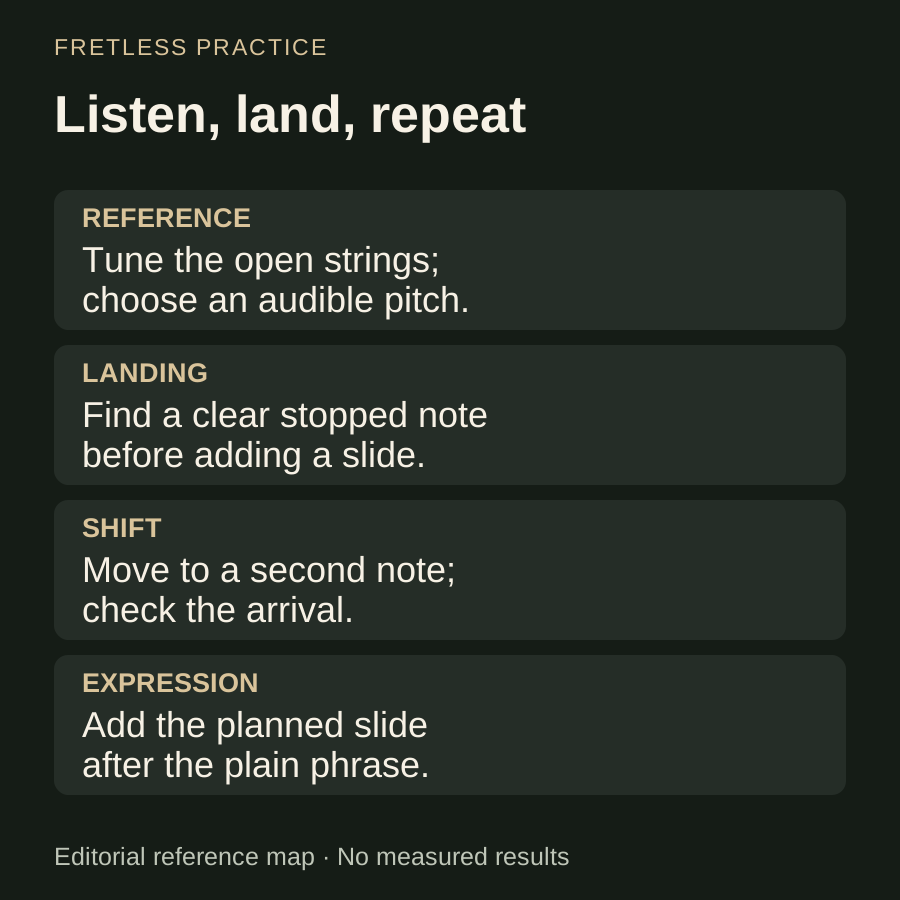
Set up a clean, audible reference sound through an appropriate bass rig. Tune the open strings first and confirm that a tuner can identify the chosen notes reliably. Our tuner guide explains reference pitch, muting and stable readings; use the range and mode suitable for your bass.
Practise a landing before adding a slide
This is a proposed practice routine, not a measured training programme. Use comfortable short sessions and pause if the position feels strained.
- Choose one stopped note and a matching audible reference pitch or drone. Record the reference and the intended tuning.
- Play the note cleanly without sliding into it. Listen first, make a small correction if needed, then use a tuner to check the settled pitch.
- Lift and repeat. Aim to recognise the error and return to the note rather than following the tuner continuously.
- Add a second note and a deliberate position shift. Check the arrival before increasing speed or adding vibrato.
- Play the short phrase in time with rests. Keep unwanted strings quiet and record a take so pitch and timing can be heard separately.
- Finally add the planned slide or vibrato. Compare it with the plain-note version to decide which serves the part.
Use only a clear reference and notes you can hear. This exercise establishes no universal daily duration, acceptable cents error or promised learning speed. Keep the take and your observations as a baseline for the next practice.
Read the actual bass specification
Fretless does not identify the string count, scale, electronics or required set. For a documented example, Ibanez lists its four-string SRH500F as fretless, with a 34-inch scale, E–A–D–G factory tuning from low to high, D’Addario ECB81 flatwound strings and an active piezo tone control. That particular combination is not the definition of a fretless bass.
Confirm the actual instrument’s fingerboard, permitted string types, winding length, fittings and care. A factory flatwound listing does not establish that every fretless requires flatwounds, or that another string will have a particular wear life. Ask the maker or a technician about the actual board and finish before changing a set.
D’Addario’s fit guidance distinguishes its ball-end-to-taper length from the bass’s nominal scale. Check the complete string route. The bass strings guide provides the wider replacement checklist, and the electronics comparison explains the separate power question.
Sources: Ibanez SRH500F: fretless specification, tuning, strings and controls; D’Addario (2021): bass string ball-end-to-taper fit
Separate player placement from setup condition
Fretless does not remove the need for setup or bridge intonation. Repairer Gerry Hayes explains using an octave reference when setting a fretless bass and places intonation after the rest of the setup. His adjustment procedure is service guidance, not a requirement to move saddles during a shop trial.
With permission, try the instrument seated and standing. Play clear notes in several positions, a position shift, rests and the musical phrase you intend to use. Record the strings and the actual sound system. Check controls and power behaviour according to the model instructions.
A troublesome note may involve placement, string condition or setup; one trial does not identify the cause. Ask a technician about unexplained dead notes, grooves, uneven response, uncomfortable action or uncertain adjustment history. Do not copy fretted-bass measurements as automatic fretless targets, and do not use a ruler or adhesive marker on a borrowed instrument without permission.
Sources: Gerry Hayes, Haze Guitars (2016): fretless setup and octave reference
Choose with a practice and ownership record
| Record | What to write down |
|---|---|
| Musical goal | Plain-note part, planned slides and the setting where it will be played |
| Pitch practice | Reference, notes, arrival accuracy and the saved take |
| Fit and condition | Reach, balance, current strings, visible condition and technician questions |
| Ownership | Compatible replacement set, fingerboard care, power and setup support |
A fretted bass can be a more straightforward reference when your immediate goal is learning notes and time. Fretless can be a deliberate first choice if its musical role matters to you and you have suitable teaching or practice support. Yamaha cautions about the additional pitch demand; this conditional recommendation is our editorial judgement, not a tested claim about beginner success.
Use the complete bass buying guide to compare reach, string count and the whole practice system. Choose from the work you are willing to practise and the condition of the particular bass.
Sources: Yamaha bass-selection guide, printed p. 8: fretless playing and intonation
Frequently asked questions
Do fretless basses need a different tuning?
Not inherently. Confirm the actual model and intended setup. The four-string SRH500F example is supplied in E–A–D–G, but the word fretless alone does not establish every instrument’s tuning.
Can a beginner start on fretless bass?
It adds a pitch-placement task to timing, muting and learning notes. A beginner may choose it for a clear musical goal with appropriate support; a fretted bass offers a more direct pitch reference. Try both and discuss the learning plan with an instructor.
How this guide was prepared
We read Yamaha’s fretless overview, the current Ibanez SRH500F specification, Gerry Hayes’s fretless-intonation explanation and D’Addario’s bass-string fit guidance. The named bass is a specification example, not an instrument we inspected. Practice and buying checks are editorial proposals; no learner outcomes, fingerboard wear rates, listening trials or physical setup work were tested. Source advice is separated from our recommendations and no human expert reviewer is claimed.
Documentation checked .