Start with the task
A string tree guides selected strings between the nut and tuning posts and can increase their downward break angle at the nut. Whether a guitar needs one depends on its actual headstock and post layout. For tuning problems, inspect the full string path and record the symptom before changing a guide; a string tree is not a universal tuning upgrade.
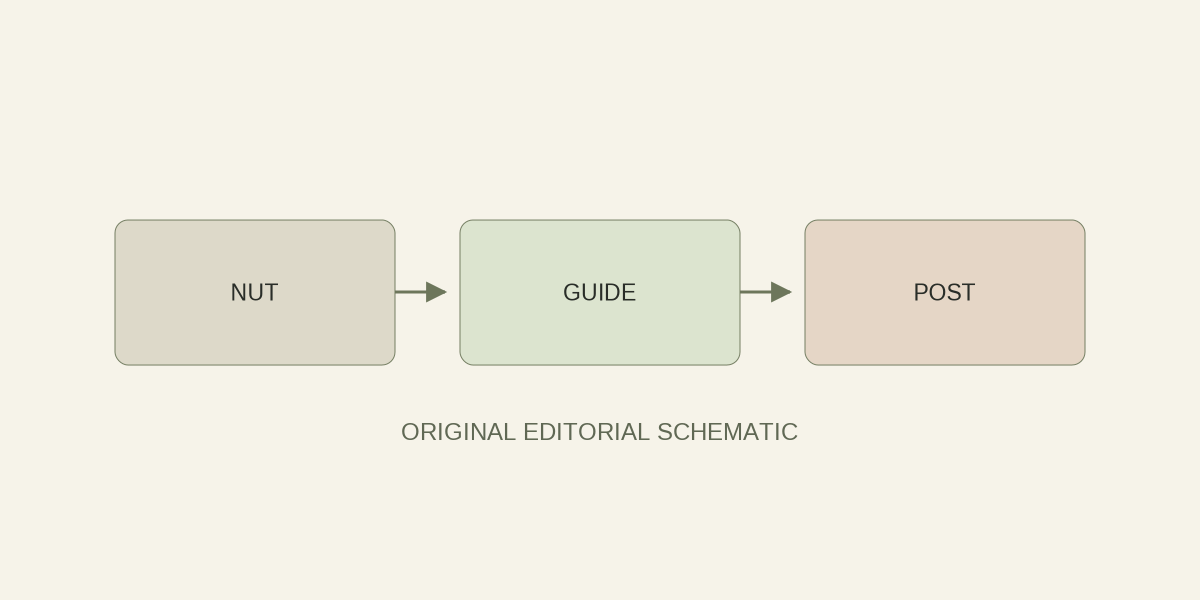
Trace the string from the nut to its tuning post
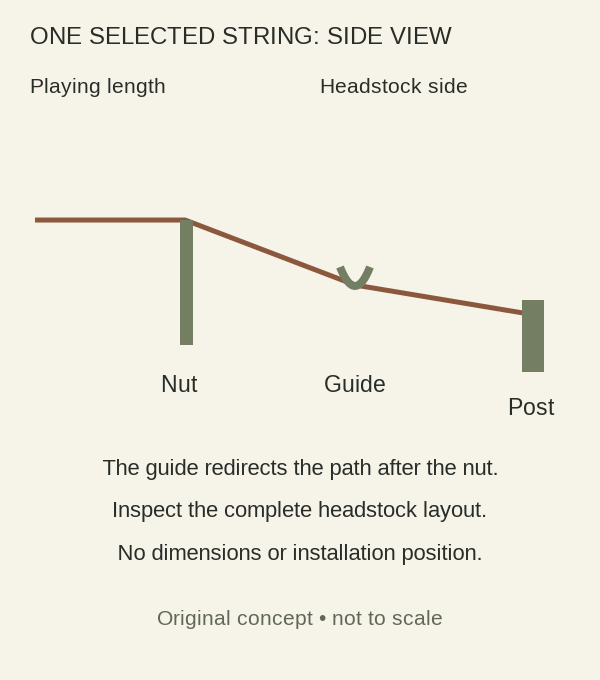
A string tree is also called a retainer or guide. Fender describes its use on flat Fender-style headstocks to increase the angle of selected strings after they leave the nut. Look at that section of the actual string path before deciding what a small piece of headstock hardware does.
The playing length runs on the other side of the nut toward the bridge. A diagram of the headstock path does not specify how hard the guitar will feel under the fingers. Keep pitch, string set, scale length and setup separate from the guide’s geometry.
This guide does not turn additional break angle into a promised increase in sustain or tuning stability. The drawing shows the relationship of contact points on one selected string; it is neither a measured model nor a placement plan.
Read the headstock and post layout together
Fender’s explanation contrasts its familiar flat-headstock arrangement with angled-headstock designs that can supply the needed path without the same separate guide. That is a reason to inspect the complete geometry, not to add a tree to every guitar without one.
| Feature | What to record | What it does not prove |
|---|---|---|
| Headstock | Actual design and existing guide arrangement | A universal required guide count |
| Tuning posts | String-hole positions and any staggered heights | That every guide can be removed |
| Nut | String seating and existing condition | A diagnosis from a photo alone |
| Guide | Contact surface, height and mounting | A drop-in replacement from its outline |
Staggered posts and locking tuners describe different features. A locking mechanism retains the string at the post; it does not by itself approve a different path over the nut. Keep the instrument maker’s required guides in the route while evaluating a replacement set.
Keep the nut, guide and bridge in the tuning check
Fender’s Telecaster setup guidance treats stringing, string condition and contact-point care as separate parts of tuning maintenance. It includes string trees among the contact points. These instructions are model context, not proof that every pitch change begins at a guide.
A ping near the headstock, a jump in pitch or a failure to return after a bend is an observation to record. String seating, the nut, guide, post and bridge can all need attention. A noise heard near one component cannot isolate the cause without examining the instrument.
Follow care instructions appropriate to the exact instrument, finish and hardware. Do not apply a general lubricant, file a contact surface or tighten screws harder simply because a symptom appears. Keep uncertain maintenance with a qualified repairer.
Sources: Fender Support: Telecaster stringing and contact-point care
Record one action and its repeatable result
- Identify the guitar, string set and current guide arrangement. Note recent restringing or hardware work.
- Tune with the same reference and a consistent light attack. Record which string is being checked.
- Make one normal musical action, such as the bend or vibrato use that precedes the problem. Do not pull aggressively on a string to provoke a result.
- Let the note settle and check the open string again. Record the direction of the change rather than calling the guide defective.
- Repeat under comparable conditions and keep the result with any accompanying noise, binding or visible damage.
This is a proposed observation routine, not a test performed here. No universal cents threshold is assigned. If the tuner gives an unstable reading, first check the tuner input and display guide. If only fretted notes disagree, the intonation guide addresses another problem.
Check replacement requirements before ordering
Compare the exact existing part with the proposed replacement: supported strings, contact geometry, height or spacer, base footprint, screw arrangement and the intended string path. Ask for the maker’s drawing when dimensions matter. Similar photographs or the same marketing label do not establish that the existing hole and height will suit.
A replacement screw must also be appropriate for the instrument and part. Do not drill another hole, force a longer screw or use the conceptual diagram as a cutting template. If preserving the headstock matters, resolve reversibility with a repairer before buying.
After approved work, evaluate the same musical action again. If strings, the nut or bridge setup changed at the same time, the result belongs to the combined work; it cannot establish a string-tree-only improvement.
Choose the next action from the recorded problem
| Situation | Useful next action |
|---|---|
| Working original system | Keep it unless a specific need is established |
| Damaged or visibly worn contact | Have the actual part and string path assessed |
| Changing tuning machines | Verify post geometry and retain required guides |
| Repeated tuning drift with no cause | Bring the string-by-string record to a repairer |
Use the locking-tuner comparison when the job is string retention at the post, and the restringing guide when installation or settling remains uncertain. Treat the guide as one part of a complete instrument, with no automatic reason to replace a working component.
Download the blank record (English CSV). The fields are empty; the sheet contains no site test results.
How this guide was prepared
AI-assisted review of Fender’s string-tree explanation and Telecaster setup guidance on 26 November 2026. We separated their headstock/contact-point descriptions from broad tone claims. The geometry sketch, tuning observation routine and replacement checklist are editorial aids; no installation, friction measurement, sustain test or human technical review was performed.
Documentation checked .