The decision in brief
Locking tuners clamp the string at the post and can simplify string changes by reducing winding. Functioning standard tuners remain a reasonable choice when you can install strings securely. A locking post does not clamp the nut or bridge, so it cannot guarantee stable tuning across the whole guitar. Check the stringing instructions, the cause of any drift and replacement dimensions before deciding.
What matters most
- Choose the locking feature for a useful string-changing routine, with model-specific instructions.
- Record recurring tuning drift before assuming the machine heads cause it.
- Check every relevant mounting dimension and preserve reversibility before replacing parts.
The mechanical difference is at the string post
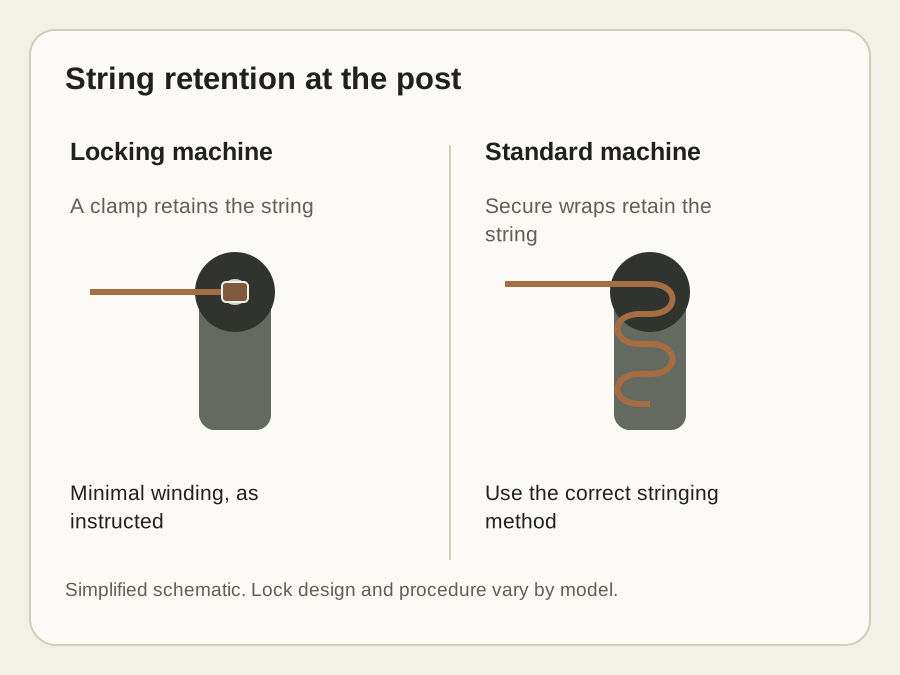
A locking tuning machine retains the string with a clamp at its post. The clamp may use a rear thumbwheel, a top mechanism or a self-locking design. Turning the tuning button still changes string tension. The lock does not hold a note at a fixed pitch.
A standard machine uses its intended stringing method to secure the string around the post. Fender’s Telecaster instructions distinguish standard, locking and vintage split-post keys. Follow the method for the fitted design.
A locking nut clamps near the nut, at another point in the string path. Fender’s locking-tremolo guidance describes systems with different nut and tuner arrangements. Installing locking tuners alone does not reproduce a double-locking system.
Locking tuners mainly change the string-changing process
Fewer winding steps can make string replacement more convenient. The benefit depends on the design and your existing stringing routine; there is no measured time saving reported here.
For the thumbwheel type in Fender’s instructions, the string is pulled taut, clamped and tuned. GOTOH’s SG Magnum Lock MG manual instead describes a self-locking mechanism and requires less than one turn around the post for that design. MG and MG-T are different variants; a generic wrap count or tightening procedure should not replace the correct manual.
Before removing a string, reduce its tension. Caparison’s MG-T instructions specifically warn against releasing the string lock under tension. Seat and settle new strings gently according to the guitar and string makers’ guidance. Avoid forcing a clamp or pulling aggressively on a string.
Tuning stability is a complete-system result
The clamp addresses string retention at the post. It leaves the nut, string guides, bridge and strings in the system. Fender’s setup guidance treats winding, new-string settling and contact points as separate matters; it does not establish that replacing the tuners cures every source of drift.
| Observation | What to check next | What the lock changes |
|---|---|---|
| String slips at the post | Stringing method, clamp engagement or worn parts | May address post retention if fitted and used correctly |
| Pitch jumps or a ping is heard near the nut | String seating and nut or guide friction | Does not change the nut slot |
| Several strings move after vibrato use | Bridge return and setup, as well as the string path | Does not set spring balance or repair a pivot |
| New strings drift after tuning | Seating and settling procedure | Does not replace that procedure |
| Open strings agree but fretted notes sound wrong | String condition, fretting pressure and intonation | Does not set saddle compensation |
These observations guide inspection; they do not identify a cause by themselves. Record the affected strings and the action that precedes the change. For persistent binding, visible damage or uncertain adjustments, have the actual instrument assessed.
Compare gear feel, weight and ratio separately from the lock
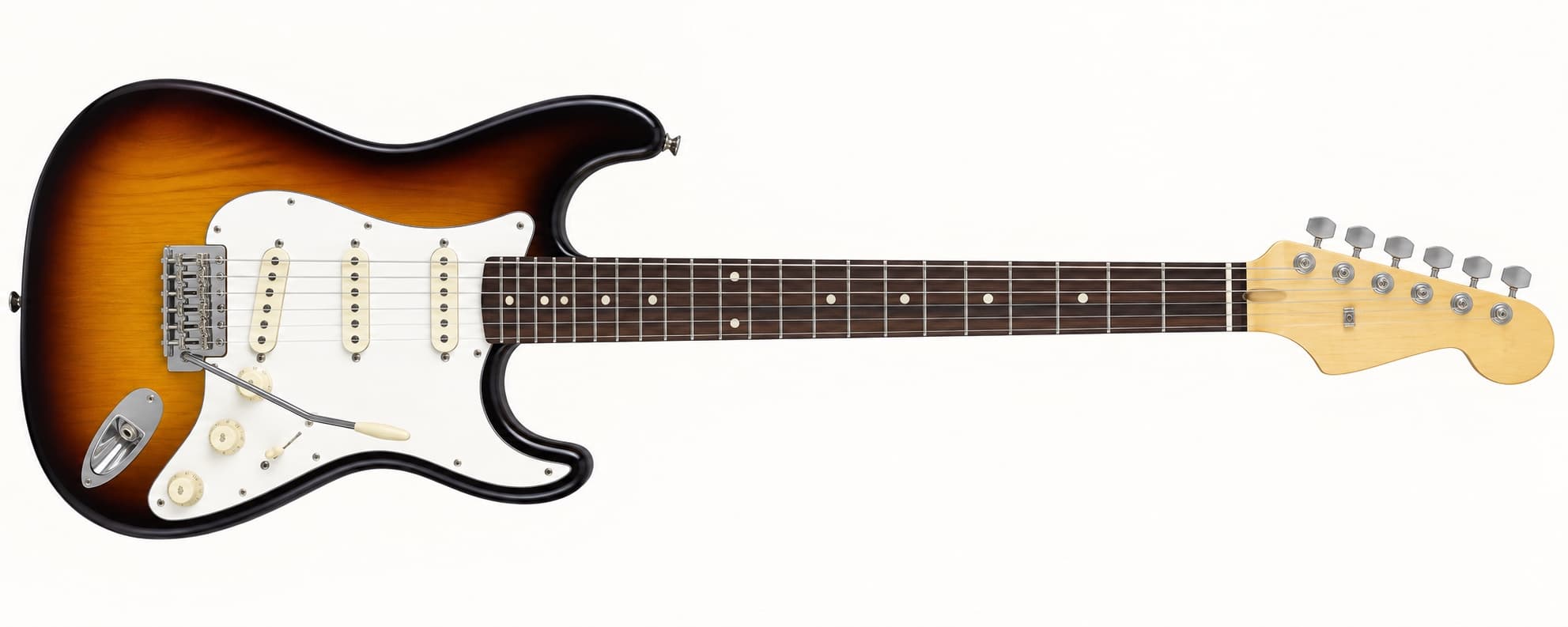
Compare the actual models for button feel, gear response, mass and post height. A lock is one feature and does not establish the quality of the gears. Gear ratio expresses button turns per post revolution; it is separate from the clamping method.
GOTOH’s MG-T drawings show several post options and gear ratios across that family. They illustrate why the model code matters. Confirm the currently supplied variant rather than treating one ratio or post length as universal.
Use complete-set weights including the relevant hardware when comparing balance. The presence of a clamp alone does not tell you the weight difference. Staggered post heights are a separate geometry choice; retain a suitable path over the nut and any required string guides.
Choose by use case rather than upgrade status
| Your situation | Decision | Condition |
|---|---|---|
| Frequent string changes; winding is inconvenient | Consider locking tuners | Correct procedure and verified fit |
| Standard tuners work smoothly and strings stay secure | Keeping them is reasonable | No unresolved damage or installation issue |
| Recurring drift with no established cause | Inspect before buying parts | Record the symptom and string path |
| Worn or damaged tuning machines | Replace with compatible parts | Choose the locking feature separately |
| Preserving original appearance and holes matters | Prioritize a reversible replacement | Confirm dimensions and retain original parts |
Compare the total replacement cost, including any required fitting, with the convenience you will use. A working standard set does not need replacement solely because it lacks a clamp.
Verify fit before retrofitting a guitar
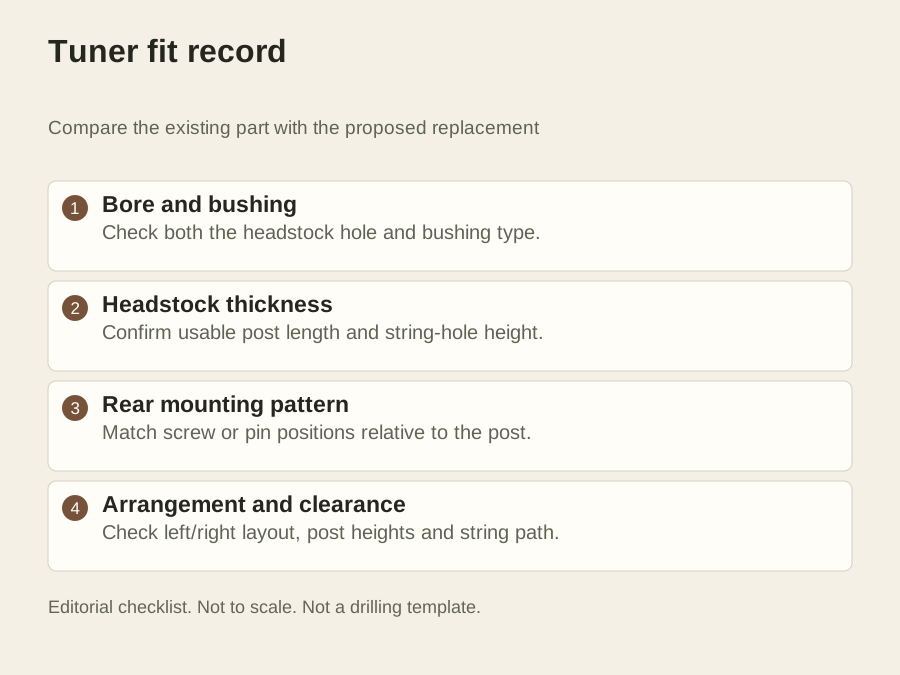
Identify the existing machine and the proposed replacement. Compare the headstock bore and bushing, headstock thickness, string-hole height, rear screw or locator-pin positions, left/right arrangement and clearance. Similar appearance or the same bore diameter does not establish a direct fit.
Schaller’s M6 Pin page gives a useful example: some designs share pin spacing while differing in the distance from the pins to the post. Its drawing supports checking both relationships, not a universal fit claim.
Keep a small record with the existing measurement, proposed specification, source drawing and pass/unresolved result for each feature. This is an editorial compatibility method, not a drilling template. If a required dimension is unavailable, ask the hardware maker or a repair technician before ordering.
New holes or enlarged bores are permanent changes. GOTOH’s installation manual warns that forced screws and excessive tightening can damage the finish or headstock. Do not drill, ream or force a mismatched set into place. Follow the actual model’s installation procedure or arrange qualified fitting.
Test the installation before judging the upgrade
Use a repeatable observation record to check function. This method is a suggested owner check; we have not performed an installation or measured tuner performance for this article.
- Record the tuner models, strings and their age, tuning, bridge state and any setup work.
- Install and settle strings using the applicable instructions. Keep the guitar in its normal playing position.
- Use the same pitch reference and a clean, sustained pluck. Record the open-string reading before and after an ordinary bend or the vibrato movement you actually use.
- Repeat to see whether the change recurs. Note which strings move and in which direction.
- Check fretted-note problems separately. Stop for damage, binding or a slipping clamp and seek repair advice.
If you change strings, adjust the nut or set up the bridge while replacing tuners, any improvement belongs to the combined work. That observation cannot isolate the benefit of the clamp. See the intonation guide when open-string and fretted-note results differ.
When this comparison changes
A headless instrument, proprietary hardware or a double-locking vibrato needs its own retention and setup instructions. For systems with a locking nut, Fender’s guidance includes nut clamps and bridge fine tuners; those steps should not be transferred to an ordinary locking machine head.
Strings, tuning, bridge adjustments and environment can change the result between checks. Caparison’s owner’s manual notes bridge implications when gauge or tuning changes and care around sudden temperature changes. Repeat observations under comparable conditions and avoid attributing every change to the tuner design.
Conclusion: buy locking tuners for convenience, then verify the whole system
Choose locking tuners when their string-changing convenience solves a need and the exact set fits the guitar. Keep working standard tuners when their stringing method and adjustment feel suit you.
For tuning drift, check the complete string path and record the symptom before choosing a replacement. Verify compatibility without permanent trial-and-error modifications. After any work, confirm both ordinary use and the actual playing conditions that prompted the decision.
Frequently asked questions
Does a locking tuner lock the note in tune?
The lock retains the string at the post. The button and gears still change tension, while the nut, bridge, strings and setup continue to affect tuning behavior.
How many wraps should a locking tuner have?
Use the instructions for the actual model. GOTOH SG Magnum Lock MG specifies less than one turn; other designs have their own stringing procedure. Do not transfer that instruction to every locking tuner.
Is matching the headstock hole enough for a direct replacement?
No. Check the bushing, headstock thickness, string-hole height, rear screws or pins, orientation and clearance. Two machines can share one dimension and differ in another.
How this guide was prepared
This documentation-based comparison checks Fender stringing and locking-tremolo guidance, GOTOH MG/MG-T documents, Schaller fit details and Caparison’s owner’s manual. Manufacturer procedures apply to the named designs. The compatibility record and repeatable pitch observation are editorial decision aids; no instrument installation, timing comparison, weight measurement or controlled tuning-stability test was performed. Images are illustrative and do not establish fit or measured performance.
Documentation checked .
Clarified model-specific stringing, clamp versus locking-nut function and symptom limits; added a compatibility record and an owner observation method; checked sources and corrected image descriptions.