Start with the question
A pickup’s DC resistance is a resistance reading, usually written in kΩ; it is not a direct measurement of output level. Use it alongside the exact pickup design, wiring state and measurement point. A reading at a passive guitar’s output jack can include the connected controls, so it need not equal a disconnected pickup’s specification. Neither a high number nor a plausible reading proves the sound, output or complete health of the pickup.
What matters most
- Keep kΩ, model, coil mode and measurement point together.
- An installed circuit can change a jack reading.
- DCR alone cannot rank output or certify pickup health.
Read the unit and exact pickup identity
One kilohm is 1,000 ohms, so 8 kΩ means 8,000 Ω. Keep the unit with the value and note whether it comes from a specification or your own meter. A quoted “8” without a unit, pickup position or model is not a reliable comparison.
Seymour Duncan explains that wire gauge, wire length and construction affect DCR. Its examples show why a finer wire can raise resistance without providing a matching rise in output, and why different pickup constructions cannot be ranked by resistance alone. Treat that as a maker’s explanation of design variables, not a universal listening ranking.
Before comparing specifications, record the model and revision, neck or bridge position, coil format, and whether the value describes the full pickup or a selected coil mode. The mini-humbucker comparison and HSS/SSS guide explain different design and switching questions; those labels do not make two resistance values directly comparable.
Name the measurement point before interpreting it
| Point | What is included | Limit |
|---|---|---|
| Disconnected pickup leads | Selected coil connection | Use that pickup’s wiring sheet |
| Passive guitar output jack | Selected pickup and connected guitar circuit | Controls and switching may affect the result |
| Powered or unfamiliar circuit | Unknown without its documentation | Do not apply the simple passive model |
Seymour Duncan distinguishes measuring from an output cable connected to the guitar from measuring a pickup that is not installed. The second method removes the rest of the guitar electronics from the reading. Its jack method calls for selecting the pickup and setting guitar volume fully up. Those conditions matter when you compare notes.
For an ordinary documented passive guitar, disconnect the guitar from amplifiers, pedals and interfaces before resistance checks. Follow the meter’s resistance-measurement instructions and the pickup maker’s procedure. Keep the selector and controls with the reading. This page does not provide a procedure for active pickups or powered circuits.
Do not open or desolder a satisfactory guitar just to make its reading match a catalogue number. If a technician needs an isolated coil measurement, retain the exact wiring information and let them decide how to obtain it. A jack reading is useful context, but it is not automatically the same measurement as a loose pickup specification.
Sources: Seymour Duncan: output-jack and pickup-lead resistance measurements
Calculate one deliberately simple loaded reading
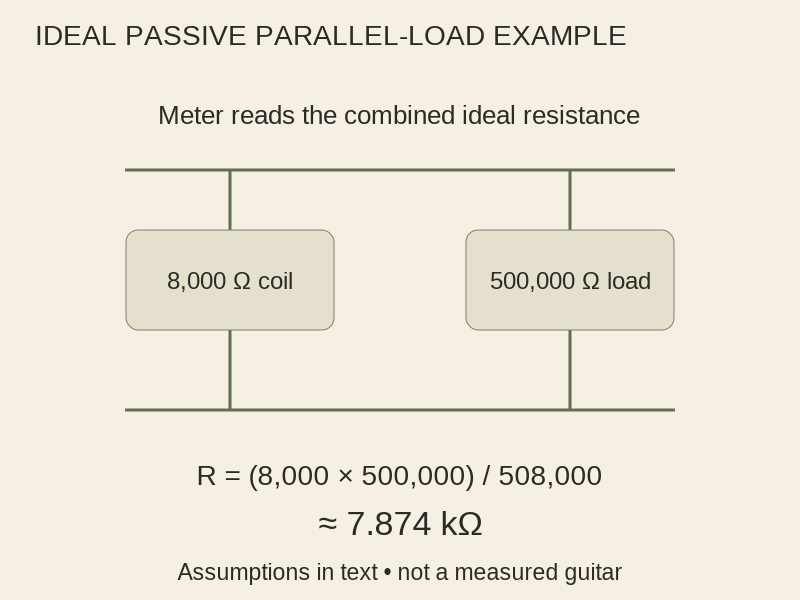
Consider a hypothetical passive circuit with an 8,000 Ω pickup resistance and a 500,000 Ω volume resistance directly across it at full volume. Ignore the tone branch, meter loading, cable resistance, tolerances and every other component. These assumptions define the example; they do not identify your guitar.
Two resistances in parallel give R = (R₁ × R₂) / (R₁ + R₂). Here that is (8,000 × 500,000) / 508,000 = 7,874.02 Ω, or about 7.874 kΩ. The lower reading follows from the stated parallel connection even though the hypothetical coil itself remains 8 kΩ.
The difference is about 126 Ω, or 1.57% of the assumed coil resistance. It is not an acceptable-tolerance rule or a correction factor to apply to every instrument. Another control value, switch position or wiring scheme changes the circuit. Use the calculation to ask what is connected before concluding that the pickup is faulty.
Separate a resistance check from an output comparison
If your real concern is one pickup sounding too loud beside another, write that complaint down separately. Record the pickup selection, coil mode, height and measurement method, guitar controls and amp input settings. Changing several of these at once makes the reason for a difference harder to identify.
For a proposed listening comparison, use the same short passage and fixed amplifier input condition first. Note balance, unwanted clipping and control response. If you later compare recordings at similar playback loudness, record that adjustment separately; playback matching answers a tone-preference question without preserving the original output difference.
A magnet family also leaves other construction variables unknown. The Alnico/Ceramic guide treats the whole pickup rather than using a material or a resistance number as a quality score. No guitar audition or output measurement is reported here.
Keep a useful reading and its limits
| Record | Detail |
|---|---|
| Identity | Exact model, position and documented specification |
| Circuit | Passive/active status, wiring and selected coil mode |
| Conditions | Measurement point, control positions and meter range |
| Reading | Value and unit, plus whether the observation repeats |
| Remaining task | Reading discrepancy, output balance, noise or tone preference |
If a reading is unexpected, check the measurement setup and documented circuit before buying a replacement. An open connection or an unfamiliar meter display needs interpretation; no single number in this article supplies a complete fault diagnosis.
A repeatable, plausible DCR reading still does not prove the absence of intermittent faults, unwanted noise or other problems during playing. Keep the symptom and reading as separate evidence when seeking qualified help. The useful result is a clear record of what was measured, rather than a hotter-versus-better ranking.
Download the blank English record (CSV). The sheet contains no completed observations or site test results.
How this guide was prepared
Seymour Duncan’s DCR explanation and its output-jack versus lead-wire guide were checked. The ideal 8 kΩ coil with a 500 kΩ parallel load is an editorial circuit calculation, not a named guitar or measured sample. This guide avoids desoldering instructions, universal resistance targets and claims that one reading certifies pickup health.
Documentation checked .