The decision in brief
A short-scale bass commonly has a nominal scale around 30 inches, compared with the familiar 34-inch long-scale reference. Its closer fret spacing can reduce some stretches. Whether the whole bass is comfortable also depends on where the nut sits relative to your body, neck dimensions, balance, strings and setup. Compare the same passages seated and standing, then check the lowest string through your usual rig. Before buying replacement strings, identify the bridge route and required winding length; the bass's scale label does not establish which set will fit.
What matters most
- Short scale describes the nominal vibrating length, not overall bass size or weight.
- Closer frets can help a stretch while first-position reach still depends on the whole instrument.
- Compare string feel with tuning, construction and setup recorded.
- Check bridge routing and winding length before ordering replacement strings.
Read short scale as a dimension, not a player category
Fender identifies about 30 inches as a common short-scale bass reference, 34 inches as the established long-scale reference and around 32 inches as medium scale. Makers also use other dimensions and labels. Read the exact model specification instead of assuming every instrument described as compact shares a scale.
The nominal scale governs the fret layout along the vibrating string. It does not state the total instrument length, weight, fret count or neck width. A shorter scale can therefore exist on a bass that still has a substantial body or a neck shape you dislike. It is a useful selection filter when a particular stretch is the problem, but it cannot summarize the complete fit.
Adults and experienced players can choose short-scale instruments for their own musical and physical preferences. The dimension does not establish a beginner-only format or lower quality tier. Begin by naming the passage or playing condition you want to improve. That gives the shop tryout a purpose beyond selecting the smallest-looking bass.
Sources: Fender: Short-scale bass dimensions and fret spacing
Separate fret spacing from where the neck sits
For a conventional twelve-tone equal-tempered fret layout with an uncompensated nut, measure along the selected string path from the nut's contact edge to the center of the 12th-fret crown and double that distance. Individual saddle compensation is separate from this nominal reference. Use the maker's reference method for compensated nuts, zero frets or other unusual layouts, and check multiscale strings individually. Our scale measurement guide explains the distinction.
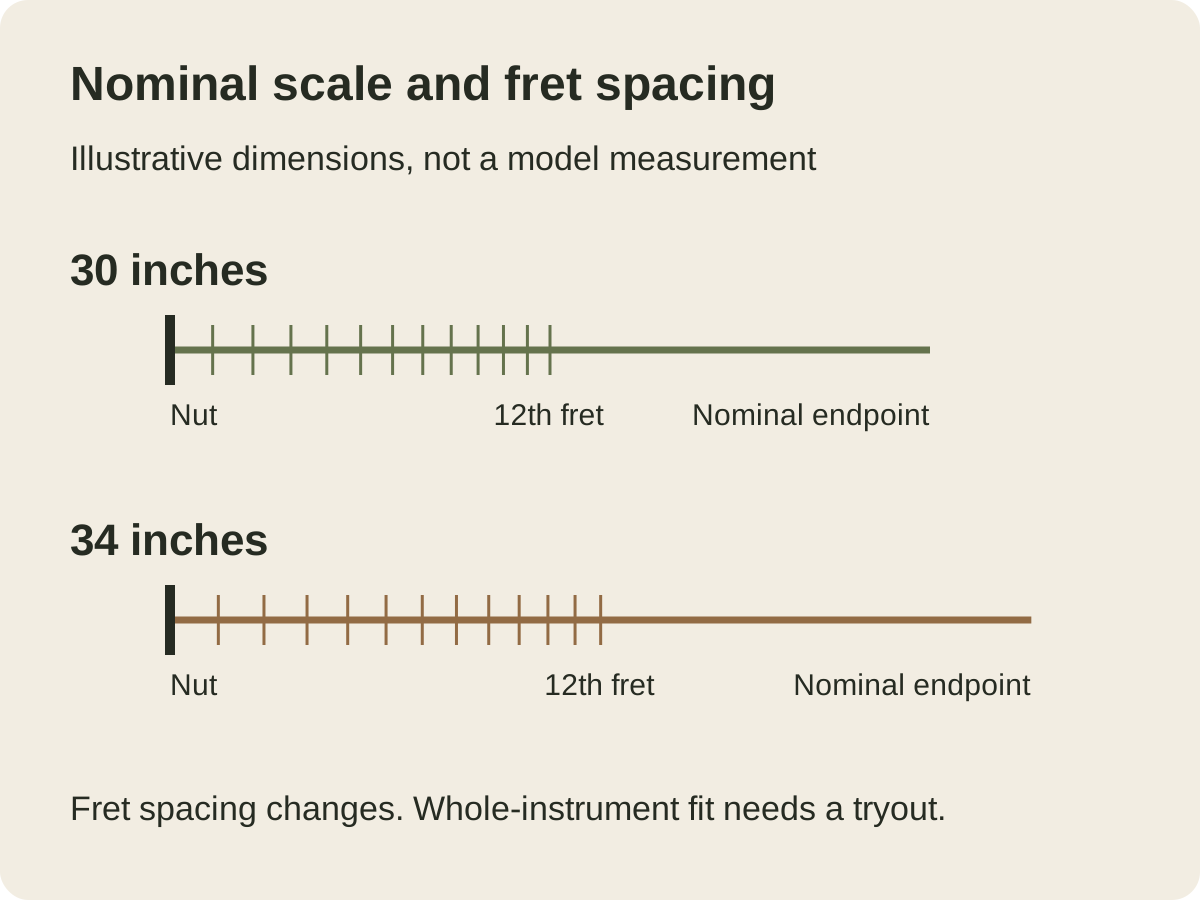
The fret positions are closer together on a shorter scale. This can reduce the distance a fretting hand spans within a low-position pattern. The location of that pattern relative to your shoulder is a separate question. Body shape, neck joint, strap-button placement and the position the bass naturally takes can leave the nut farther away than its small fret spacing suggests.
Compare the basses in a realistic playing position. Set the strap height you expect to use rather than copying the shop display. Reach to the first fret without supporting the neck with your hand. Then try the particular interval or shift that prompted the search. Note both the reach to the position and the spacing inside it; improvement in one does not guarantee improvement in the other.
Compare the whole fit in the same session
| Observation | What short scale changes directly | What the model still determines |
|---|---|---|
| Fret spacing | A shorter nominal length places frets closer | Neck width, profile and string spacing |
| First-position reach | Scale can contribute to reduced reach | Nut position relative to your body and strap height |
| String response | Less ideal tension for the same string (mass per unit length) and pitch | Installed strings, tuning, action and relief |
| Carrying and balance | No fixed weight or balance follows from the label | Complete instrument dimensions, mass and strap behavior |
| Replacement strings | The speaking length is shorter | Anchor path, winding length, ends and taper |
Play a passage crossing strings as well as a low-position stretch. A narrow neck or close spacing may help one task while making clean muting less familiar. Check whether the thumb and wrist can move freely. Try a comfortable shift when useful instead of forcing every note of a wide pattern under a stationary hand.
After the seated check, stand with the normal strap. If the neck falls when the fretting hand relaxes, the hand may be doing support work in addition to playing. A short scale alone cannot eliminate that problem. Compare another body or strap arrangement and seek instruction if your technique is contributing to strain. Persistent pain deserves an appropriate professional assessment, not a promise that one instrument dimension will cure it.
Sources: D’Addario, January 2026: String tension variables and calculation
Keep the tension comparison conditional
In the ideal string relationship, a shorter vibrating length requires less tension when the string’s mass per unit length and target pitch stay the same. That describes a controlled relationship. Two shop basses seldom differ only in length: one may carry heavier strings, a different winding or a setup with higher action. Their playing response therefore cannot be assigned to scale alone.
If a candidate feels too yielding under your normal attack, first record the installed set and tuning. Ask about approved alternatives and the setup they may require. If it feels unexpectedly stiff, compare action and neck relief as well as strings. A gauge number gives diameter, not a complete prediction of the effort or flexibility you will experience.
A useful comparison keeps two questions separate. Does this complete bass feel better for the task you play? Which changes might reproduce that improvement? The first can be answered by a relevant audition. The second needs a controlled comparison and product-specific string information. The bass string guide covers construction and winding choices in detail.
Sources: D’Addario, January 2026: String tension variables and calculation
Listen to the lowest string in a real phrase
Use the same amplifier or interface and a similar listening level for each candidate. Begin with a familiar setting, then play the lowest notes using your ordinary finger or pick attack. Include a sustained note, a moving line and a rest that reveals muting. Note whether the onset, sustain and pitch remain useful in the music you actually play.
A strong attack can create a different result from a gentle shop demonstration. A bass that seems comfortable in isolated notes may require a change in touch during a faster line. That is a trade-off to assess, not proof that short scales are unsuitable for a genre. Try the musical task before assigning labels such as vintage, modern or weak.
Keep expectations bounded when comparing different models. Pickups, controls, string age and the monitoring system also affect what you hear. If the sound is unclear, inspect the playing and setup before blaming the dimension. Do not promise a fixed low-frequency response or an automatic tonal improvement from a nominal scale number.
A 30-inch bass does not identify the replacement set
The usable string path extends beyond the vibrating section. A through-body route, tailpiece or other anchor arrangement can add distance before the saddle. D’Addario's fit guidance measures from the ball seating point to the taper and asks buyers to establish the anchor-to-nut distance. Use the exact string maker's fitting definition and product instructions.
La Bella provides a concrete model boundary: its STANG set is intended for vintage through-body Fender Mustang basses and is not specified for newer top-loading Mustang bridges. The maker directs top-loading models to its short-scale sets. That example shows why a familiar bass family name and short nominal scale cannot replace the bridge check. It is not a recommendation of a set for an unidentified bass.
Record the instrument revision, bridge route, accepted end fitting and current string code before ordering. Ask where the full winding and taper must sit on the saddle, nut and post. Do not cut a long-scale set merely on the assumption that any excess length is expendable; string construction and preparation instructions can differ. Retain a working replacement specification once fit is established.
Sources: D’Addario: Bass string winding length and taper measurement; La Bella: STANG through-body and top-loading fit boundaries
Use a focused seated and standing tryout
- Name the problem: a first-position reach, an awkward span, string response or carrying burden.
- Record the scale, neck dimensions where available, strings and tuning of each candidate.
- Play the same low-position phrase seated, with the instrument supported naturally.
- Repeat it standing at the strap height you normally use.
- Play across strings and include shifts, rests and the attack used in the actual arrangement.
- Check the lowest string through the same rig at a similar listening level.
- Confirm replacement strings, case fit and service access before choosing.
Do not redesign your whole technique between candidates simply to make a preferred bass win. A comfortable shift is part of normal playing, but a raised shoulder, locked elbow or hand constantly holding the neck up deserves attention. Note the position and passage where the issue appears so the next comparison can answer it.
If the shop allows a longer trial, repeat the passages after an ordinary practice period. An immediate impression can differ from how the instrument behaves over a session. Describe what you observed and the conditions, without converting one player's experience into a universal comfort score.
Worked example: closer frets with a remaining reach problem
Consider a hypothetical player comparing a 30-inch candidate with a familiar 34-inch bass. Seated, the closer frets make a low-position pattern easier to span. Standing, the candidate's neck settles farther to the left and the player keeps lifting it with the fretting hand. The first observation supports a spacing benefit; the second identifies a remaining support and reach problem.
The next step is to compare the natural position, strap arrangement and another model with similar spacing. Buying the first candidate solely because it is short would leave the original playing task partly unresolved. If the player usually performs standing, the standing result deserves greater weight than a brief seated advantage.
Suppose another candidate remains comfortable in both positions but feels too yielding under the player's strong attack. Record its strings, tuning and setup, then ask whether an approved alternative set and setup can address that response. Confirm the replacement fit before treating the proposed string change as a solution. A suggestion from the shop is not yet an observed result.
Choose when the important passage improves in the position actually used, the lowest-string response works through the rig and the remaining ownership requirements are manageable. If only one of those conditions is established, arrange the missing trial or compare another bass. The example illustrates a decision method; it is not a report of tested instruments or a promise about either scale.
Check the delivered condition and ownership details
Short-scale dimensions do not excuse poor fretwork, unstable tuning or an unsuitable setup. Play every string across the positions you use, inspect the neck and hardware, and check controls through the intended system. If a used bass has altered hardware, verify that the bridge, neck and strings remain compatible. A technician should assess uncertain structural or adjustment issues.
For a remote purchase, ask for the exact model revision, scale, bridge route, installed strings and included case or bag. Confirm whether a weight figure is measured on the particular unit or a nominal listing. Smaller nominal scale does not establish that it fits a particular case or is lighter to carry.
Retain the manufacturer's care and setup instructions. A change in string set or tuning can require relief, action and intonation checks. Follow the instrument's procedure or arrange service rather than applying adjustment dimensions from another bass. The setup guide supplies an inspection order, not model-specific bass tolerances.
When the advice changes: low tunings and specialist basses
For a lower tuning, start with the target notes and approved string options. The conditional scale-and-tension relationship still applies, but the installed set and intended response become central. Evaluate the actual lowest note through the performance rig. A short scale is neither an automatic exclusion nor a guarantee that a conventional set will work.
A multiscale bass assigns different lengths to different strings. Compare its actual layout rather than describing it with one short-scale number. Headless or proprietary systems also need their own string ends and preparation instructions. The ordinary ball-end examples cannot establish those replacements.
A fretless instrument, acoustic bass or unusually small bass may need another measurement or string category. Identify the maker's intended system first. For a player seeking relief from pain or a medical limitation, an instrument tryout can inform a choice but cannot replace appropriate care or technique assessment.
Conclusion: buy the improvement you can demonstrate
Choose a short-scale bass when its closer spacing and complete physical arrangement help the passage and playing position you need. Confirm that its string response, sound and muting remain workable through your rig. Then establish a replacement set that fits the exact bridge route.
Keep a brief record of the problem, observed improvement, remaining compromise and ownership requirement. If the improvement is only cosmetic or disappears when you stand, compare another candidate before treating scale as the answer. The bass buying guide covers the broader register, electronics and amplification decision.
Frequently asked questions
What scale length is a short-scale bass?
Around 30 inches is a common reference, while 34 inches is a familiar long-scale reference and around 32 inches is often called medium. Labels and models vary, so read the exact nominal scale specification.
Is a short-scale bass easier for small hands?
Closer fret spacing may help some stretches. Neck width and profile, string spacing, setup and the nut's position relative to your body also matter. Test the same passages seated and standing.
Are short-scale bass strings always the right replacement?
No. Identify the bridge route, anchor-to-nut path, end fitting and winding requirements. A through-body or unusual anchor can need a different set from a top-loading instrument with the same nominal scale.
Does short scale always feel looser?
A shorter vibrating length requires less ideal tension when the string’s mass per unit length and target pitch stay the same. Actual basses can use different strings and setups, so the scale label alone does not predict their feel.
Can a short-scale bass work in lower tunings?
Evaluate the exact tuning, approved strings and setup on the model, then test the low-note response through your intended rig. Neither the short-scale label nor a heavier-gauge label establishes the result on its own.
How this guide was prepared
This guide compares Fender’s nominal bass-scale overview, StewMac’s conventional scale-measurement explanation, D’Addario’s tension relationship and winding-length instructions, and La Bella’s model-specific STANG fit boundary. The fret-spacing diagram was checked against an ideal twelve-tone equal-tempered layout. Seated/standing tryouts and the worked player example are proposed or hypothetical, not a performed instrument comparison, comfort study or medical assessment. The reused AI-generated generic four-string bass detail does not establish a model or scale. Exact instrument and string instructions govern special layouts and replacement fit.
Documentation checked .
Qualified nominal-scale measurement and matched-string tension comparisons, attached direct sources, and documented the diagram and tryout limitations.