The decision in brief
Choose a first guitar around the music and lessons you want, then try the actual instrument for comfortable holding and simple playing. Electric, steel-string acoustic and nylon-string instruments are different options, not a compulsory learning sequence. Include the listening equipment, protection and any assessed setup in the budget. If an important fit or condition question remains unresolved, get help or leave the purchase open.
Start with the music and the practice setting
Name a piece, style or lesson you want to begin with. Ask the teacher about any actual course requirement before choosing a family. Also identify where practice will happen, whether quiet listening is necessary and how the instrument will be stored.
Fender’s beginner guidance considers personal music interests, dimensions and equipment. Use that as manufacturer advice about questions to ask, rather than a ranking of its products or proof that a guitar changes practice habits. If you have no clear preference, try different families or hear a demonstration before paying. You can revise the choice as your interests become clearer.
Sources: Fender: personal beginner needs and equipment (manufacturer guidance)
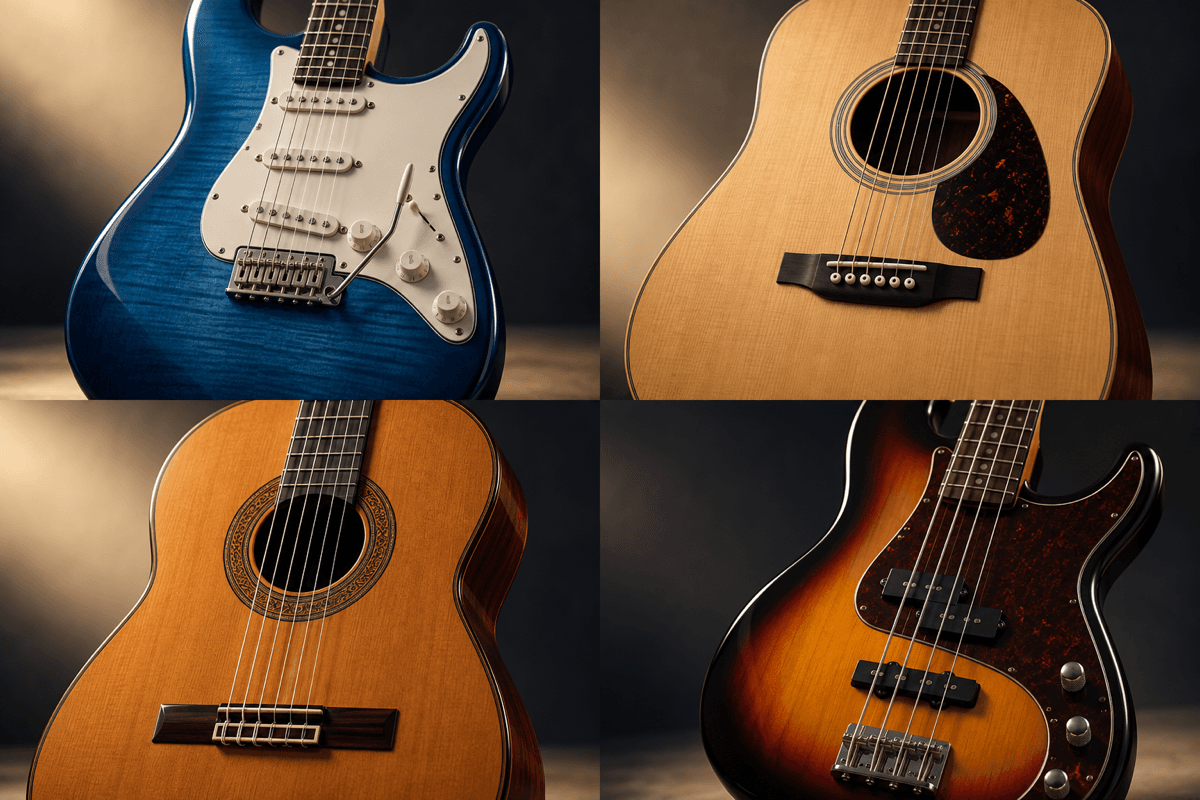
Electric, steel-string or nylon-string: which first?
| Starting option | What to try | What else to confirm |
|---|---|---|
| Electric guitar | The amplified sounds that interest you | Working amplifier or headphone listening route, cables and controls |
| Steel-string acoustic | Unamplified chords, body depth and reach | Installed string type, playing condition and appropriate care |
| Nylon-string or classical guitar | The required lesson technique and neck spacing | Exact neck dimensions and maker-approved strings |
| Bass | The bass parts you want to learn | Its separate musical role, physical fit and suitable monitoring |
Yamaha’s acoustic guide cautions that steel and nylon systems are not interchangeable. Do not buy one family expecting to turn it into another by fitting different string materials. A traditional classical neck is often wider than a steel-string neck, but inspect the actual model; string material alone does not prove easier playing.
An electric guitar is a legitimate first choice when it fits your lesson and listening plan. See the electric buying guide or steel-string acoustic buying guide once you have a family to compare.
Sources: Yamaha: acoustic guitar selection and string-family limits
Check body fit before counting features
Let the learner hold each candidate in the normal practice position. Use an appropriate chair, support or strap. Try reaching the strings, making a comfortable simple shape and changing position. Notice the body edge, neck position and grip. Stop a movement that is uncomfortable; do not force a stretch to demonstrate that the guitar fits.
Taylor distinguishes body comfort from neck playability. This is maker guidance, not a clinical test or proof that one size suits everybody. Age, a fraction-size name or “thin neck” does not settle the choice. Compare scale, spacing, body and setup together; the fit guide explains those separate factors. A short shop trial cannot guarantee comfort over every future session.
Sources: Taylor: body comfort and neck playability (manufacturer explanation)
A good setup is a beginner feature
Use the actual guitar to check whether ordinary learning tasks are possible. With permission, play open strings and comfortable notes in different positions. If you cannot yet do that, ask a teacher, competent player or seller to demonstrate them slowly. Record where excessive effort, persistent buzz, dead notes or rough fret ends occur.
These observations do not identify a repair or prove that the instrument is unsuitable by design. Ask for a competent assessment when condition is uncertain. Do not assume that every high-action sample has a cheap fix. Agree any required work and recheck the result before relying on it.
Fender’s factory references depend on its strings, models and specified methods. They are not universal beginner thresholds. Any action reading needs the string, fret, unit, tuning and method; the action guide provides the recording procedure. A new or expensive guitar still needs its current condition checked.
Sources: Fender Support: factory-string and model conditions for setup references

Budget for a working system, not just a guitar
Price a working practice setup. Include the instrument, suitable protection or storage, a way to tune, the strings and any assessed service. Add a strap, picks or other accessories when your chosen playing method needs them. Separate equipment included in the sale from items you still need.
For electric guitar or bass, verify a listening route you can actually use. That may involve an amplifier, a suitable headphone device or an interface plus the required cables and listening equipment. Check the exact connections, power requirements and instructions rather than assuming a bundle or a headphone socket provides every function. Fender’s beginner guidance specifically separates electric/bass equipment costs from the guitar.
No fixed price is recommended here. A bundle deserves the same fit and function checks as separate items. A required repair quotation is different from an assumed allowance; keep the unknown cost visible.
Sources: Fender: personal beginner needs and equipment (manufacturer guidance)
A practical first-guitar check
This is a proposed learner check, with no fixed duration or instrument test performed by this site. Agree the demo with the owner or shop.
- Identify the actual guitar, string family, tuning and included items.
- Hold it normally and try a comfortable movement; ask for appropriate guidance if you cannot assess fit.
- Use a working tuner and play or request open-note and fretted-note demonstrations.
- Observe the functions you need. On an electric, try relevant switch positions and controls through the planned listening route.
- Write the useful result, any discomfort or persistent problem, and the check still needed.
- Confirm actual service, delivery and return/exchange terms before deciding.
Ask the demonstrator to show the musical task you need, not only a fast solo. Keep your own holding and playing observation separate from the demonstrator’s sound. If basic fit or function remains uncertain, seek a suitable assessment or try another candidate; a fixed number of minutes cannot complete those checks.
When buying online, reduce uncertainty deliberately
Confirm model/version, handedness, dimensions, installed string family, condition, included equipment and the actual seller’s terms. Ask whether photographs show the unit offered. For a used purchase, ask about known repairs and modifications and use the inspection guide for the questions that need further evidence.
Pictures and a recorded demonstration may identify questions, but they cannot prove your grip, every fret’s condition or the absence of hidden damage. Phone audio is not a controlled sound ranking. Keep essential unknowns in writing. If you cannot try the guitar, confirm how it can be evaluated after delivery under the actual agreement; this guide verifies no seller, price or universal return entitlement.
Plan the first month as part of the purchase
Plan where the guitar will live, how to tune it and the first small musical task. Check that the equipment and lesson plan are usable before buying more accessories. Follow the actual maker’s arrival, storage and care instructions.
After beginning practice, keep notes about what works and what prevents comfortable use. A symptom may need help with technique, fit or the instrument; it does not establish one cause. If a change or service is proposed, record it and recheck the relevant function. Changing your preferred family later is possible; the first purchase does not commit you to one type forever.
Common first-guitar mistakes to avoid
- Choosing only by a “beginner” badge, logo or price.
- Assigning a family or fraction size without trying the learner and instrument together.
- Buying nylon and steel systems as though their strings were interchangeable.
- Forcing uncomfortable movement or treating persistent problems as inevitable learning.
- Assuming every setup symptom is a cheap adjustment.
- Leaving essential listening equipment or protection out of the budget.
- Using an unspecified “factory setup” or a demonstration as proof of the whole guitar’s condition.
Before committing, state whether the learner can hold and use the instrument, what remains unverified, what equipment is ready and what the agreement covers. An unresolved essential is a reason to seek help or postpone the choice.
Conclusion: buy the instrument that invites practice
Choose the first guitar and equipment that support your current music and learning situation. Compare the actual learner, instrument and listening route, and resolve essential fit or condition questions before paying.
Once the family is clear, use its specialist guide. For a later purchase or a broader comparison, the complete buying framework organizes specifications, evidence and the final decision.
Frequently asked questions
Should a beginner start on acoustic or electric guitar?
Either can be appropriate. Match music, actual lesson requirements, fit and the practice/listening setting. No acoustic-first sequence is required here.
Are nylon strings always easier for beginners?
String material alone cannot establish easier playing. The complete neck, spacing, setup and lesson technique matter. Use the maker-approved string system; do not substitute steel and nylon to change families.
What matters more than the first guitar’s brand?
Whether the actual instrument fits and functions for your learning task, the necessary equipment is usable and the purchase terms are clear. A logo does not verify condition.
How much should I spend on a first guitar?
Set a complete budget for the instrument, essential equipment, protection, strings and any assessed work. No one amount applies to every player, market or seller.
Can a used guitar be a good first guitar?
It can if its actual fit, condition and needed work are understood. Request appropriate inspection when your experience is insufficient; unresolved condition or repair cost keeps the decision open.
How this guide was prepared
We read Fender’s beginner selection and factory setup guidance, Yamaha’s acoustic-selection PDF and Taylor’s 2017 comfort/playability explanation. Manufacturer material supports equipment, string-family and model-specific setup context; it is not independent proof of a best beginner model or improved practice habits. The learner checks and first-month plan are proposed editorial methods. We assessed no learner, played or adjusted no instrument, verified no seller terms or current prices, and performed no human technical or clinical review. Images are illustrations, not trial samples. AI assistance was used for source comparison and language checks.
Documentation checked .
Separated first-learning needs from the general buying framework, removed an unsupported practice-frequency suggestion and fixed check duration, clarified observation versus diagnosis, added beginner demonstration and purchase/defer steps, and corrected cropped-image descriptions.