
The decision in brief
A B-standard baritone plays guitar intervals five semitones below standard guitar. A Fender-style Bass VI uses E A D G B E an octave below standard guitar, placing its lowest open E seven semitones below that baritone’s B. Both have six strings, but their target register, string system and musical use differ. Choose the actual tuning and part, then check the model and complete amplified setup.
Start with the open-string pitches
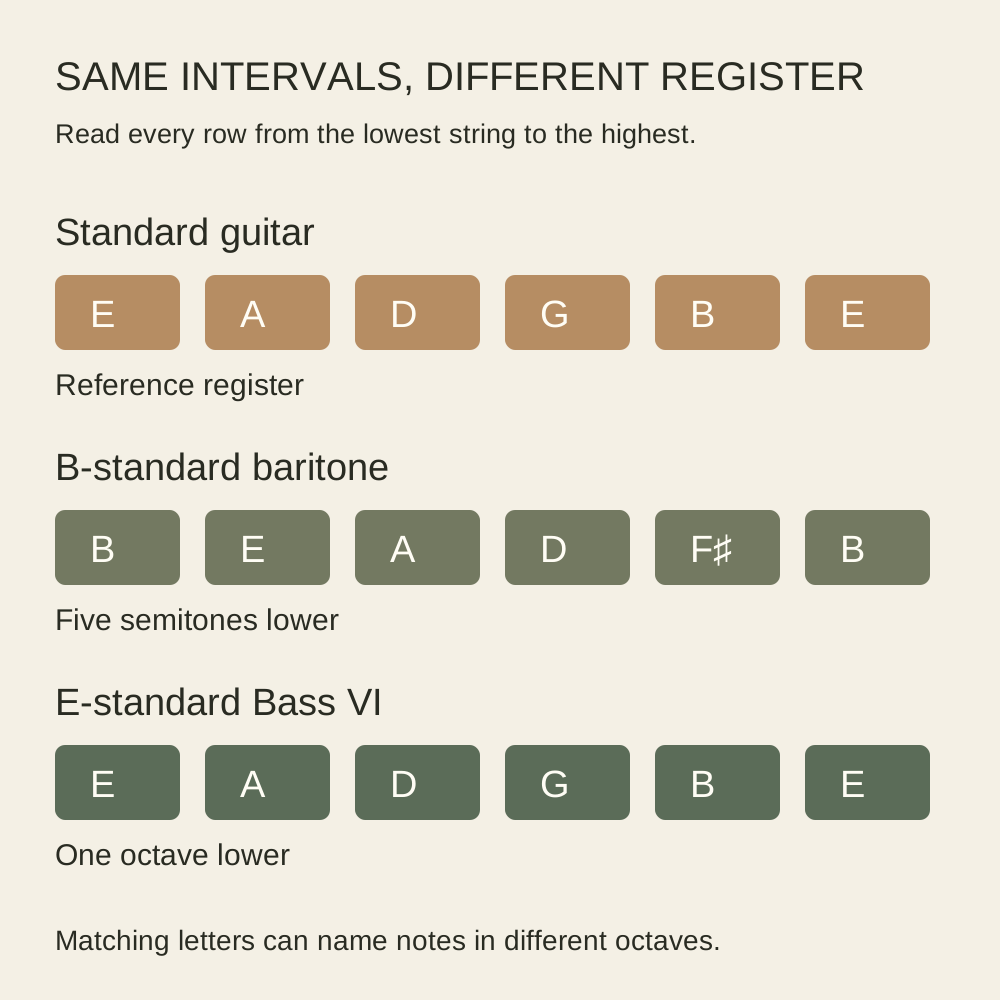
Read every string from lowest sounding pitch to highest. Fender identifies its Bass VI as a six-string bass with guitar-style tuning an octave below standard guitar. PRS lists the SE 277 in B standard. Those two baselines make the register difference explicit.
| Instrument baseline | Low-to-high open strings | Relative to standard guitar |
|---|---|---|
| Standard six-string guitar | E A D G B E | Reference register |
| B-standard baritone | B E A D F♯ B | Each string five semitones lower |
| E-standard Bass VI | E A D G B E | Each string one octave lower |
The baritone’s fifth-string E matches a standard guitar’s lowest open E. The Bass VI’s lowest E is an octave below that standard-guitar E. As a result, the Bass VI starts seven semitones below this B-standard baritone. These relationships concern the specified tuning, not every instrument carrying a baritone label.
Sources: Fender: Bass VI register, tuning and 30-inch scale; PRS: SE 277 nominal scale and documented B-standard tuning
Separate a familiar shape from the resulting pitch
The three tuning patterns above share the same adjacent-string intervals: fourth, fourth, fourth, major third, fourth. A familiar six-string chord shape can therefore preserve its interval pattern, while the sounding key and register change.
For example, take the ordinary open E-minor shape, 0–2–2–0–0–0 from the lowest string to the highest. Here 0 means an open string and 2 means fret 2. The same fingering produces B minor on the B-standard baritone. On an E-standard Bass VI, it produces E minor an octave lower than on the standard guitar. These are tuning-derived examples, not instructions to retune any guitar or proof that the whole chord will suit an arrangement.
Before using a tab or chord chart, identify the tuning it assumes. Agree whether a chord name describes the sounding harmony or a shape on a transposing instrument. If another player asks for E minor, a familiar shape on the baritone does not automatically provide the requested pitches. Use the standard-tuning reference to establish the starting map.
Use scale as a model specification, not a naming rule
PRS specifies 27.7 inches for its B-standard SE 277. Gretsch’s G5260 model 2516002519 is also documented B to B, at 29.75 inches. Fender describes the Bass VI baseline as 30 inches. The near overlap shows why a rule such as “all 30-inch-looking instruments are basses” is unhelpful.
| Documentation example | Nominal scale | Documented tuning baseline |
|---|---|---|
| PRS SE 277 | 27.7 in | B E A D F♯ B |
| Gretsch G5260 2516002519 | 29.75 in | B to B |
| Fender/Squier Bass VI explanation | 30 in | E A D G B E, octave below guitar |
These are examples, not rankings or promises of current availability. A longer nominal scale can also change reach. Try the actual neck and balance; do not treat a small scale difference as proof of equivalent tension or playing feel. The scale-length guide explains the separate measurement and string variables.
Sources: PRS: SE 277 nominal scale and documented B-standard tuning; Gretsch: G5260 model 2516002519 scale and B-to-B string specification; Fender: Bass VI register, tuning and 30-inch scale
Try the register inside the musical part
Write the lowest note the part needs and whether it supplies a bass line, a lower guitar accompaniment or a featured melody. The B-standard baseline does not reach the Bass VI’s low E. Conversely, access to low E does not establish that an arrangement needs every note of a familiar full guitar chord in that register.
Try a short line in the required register, then a sparse chord or two-note figure. Listen with the other instruments or a reference accompaniment. Notice attacks, note endings and whether the line remains distinct. Adjust the part before treating extra gain or bass EQ as the answer.
The bass and guitar role comparison covers the broader ensemble decision. A Bass VI can carry bass duties, melodic parts or other textures according to the arrangement. A baritone can contribute a low line too, within its actual range. The label does not allocate a permanent role.
Check strings, setup and the listening path
Use the exact instrument’s approved string system, tuning and setup as a starting point. Fender describes a specific Bass VI set; PRS and Gretsch document their baritone string baselines. Sharing six strings does not establish interchangeability. Confirm usable winding length, nut and tuner fit, bridge travel and the desired tuning before changing a set.
Do not assume a baritone becomes a Bass VI by fitting any heavy six-string set and lowering the pitch. That is a different setup proposal requiring model-specific assessment. Our baritone guide covers those compatibility checks; the bass-string guide explains why scale labels alone do not establish string fit.
Use amplification or monitoring appropriate to the actual instrument and required register, following the equipment manuals. Test at a manageable level. A guitar-input socket does not establish how every speaker system will handle the desired low-register part.
Sources: Fender: Bass VI register, tuning and 30-inch scale; PRS: SE 277 nominal scale and documented B-standard tuning; Gretsch: G5260 model 2516002519 scale and B-to-B string specification
Use two musical tasks before deciding
- Confirm the model, installed strings and tuning, including register. Record any departure from the documented baseline.
- Play the same short bass-line task in its intended sounding register. Note whether each candidate reaches every required note without an untested retuning.
- Play a separate lower-guitar task: a riff, sparse accompaniment or melody. Record the actual sounding key, reach and note control.
- Repeat with your intended monitoring and accompaniment. Keep rig changes and instrument changes in the notes.
| Task | Useful result to record |
|---|---|
| Bass line | Required lowest note, available positions, muting and note endings |
| Lower guitar part | Sounding key, voicing, reach and place in the arrangement |
| Practical setup | Installed set, tuning, monitoring and unresolved work |
This proposed trial evaluates a musical job, not a universal winner. If one task requires an untested string or setup conversion, record that limit instead of imagining the result. Choose the documented system that serves the part you will actually play.
How this guide was prepared
We compared Fender’s Bass VI explanation with the current official PRS SE 277 and Gretsch G5260 model 2516002519 specifications on October 26, 2026. Tuning intervals and octave relationships in the map are editorial music-theory derivations from those documented tunings and standard guitar tuning. Named instruments are specification examples, not tested recommendations. The arrangement trial is proposed guidance. We played, restrung and measured none of these instruments and claim no independent human technical review.
Documentation checked .