The decision in brief
Consider a baritone electric guitar when your music needs a lower-tuned six-string guitar voice and a standard-scale guitar with your preferred strings does not give the tension, intonation or feel you want. Compare the actual model's scale length, factory tuning, string set, nut and bridge range, pickup response and physical reach. Baritone is not one fixed specification, and it is not automatically a substitute for a bass or Bass VI. Try the exact tuning and complete amplified rig before buying.
What matters most
- Choose the low-register musical role before choosing a baritone label.
- Verify the exact model’s tuning, complete strings and scale; factory details may differ from the shop sample.
- Nominal scale, compensated string length and total instrument length are different measurements.
What makes a guitar a baritone?
Consider a baritone when you need guitar-style chords or riffs in a lower register and your current guitar does not provide the string response, intonation or reach you want. It is usually a lower-tuned guitar design with a suitable scale and string set. The label does not supply a complete specification or an approved range of tunings.
Read the exact model, market and tuning. The following manufacturer examples are documentation baselines, not recommendations or instruments tested for this guide. Both retain six-string guitar intervals in B standard, but their nominal scales differ.
| Documented example | Nominal scale | Factory tuning, low to high | String baseline, gauge list high to low |
|---|---|---|---|
| Ibanez RGIB21, USA page | 28 in | B–E–A–D–F♯–B | D’Addario EXL157: .014/.018/.026/.044/.056/.068 in |
| PRS SE 277, official page | 27.7 in | B–E–A–D–F♯–B | 14–68 set (.014–.068 in endpoints only) |
PRS does not identify every intermediate string gauge in that field, so do not infer its complete set from Ibanez’s specification. Factory information also does not prove that a shop sample still has those strings or tuning. Confirm the instrument in front of you.
Sources: Ibanez USA: RGIB21 scale, factory tuning and strings; PRS: SE 277 scale, factory tuning and strings
Where a baritone sits between guitar and bass
| Instrument | Useful question | Verify |
|---|---|---|
| Standard electric guitar | Does a competent string/setup change already serve the part? | Target pitch, string fit and adjustment range |
| Baritone electric guitar | Do you want lower guitar voicings with a different scale/string system? | Exact model tuning, scale and reach |
| Fender/Squier Bass VI examples | Do you want the register an octave below standard six-string guitar? | 30-inch scale, EADGBE bass register and model-specific strings |
| Conventional bass | Is the part the ensemble’s low foundation? | Instrument and amplification appropriate to that role |
Fender describes its Bass VI examples as bass instruments with a 30-inch scale and E–A–D–G–B–E tuning one octave below a standard guitar. The tuning letters resemble guitar tuning, but the pitches are lower. Six strings or a familiar body shape do not make a Bass VI identical to the B-standard baritone examples above.
Other instruments and modifications need their own specification. Decide the musical part before buying a label. Our bass vs guitar comparison explains the broader role choice.
Start with scale length and physical reach
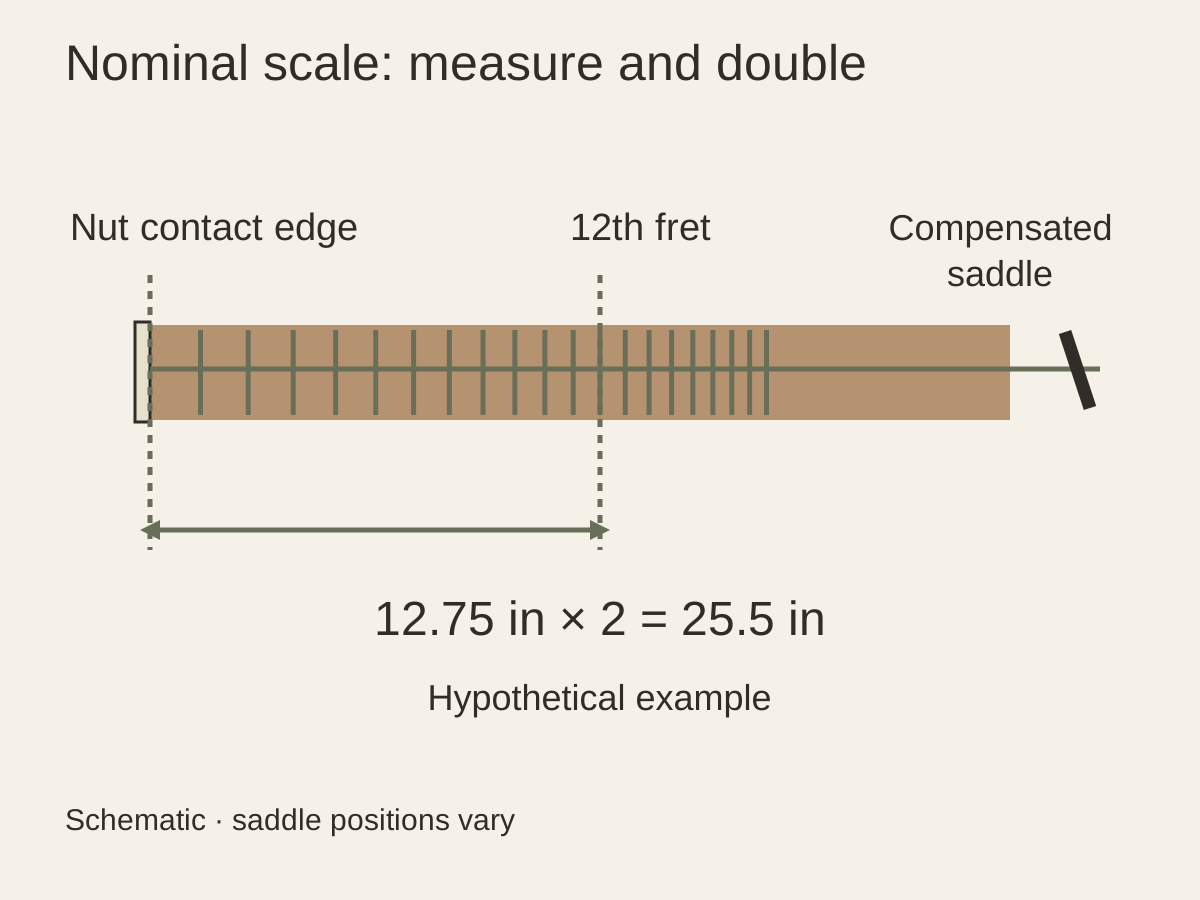
A maker’s nominal scale is the reference used for fret placement. An individual open string’s speaking length runs from its nut contact point to its saddle contact point; compensation can make that length different from the nominal figure. Do not treat every physical nut-to-saddle measurement as the exact advertised scale.
For a conventional equal-tempered layout with an uncompensated nut, the nut contact edge to the centre of the 12th-fret crown, doubled, checks nominal scale. StewMac demonstrates this distinction when locating a compensated saddle. Compensated nuts, zero frets and other layouts need the maker’s measurement method. Multiscale instruments need string-specific specifications.
D’Addario’s tension explanation uses vibrating length, pitch and mass per unit length. A longer speaking length raises ideal tension when the same string and pitch are held constant. It does not alone guarantee comfortable fretting or a tight amplified sound. Try first-position reach, seated balance and standing reach with the intended strings and setup. The scale-length guide covers measurement in detail.
Sources: StewMac: nominal scale measurement and saddle compensation; D’Addario: unit weight, vibrating length, pitch and tension
Choose tuning and strings as one system
Write the whole target tuning, including its register, before choosing strings. B standard, A standard and dropped variants are different setup requests. Lowering pitch lowers ideal tension for the same string and speaking length; changing string construction changes mass per unit length. Matching only the two outer gauge numbers cannot establish equal tension.
Use the named model’s factory setup as a documented starting point, not a guarantee for every tuning. Check the string’s usable length and where its full wrap or taper will sit at nut, saddle and tuning post. Confirm that the thickest string fits the nut and hardware. Do not force a thick string through a narrow slot; widening a slot may prevent a simple return to the original set.
A major pitch or gauge change can require relief, action, intonation and bridge-balance checks. Fender explicitly bases its setup references on factory gauges and advises model-specific adjustment. Ask the maker or a technician about the intended system before changing it. Read the string gauge guide and string compatibility guide for the related checks.
Sources: D’Addario: unit weight, vibrating length, pitch and tension; Fender Support: gauge-dependent setup and measurement conditions
Evaluate the amplified sound at useful settings
Listen clean first, then through the gain and effects you will use. Play your low riff, a chord containing the lowest string and a higher-register passage. Note whether the low notes remain intelligible, how long a muted note lasts and whether the part leaves room for the bass. These are listening questions, not predicted results from a pickup name.
Keep input settings fixed to hear how each guitar drives the rig. For a preference comparison, match recorded playback volume where possible; lowering the guitar volume before a distorted amplifier also changes drive and must be recorded as another condition. Different guitars remain complete-system comparisons even with the same amplifier.
If the goal is an ensemble part, compare it with the actual bass and arrangement at suitable volume. A sound preferred alone may need a different EQ or part in the mix. That does not show that the baritone replaces the bass or that every low-tuned guitar behaves alike.
Inspect the practical hardware details
Check saddle seating, intonation adjustment range, tuner operation and the string path in the intended tuning. A fixed bridge is one option to try if simple retuning matters; a vibrato-equipped model needs its own setup and operating checks. Ask what strings and setup the shop sample currently uses.
Play the lowest string across the fretboard with a light and normal attack. Note dead notes, choking bends, intermittent output or uncomfortable action without diagnosing the cause from one symptom. For an intonation screen, retune the open string and compare its octave harmonic with the gently fretted 12th-fret note using a tuner. A mismatch may need setup; it does not by itself prove a defective model.
Inspect nut behaviour, bridge travel and controls. Relief, nut height, action and intonation are separate adjustments with limits; a truss rod is not a universal fix. Follow the maker’s procedure or ask a technician. The action guide explains the measurement context. Also confirm the case, stand and storage dimensions for the actual instrument.
Sources: Fender Support: gauge-dependent setup and measurement conditions; Floyd Rose: octave harmonic versus fretted intonation check
A repeatable baritone shop test
- Confirm exact model, nominal scale, documented factory tuning and strings currently installed.
- State your target tuning and register. Ask the shop before a major retuning or string change.
- Check first-position reach, balance and a passage above the 12th fret.
- Play the same low riff and chord clean, then with your intended gain.
- Check tuner readings, selector positions, controls and any vibrato gently.
- Record current conditions, preference, remaining questions and required setup or equipment.
| Observation | Write this down |
|---|---|
| Identity | Exact model, factory specification and actual strings |
| Low-register job | Full tuning, lowest required note and musical part |
| Trial | Setup, amplifier settings, reach and response |
| Decision limit | Target tuning not tried, changed conditions or technician work still needed |
This is a suggested procedure and blank record, not a timed or completed test. A sample prepared for B is not a fair trial of A until the different string tension and setup are considered. A standard-scale comparison is useful only when both guitars are competently prepared for the actual job.
When this advice changes
A multiscale instrument needs separate bass- and treble-side measurements. A seven-string baritone can change neck width, muting requirements and string availability; compare the exact models rather than inferring neck dimensions from string count. A Bass VI-style instrument may be tuned into an even lower role with a different string system. Do not apply the six-string example blindly to any of these.
If a producer needs a specific recorded low end, compare the baritone with a standard guitar, Bass VI and bass in the actual arrangement. The right solution can be a different part or signal chain rather than a longer scale. Vintage or modified instruments need individual setup and structural review before a major gauge change.
Who should buy one—and who should wait?
A baritone is a candidate when you repeatedly write or perform below your standard guitar's comfortable range, want guitar-style voicings there, and can use the extra reach and suitable rig. It is a specialist addition, not an automatic upgrade in quality. Choose the exact model only after the tuning, scale, string path, setup and real musical role line up.
Wait if your target tuning is uncertain, you have not tested a well-set-up standard guitar in the required range, or you actually want the bass role rather than lower guitar voicings. A short trial or rental can reveal whether the new instrument changes your music enough to justify its extra kit. For the broader electric-guitar decision, use our electric guitar buying guide.
Frequently asked questions
What tuning is a baritone electric guitar in?
There is no universal tuning. Some models ship in B standard, but verify the exact manufacturer's specification and string set.
Is a baritone guitar the same as a Bass VI?
No. They can overlap in appearance, but their intended tuning, scale, strings and musical role may differ; compare actual models.
Can I put baritone strings on a normal guitar?
Only after checking string length, nut, bridge, setup range and the maker's guidance. A packet cannot turn every standard guitar into a practical baritone.
Do I need a special amplifier?
Not automatically, but test the lower range through the real amp, speaker or interface at the intended volume and check equipment compatibility.
Is longer scale always better for low tuning?
No. Longer scale affects tension and reach; the useful result depends on the chosen strings, pitch, setup and player comfort.
How this guide was prepared
This documentation-based guide checks the Ibanez USA RGIB21 and PRS official SE 277 specifications, Fender’s Bass VI explanation, StewMac’s scale measurement example, D’Addario’s string-tension variables and Fender’s setup conditions and Floyd Rose’s octave-harmonic/fretted-note intonation screen. Named models illustrate documented differences; they are not tested recommendations, rankings or claims of availability. The shop routine and observation record are editorial suggestions. No instruments were played, installed, measured or reviewed by a human technical specialist for this revision. Source comparison and language editing used AI assistance. No numerical tension or comfort test is claimed.
Documentation checked .
Added model-specific tuning and string baselines, clarified the Bass VI octave distinction and nominal scale versus compensated string length, replaced an inaccurate scale illustration and removed an unsupported fixed shop-test duration.
Sources and further reading
- Ibanez USA: RGIB21 scale, factory tuning and strings
- PRS: SE 277 scale, factory tuning and strings
- Fender: Bass VI tuning and scale distinction
- StewMac: nominal scale measurement and saddle compensation
- D’Addario: unit weight, vibrating length, pitch and tension
- Fender Support: gauge-dependent setup and measurement conditions
- Floyd Rose: octave harmonic versus fretted intonation check