The decision in brief
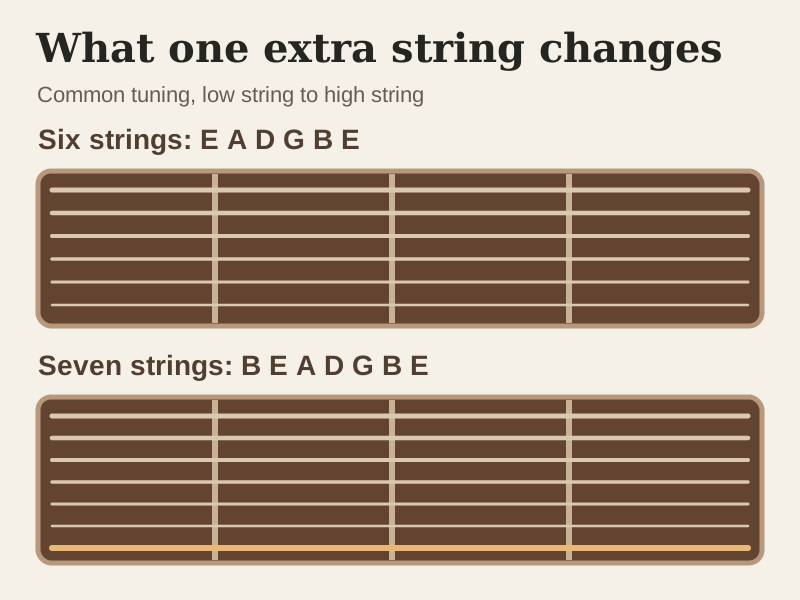
For the conventional standard tunings compared here, six strings run E–A–D–G–B–E from low to high; a seven-string in B standard runs B–E–A–D–G–B–E, adding a lower B while preserving the upper six. Choose seven when that arrangement serves actual passages and the specific guitar fits your playing. Choose six when it already covers the music or an acceptable alternative tuning does. Verify pitches, scale, actual spacing, strings and setup; count alone does not establish neck width, tone or learning difficulty.
Start with the musical job, not the string count
Start with a passage’s lowest and highest notes, needed open strings and chord voicings. In the standard layout used here, a seventh low B adds lower notes while leaving the upper six at their familiar pitches. It is useful when you need that combination, not because a string count is a skill grade.
A six-string is a complete instrument. Retuning may provide a required low note, but it changes the note map of the affected strings and must suit the instrument. Do not retune an unfamiliar guitar beyond its supported arrangement simply for a comparison. If the extra range has no identified role, compare fit and control before buying it.
What the common tuning map really adds
Fender’s standard-tuning explanation writes the six-string sequence E–A–D–G–B–E from low to high. Only that note-order convention is used here; its comfort and historical narratives do not establish learning outcomes.
Ibanez’s RG7421 page lists factory tuning high to low as 1E, 2B, 3G, 4D, 5A, 6E, 7B. Reversing that written order gives B–E–A–D–G–B–E, low to high. This is a published seven-string example, not a rule for every extended-range guitar.
In that layout, the familiar upper six keep their pitches and intervals; the added string needs intentional inclusion or muting. Other tunings may change that relationship. Write the actual open notes and which part uses them. A low B on a differently tuned six-string is an alternative layout, not the same seven-string pitch map.
Sources: Fender: standard six-string sequence, low to high; Ibanez RG7421: stated factory tuning
A side-by-side decision table
| Decision | Six-string candidate | Seven-string candidate |
|---|---|---|
| Layout used here | E–A–D–G–B–E | B–E–A–D–G–B–E |
| Musical role | Passage fits the verified tuning | Passage uses extra range or voicing |
| Control | Mute/include the fitted six | Mute/include the fitted seven |
| Fit | Verify width, spacing and profile | Verify width, spacing and profile |
| Support | Suitable strings, hardware and setup | Suitable strings, hardware and setup |
These are candidate checks, not universal neck dimensions or ease ratings. Alternative tunings, baritone and multiscale designs require their own pitch and dimension records. Both formats still need the actual instrument to serve the task.
Neck width, spacing and body balance matter together
Ibanez publishes 48 mm width at the nut, 10.5 mm string space, a 648 mm/25.5-inch scale and neck dimensions for the cited RG7421. Those figures describe that listing. Its “string space” entry is separate from nut width; it is not a measured outer-string span at the nut.
Compare actual nut and bridge spacing, profile/depth, radius, body position and strap balance on your candidates. Adding a string does not by itself supply a universal width increase over every six-string. Try the same passage and note whether reaching, picking or muting changes. The nut-width guide distinguishes width from spacing.

Low-string clarity depends on the whole system
D’Addario’s gauge definition describes thickness commonly in thousandths of an inch. The decimal diameters below are in inches; a shorthand “59” denotes .059 inch, not 59 mm.
The cited RG7421 lists the factory set .010/.013/.017/.026/.036/.046/.059 inches. The separate Ibanez IEGS7 set lists .009/.011/.016/.024/.032/.042/.054; Ernie Ball’s seven-string range includes its P02623 Super Slinky set ending in .052. These examples show different offered sets, not interchangeable factory recommendations or required low-string targets.
Pitch, scale, string construction, gauge and setup must be considered together. A larger gauge may need suitable nut-slot, tuner and bridge clearance. Confirm support before fitting parts or cutting anything. Listen through the intended signal path; an unplugged sound does not establish the low part’s place in a processed mix.
Sources: Ibanez RG7421: factory string gauges; Ibanez IEGS7: separate accessory string-set gauges; Ernie Ball P02623: separate offered seven-string set; D’Addario: gauge-unit convention
Check the hardware that must serve seven strings
Verify that the fitted nut, bridge, pickups and other parts serve the actual seven-string model and string arrangement. A generic photograph cannot confirm spacing, pickup sensing coverage or replacement compatibility. Request the relevant maker instructions when the low gauge, tuning or hardware will change.
With permission, play open and fretted notes at normal pressure, then try muting the added string in your passage. Record buzz, uneven output or retuning needs as symptoms needing assessment. Do not assume a symptom proves the format is wrong or that one routine adjustment will fix it. Floating-vibrato interactions depend on the exact system and configuration.
Who should start with six, and who should test seven?
Consider six when the needed notes and voicings fit the arrangement you want to use. Consider seven when the added course solves a recurring passage or voicing while the upper six must retain their pitches. These are musical requirements, not beginner or genre rankings.
A new player can discuss the actual repertoire and teaching approach with a teacher, then try a suitable instrument. There is no learning-speed result or hand-size prescription in this guide. Keep comfort, setup and ability to control unused strings tied to this player and guitar.
A passage-based comparison in the shop
Use the time your comparison needs; a timed routine cannot certify fit or condition. Begin with the guitar’s supported tuning and stop an uncomfortable or unfamiliar operation.
- Record models, actual pitches, fitted string sets, scale and setup; retain unknown values.
- Play the same upper-six passage in the layouts being compared, deliberately muting unused strings.
- Play the passage that needs the lower register or additional voicing.
- Use the intended signal path; hold amplifier input settings fixed for drive and comparable listening/playback volume for preference.
- Check seated/standing fit and normal control/bridge functions with permission.
- Record documented specifications, task observations, unmatched conditions and the decision or open question.
This is proposed guidance, not a performed site test. A remote demonstration can answer limited questions; retain the remaining condition/fit uncertainty and check actual seller terms rather than assuming a return right.
When this advice changes
Alternative seven-string tunings may not preserve the standard upper six. A baritone six-string or eight-string solves a different pitch-map question. Verify the layout, parts and intended setup instead of transferring this B-standard example unchanged.
The cited specifications were read on 15 October 2026; model versions and fitted sets can differ. This guide verifies no local stock, seller terms or individual unit measurements. Persistent discomfort needs appropriate individual advice; string count does not diagnose it. A different rig, processing or setup also prevents a demonstration from isolating the format’s sound.
Conclusion: buy the range you can use
Choose the range and voicings that your actual music uses on an instrument you can play comfortably and control. In the stated B-standard layout, seven preserves the familiar upper six and adds low B; other layouts need their own records.
Keep four fields together: documented model/tuning/strings; observations from your passage; unmatched variables; decision and unresolved questions. Neither the extra string nor a simpler-looking specification decides the result for every player.
Frequently asked questions
What tuning does this seven-string example use?
The cited Ibanez RG7421 lists E B G D A E B from high to low: B E A D G B E from low to high. Verify your exact guitar; other layouts are possible.
Is a seven-string necessarily wider or harder to learn?
An extra string adds a course to reach and control, but exact width, spacing, profile, setup, task and adaptation vary. This guide establishes no universal width increase or learning-difficulty ranking.
Can a six-string supply low B?
A suitable six-string tuning can, if its design, strings and setup support it. Its affected note map changes; it does not simultaneously preserve the same seven-string B-standard layout.
Is .059 the required seventh-string gauge?
No. It is the cited RG7421 factory example. Different accessory sets have other gauges; confirm tuning, scale, construction, clearances and the maker’s support for the actual instrument.
How this guide was prepared
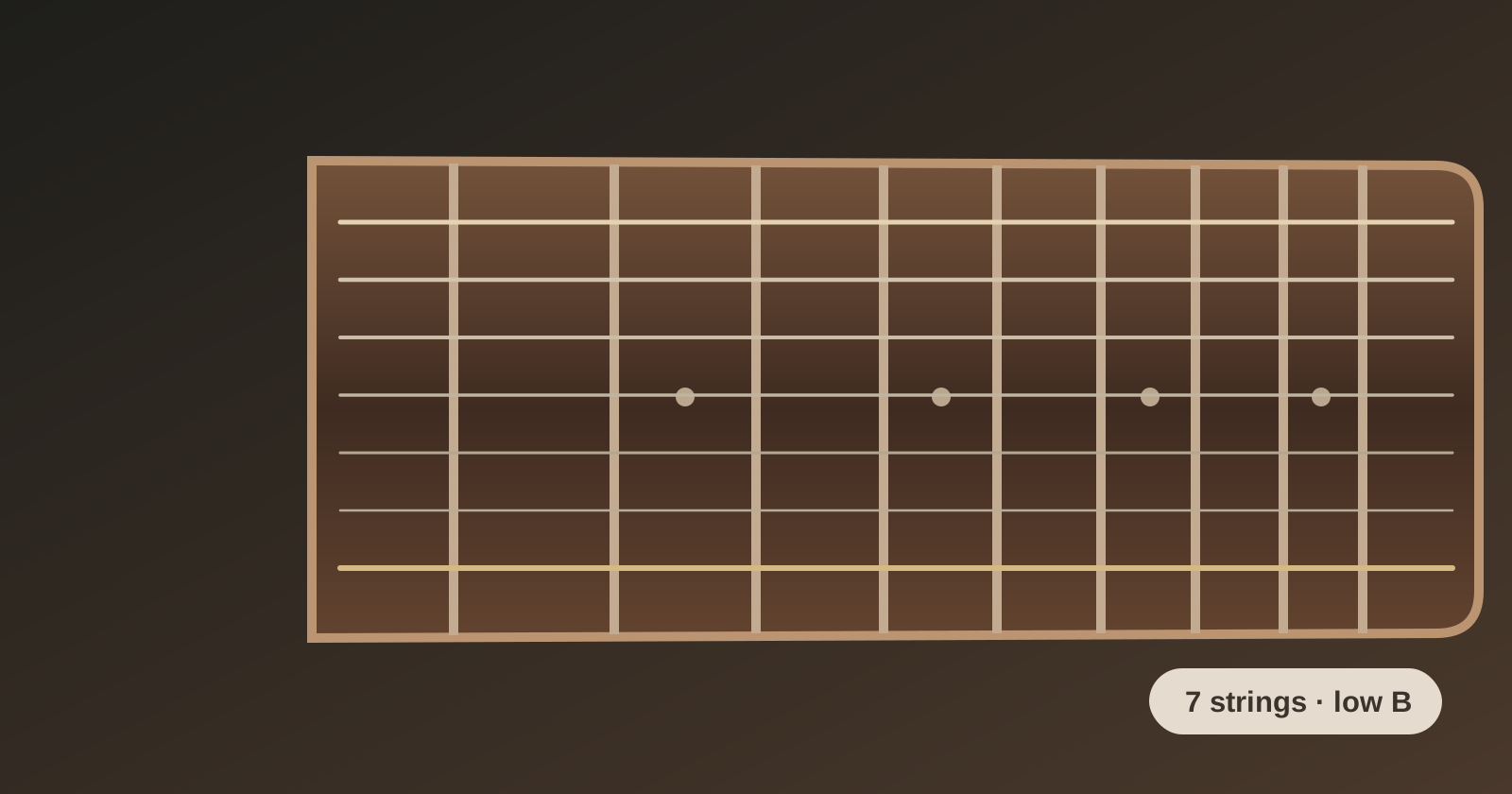
AI-assisted comparison of the published Ibanez RG7421 tuning/dimensions/factory strings, the separate IEGS7 accessory set and Ernie Ball’s offered seven-string gauges, with Fender’s standard note order and D’Addario’s gauge-unit definition. Reversing the manufacturer’s high-to-low written note order is an explicit editorial step. The passage-based four-field routine is proposed guidance; no guitar was played, retuned, measured or modified, and no controlled sound, learning or human expert review was performed. Schematics illustrate counts, not physical orientation or model geometry.
Documentation checked .
Rechecked model-specific pitch order, dimensions and actual string sets; removed universal width/learning claims and store-demo framing; added a passage-based record and clear input/playback conditions; corrected schematic scale/orientation limits and the nonbinding ten-minute heading.