
The decision in brief
Choose an eight-string set for the actual guitar, tuning and hardware. Read all eight gauges and confirm that the usable string length and ends fit the complete route from anchor to tuner. Eight strings do not imply one factory tuning or a universally suitable low-string gauge. Preserve a known compatible setup when replacing like for like; assess a tuning or gauge change before installing it.
Start with the guitar’s current specification
Write the exact model and version, installed set if known, supported tuning, bridge attachment and scale arrangement. The maker’s factory specification is a starting reference for that version. An instrument modified by a previous owner needs its own assessment.
Keep a successful compatible set’s packaging or product code. If the set is unknown, record that uncertainty before ordering another. A large low-string diameter can be a deliberate setup choice, but finding it on a guitar does not establish what every similar instrument supports.
Our six-string and seven-string comparison explains the range question. This guide concerns the replacement set and its fit after the instrument has been identified.
Map the published tuning and all eight gauges
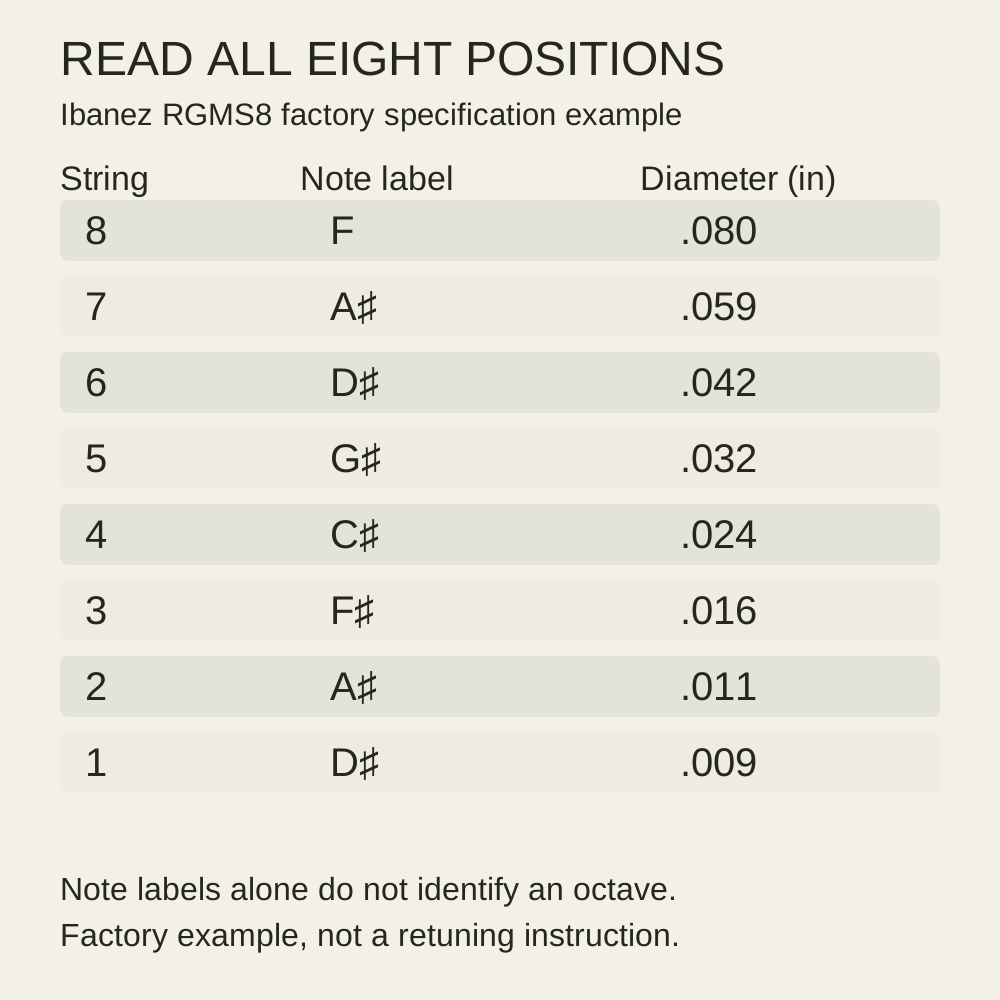
Ibanez lists the RGMS8 factory tuning first string to eighth as D♯, A♯, F♯, C♯, G♯, D♯, A♯, F. Its gauge sequence in the same direction is .009, .011, .016, .024, .032, .042, .059, .080 inches. The table reverses both lists together; it does not prescribe those pitches or diameters for another guitar.
| String number | Published note label | Nominal diameter |
|---|---|---|
| 8 | F | .080 in |
| 7 | A♯ | .059 in |
| 6 | D♯ | .042 in |
| 5 | G♯ | .032 in |
| 4 | C♯ | .024 in |
| 3 | F♯ | .016 in |
| 2 | A♯ | .011 in |
| 1 | D♯ | .009 in |
String 1 is the high-string end of this written factory arrangement. The note labels contain sharps that need to stay with their letters. They do not provide octave numbers. Verify the intended register with the model’s instructions and an appropriate tuning reference before turning a machine head.
A chart built by adding two low strings to E A D G B E would describe a different layout from this particular factory example. Use the six-string tuning reference as a reference map, while retaining the eight-string instrument’s own instructions.
Sources: Ibanez RGMS8: factory tuning, complete gauges and multiscale dimensions
A pack’s endpoints leave six gauges unspecified
D’Addario identifies EXL140-8 as an eight-string 10–74 Light Top/Heavy Bottom set. That designation differs from the .009-to-.080 factory sequence above. It is a separate product example, not the replacement we approve for the RGMS8. The named pack has a thicker first-string endpoint (.010 versus .009) but a thinner eighth-string endpoint (.074 versus .080). A single “heavier” label cannot describe that whole comparison.
Write each candidate’s complete gauge list, construction, intended instrument and product code. Two endpoint numbers cannot tell you the middle six diameters. A packet labelled “eight-string” identifies a format without confirming the tuning or the hardware it will suit.
Gauge measures diameter. Its relation to tension also depends on pitch, vibrating length and string construction; the gauge guide explains those variables. Avoid choosing a low string by a universal “tight enough” number without stating the instrument and intended pitch.
Sources: D’Addario EXL140-8: eight-string 10–74 product designation
Check usable length and every attachment point
Trace the physical route from the string anchor to the saddle, across the nut and onward to the tuner. Confirm the correct end fitting and enough suitable length for the maker’s installation method. Nominal scale describes the vibrating reference; it does not include the whole fitting route.
The cited RGMS8 has a multiscale layout, so a single generic guitar-length label is particularly incomplete. Verify each string’s route and the set maker’s usable-length information. A headless clamp, string-through route or specialist bridge needs its matching instructions; do not transfer one installation method to all eight-string guitars.
Confirm that the intended string can seat correctly at the bridge and pass through the appropriate tuner or clamp. Ask a technician about nut-slot fit and any required changes. Do not force a thick string into a slot or drill a tuner to make an uncertain set fit. The scale-length guide separates scale from the rest of the string path.
Sources: Ibanez RGMS8: factory tuning, complete gauges and multiscale dimensions
Define the change before removing the old set
State the goal: replace a worn compatible set, alter a specific string’s resistance in a named tuning, or prepare an assessed new setup. These jobs need different decisions. Repeating the exact known compatible set can preserve a useful baseline.
For a different gauge or tuning, agree on the full proposal before installation. Nut clearance, neck relief, bridge position and intonation may need assessment. Follow the exact guitar and string instructions for fitting, trimming and tuning. Our restringing guide provides a checklist for choosing the appropriate method.
Retain the product identity, all eight intended pitches and any authorized setup work. A package description cannot promise that a new set will cure buzzing or supply a particular recorded sound. If the guitar’s condition is uncertain, settle that question before increasing its load.
Compare the strings in the part you play
After correct installation and a checked setup, use a short passage at a manageable listening level. Play the low-string part, then an upper-string phrase while controlling unused strings. Note the actual tuning, normal attack, pitch stability and any symptom that needs attention.
| Keep with the guitar | Record after the change |
|---|---|
| Model, tuning and old set | Exact new product and all eight gauges |
| Reason for replacement or change | Same passage and intended signal path |
| Unknown fit or condition details | Resolved work and remaining questions |
| Strings and setup as one baseline | Any additional adjustment or rig change |
This is a proposed observation routine. It is not a site test or a rating of string brands. A clearer low part on your complete rig can be useful without proving that gauge alone caused it. For persistent buzz or poor pitch behaviour, continue with the setup guide and record the symptom before requesting work.
How this guide was prepared
We checked the official Ibanez RGMS8 specification and D’Addario EXL140-8 product page on October 27, 2026. The note and gauge map reverses Ibanez’s printed first-to-eighth order into eighth-to-first order; it is not a pitch-frequency or tension measurement. Named products illustrate specification reading, not interchangeable recommendations. Installation and playing checks are proposed guidance. We fitted, tuned and tested no strings or guitars and claim no human specialist review.
Documentation checked .