The decision in brief
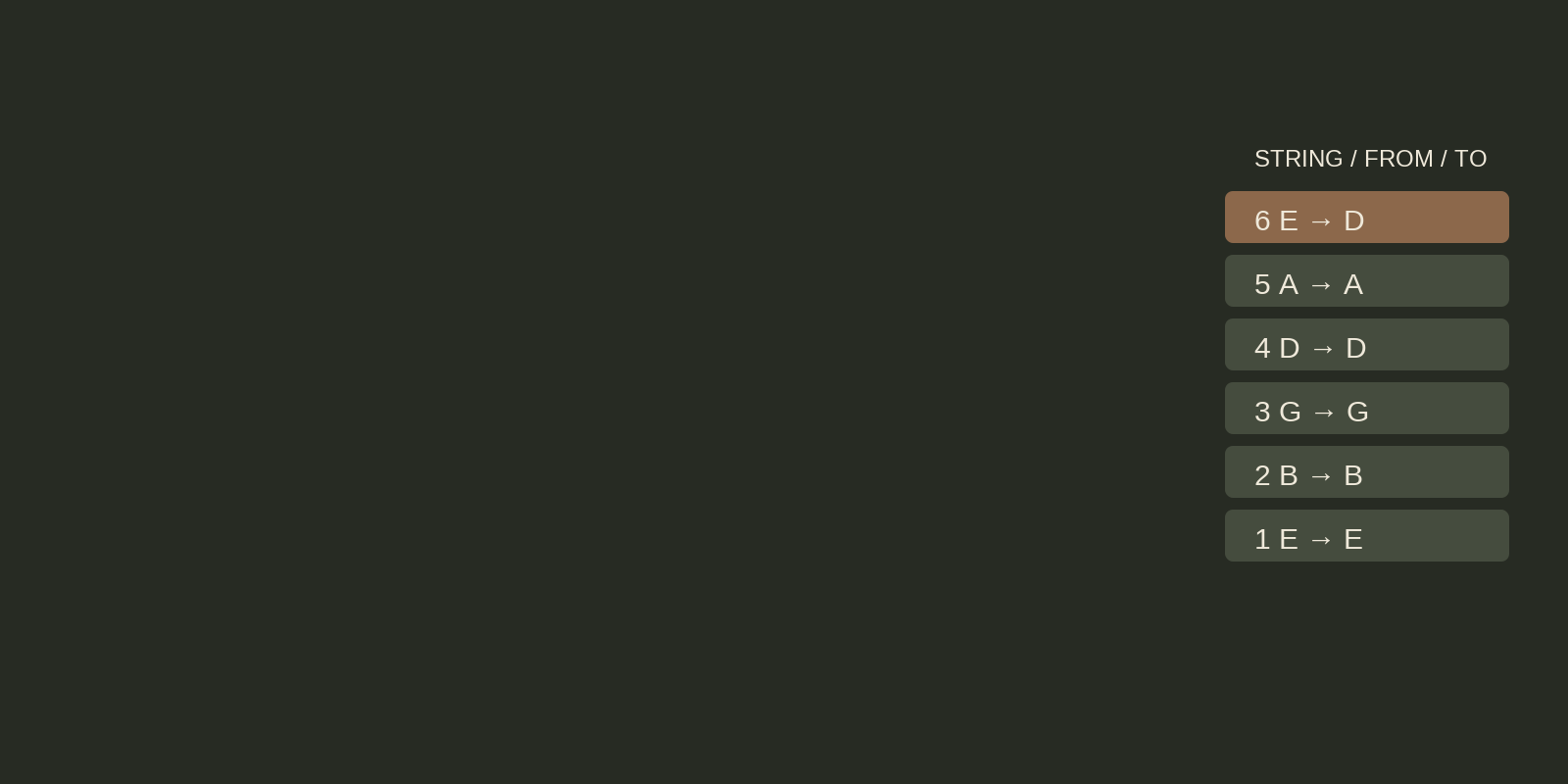
Drop D on a six-string guitar is D A D G B E from string 6 to string 1. Starting in E standard, lower only string 6 from E to D, a whole step. Use a tuner that can identify D, then recheck all six strings. Notes on strings 1–5 stay in their usual places; any shape using string 6 needs checking. Confirm the procedure for a locking or floating bridge before retuning.
Read the notes in string-number order
String 6 is the lowest-pitched string in this starting setup; string 1 is the highest. Fender identifies Drop D as the standard six-string tuning with the low E lowered to D. Keep string numbers attached to the letters so the two D strings are not confused.
| String | E standard | Drop D | Change |
|---|---|---|---|
| 6 | E | D | Down one whole step |
| 5 | A | A | No intended change |
| 4 | D | D | No intended change |
| 3 | G | G | No intended change |
| 2 | B | B | No intended change |
| 1 | E | E | No intended change |
The D on string 6 is one octave below the open D on string 4. They share a note name, not the same pitch. This is a useful listening reference after checking the tuning; it does not replace a stable tuner reading. See the standard-tuning map if you need to establish the starting setup.
Sources: Fender: Drop D tuning, low-to-high notes and octave reference
Lower the sixth string and verify the whole guitar
Remove any capo and begin with a guitar already set up for E standard. This sequence concerns the tuning change, rather than a restringing or bridge-adjustment job. If the nut locks the strings, follow the exact hardware instructions before operating the machine heads; do not force a locked string.
- Choose a chromatic mode or a documented Drop D setting on your tuner. A mode that expects standard string 6 to be E may give an unhelpful string indication.
- Pluck string 6 alone and gradually lower its pitch. Watch the note name move toward D as well as watching the flat/sharp display. Tuning-key direction depends on how the string is wound.
- Let the note settle, check D again and compare it with string 4 as an octave reference. Do not attempt to raise string 6 to the pitch of string 4.
- Check strings 5 through 1, then return to string 6. Repeat the check if another string’s pitch moved.
- Play the passage at your normal picking strength, then check tuning once more.
Keep the tuner’s reference setting consistent with the session. If the display jumps, first isolate the string and follow the stable-reading checks rather than turning the key rapidly in response to every movement.
Sources: BOSS TU-3W manual: chromatic mode and note-name display
Relearn the sixth-string notes you actually use
Every note at a given fret on string 6 is now two semitones below its E-standard counterpart. To recover the same pitch on that string, move two frets higher where the neck permits. That rule applies to string 6 only; shifting an entire familiar chord shape by two frets would also change its other notes.
| Fret on string 6 | In E standard | In Drop D |
|---|---|---|
| Open | E | D |
| 2 | F♯ | E |
| 3 | G | F |
| 5 | A | G |
| 7 | B | A |
| 12 | E, one octave above open E | D, one octave above open D |
Work out a familiar bass note before strumming the full chord. A standard E shape that includes open string 6 no longer has E as that lowest note. A voicing confined to strings 1–5 retains those pitches, provided those strings were rechecked and remain in tune. Sethares’s Drop D discussion makes the same useful distinction: familiar upper-string material remains available when the changed bass string is omitted.
Sources: Bill Sethares: Alternate Tuning Guide, Drop D section, PDF pages 71–72
Try three-string fifths without strumming the whole guitar
The lowest three open strings give D–A–D: root, fifth and octave. Moving all three up by the same number of frets preserves that relationship. The examples below use only strings 6, 5 and 4; keep strings 3, 2 and 1 silent.
| Frets on strings 6 / 5 / 4 | Notes | Chord name |
|---|---|---|
| 0 / 0 / 0 | D–A–D | D5 |
| 2 / 2 / 2 | E–B–E | E5 |
| 3 / 3 / 3 | F–C–F | F5 |
A fifth chord contains no third, so these shapes alone do not specify major or minor. Adding the upper open strings changes the note collection; a single finger across the lowest three strings is not permission to strum all six.
For an original practice task, play four steady pulses on open D5, then four on E5 and four on F5. Leave a rest before returning to D5 and use it to check that unwanted strings stop ringing. Choose a tempo where you can hear each change. This is a suggested exercise, not a performance result or a speed target.
Check the bridge response and plan the return to standard
A floating bridge responds to the balance of string and spring forces. Floyd Rose’s troubleshooting discusses that balance and the interaction between strings. Lowering one string can therefore require repeated checks of the others; a quick machine-head change may not leave the rest of the guitar where it started. Use the instructions for your exact system, or ask a technician to prepare it for the tunings you need.
A fixed bridge removes that particular floating-balance issue, but it does not certify the low string’s feel or fretted accuracy. Try your usual attack on the open low D and on the fretted notes in the part. If the string feels uncontrolled, rattles or gives an unstable reading, record the symptom before choosing a different gauge or changing the setup. The string-gauge guide explains the separate selection question.
- Record the guitar, string set, starting tuning, bridge type and tuner mode.
- Note whether all six strings stabilize and whether the part works at your normal picking strength. Separate a changed fingering from a mechanical problem.
- When returning to E standard, raise string 6 only to its original E target using the hardware’s approved procedure; recheck every string.
- If frequent changes are impractical, consider a prepared second instrument or a different arrangement before making hardware modifications.
Keep the successful tuning and fingering notes with the song. The useful result is a repeatable way to play the part, rather than an assumption that an alternate tuning must suit every guitar.
Sources: Floyd Rose: floating-bridge troubleshooting and pitch interaction
How this guide was prepared
We checked Fender’s Drop D explanation, the Drop D section of Bill Sethares’s Alternate Tuning Guide Floyd Rose’s floating-bridge troubleshooting and the TU-3W manual’s chromatic-mode description on November 9, 2026. The note tables and three-string chord examples are editorial derivations from the stated open notes and semitone fret spacing. The practice sequence is proposed, not a session we performed. We made no tension, intonation or bridge measurements and assessed no individual guitar.
Documentation checked .