Start here
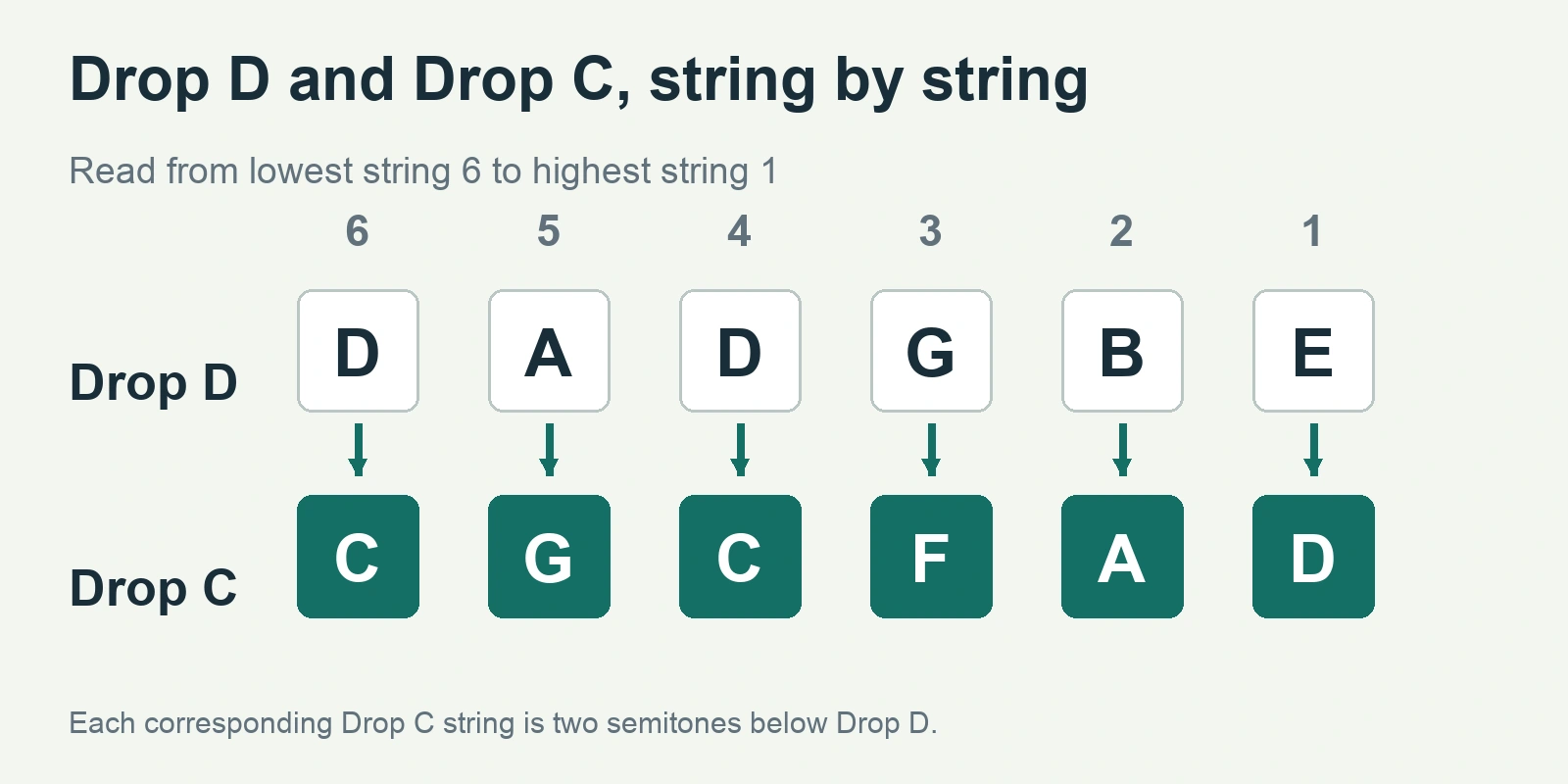
Drop D is D A D G B E and Drop C is C G C F A D, read from string 6 to string 1. Each Drop C string is a whole step below its Drop D counterpart, so the same fingering sounds a whole step lower. Choose for the required notes, the part and how the guitar behaves at that tuning.
Read all six notes
| String | E standard | Drop D | Drop C |
|---|---|---|---|
| 6 — lowest in these setups | E2 | D2 | C2 |
| 5 | A2 | A2 | G2 |
| 4 | D3 | D3 | C3 |
| 3 | G3 | G3 | F3 |
| 2 | B3 | B3 | A3 |
| 1 | E4 | E4 | D4 |
From E standard to Drop D, only string 6 has a different target. From E standard to Drop C, string 6 goes down four semitones and the other five go down two. From Drop D to Drop C, all six go down two semitones. Keep the starting tuning written beside the instructions.
Both tunings contain two open strings with the same low note name. They are an octave apart. Use a chromatic tuner and confirm the intended register. A note-name match alone can hide an octave error. The Drop D guide covers the first change from E standard.
What the same fingering produces
| Frets on 6 / 5 / 4 | Drop D notes | Drop C notes |
|---|---|---|
| 0 / 0 / 0 | D2–A2–D3, D5 | C2–G2–C3, C5 |
| 2 / 2 / 2 | E2–B2–E3, E5 | D2–A2–D3, D5 |
| 3 / 3 / 3 | F2–C3–F3, F5 | E♭2–B♭2–E♭3, E♭5 |
These three-string shapes contain a root, fifth and octave. The “5” chord suffix names a fifth chord. The chord has no third to establish major or minor. Keep strings 3, 2 and 1 muted for the examples.
To recover a given Drop D pitch in Drop C, move two frets higher on the same string where the neck allows it. That works because every corresponding string moved by the same interval. It also changes the available open-string choices and the reach of the part.
Compare the sounded notes with the song’s requirements before deciding that a familiar shape is correct. The power-chord comparison explains when the missing third matters.
Choose for the part and the band
Write the lowest required note and whether the part relies on open strings. Drop D provides a low D while keeping strings 1–5 at their E-standard pitches. Drop C reaches C2 and lowers the entire Drop D shape set by a whole step. That can suit a lower arrangement, provided the rest of the ensemble uses the intended key.
If a chart is written for Drop D, playing the same frets in Drop C transposes the part. Singers, bass players and recorded backing tracks will still need the intended pitches. Decide together whether the performance is staying in the original key or moving it.
An original exercise is to play four steady pulses at 0 / 0 / 0, four at 2 / 2 / 2 and four at 3 / 3 / 3 on the low three strings, with a rest between changes. Try only the tuning your guitar is prepared to support. Use the table to name the notes and record how the open bass supports the phrase.
Check the guitar before choosing a string set
Lowering pitch on the same string at the same scale length reduces its required tension. The hand feel and usable response still depend on string construction, setup and picking strength. Record the complete gauges, intended pitches and effective scale length before comparing sets. The string-gauge guide covers those variables.
Test the low string at your normal attack. Note an unstable pitch reading, unwanted buzz or excessive movement, then check the whole guitar’s setup. A heavier string may address one preference while changing nut fit, bridge balance or intonation. Use the instrument maker’s limits and have fit questions checked before modifying a nut slot.
On a floating bridge, changing string tension also changes the balance with the springs, so other strings can move as you retune. Floyd Rose documents this interaction. Follow the procedure for your exact hardware and recheck every string. A fixed bridge avoids that particular floating balance but still needs a playable setup at the target pitch.
If the guitar has a locking nut, follow its instructions before using the machine heads. Use the bridge comparison when frequent tuning changes are part of the plan.
Sources: D’Addario on string tension, pitch and scale length; Floyd Rose on floating-bridge balance and tuning interaction
Make the change and verify the part
- Record the current tuning, complete string set, guitar and bridge type. Confirm that the proposed tuning is suitable for that setup.
- Use the six target pitches in the table. Make small pitch changes under the hardware instructions and follow the tuner display instead of assuming one turning direction works for every tuning machine.
- Recheck all six strings in several passes, especially with a floating bridge. Confirm the octave as well as the note name.
- Play the actual phrase at normal force. Check open notes, fretted notes, unwanted strings and return to pitch.
- Record any setup concern before changing another variable. Seek a technician’s help if the bridge, nut or string fit needs work.
If open strings tune correctly but the fretted part sounds off, examine the intonation checks after the tuning and setup have settled. Return to the recorded original tuning using the same documented hardware procedure.
Sources: Fender on Drop D tuning; Fender on Drop C tuning; Floyd Rose on floating-bridge balance and tuning interaction
Keep a record you can reuse
| Field | What to enter |
|---|---|
| Music | Required low note, original key, fingering and open-string needs |
| Instrument | Exact guitar, scale length, bridge and nut system |
| Strings | Complete gauges, product identity and condition |
| Before and after | All six target pitches and stable tuner readings |
| Playing check | Usual attack, buzz, fretted accuracy and remaining setup questions |
Download the blank Drop D and Drop C record (English CSV). Choose the tuning that supplies the notes and fingering the part needs, then prepare the instrument for that choice. Keep observations about string feel separate from claims about a universal gauge or better sound.
How this guide was prepared
We checked Fender’s Drop D and Drop C note maps, D’Addario’s tension explanation and Floyd Rose’s account of floating-bridge interaction. We derived the string-by-string pitch differences and low-three-string fifth-chord examples by counting semitones. The original exercise and blank setup record are proposed tasks for readers.
Documentation checked .