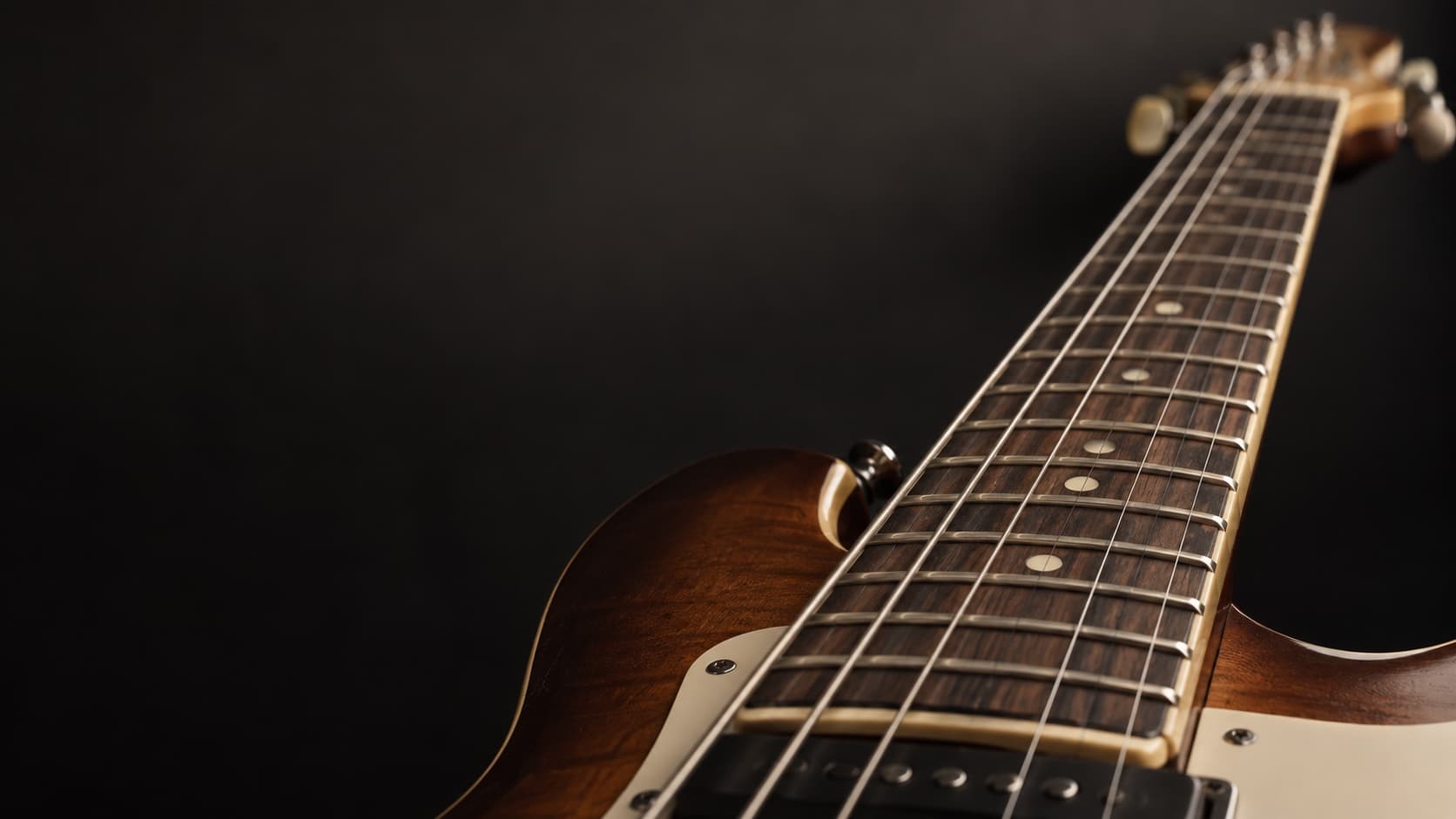
The decision in brief
Choose between actual ebony- and rosewood-board guitars by their documented material and surface treatment, neck fit, fretwork and present condition. Ebony can be naturally streaked; colour alone neither identifies a species nor grades an instrument. Try the same useful passages and follow the exact maker’s care instructions. A complete-guitar preference cannot isolate board wood or establish a universal tone, comfort or durability ranking.
What the material name tells you
A material entry tells you what the maker specifies, not the delivered surface, fret condition or entire neck geometry. Fender’s ebony article documents the material in its named American Elite instruments. Its premium/tone descriptions are manufacturer claims, not a comparative test used here.
Check the model, version and whether the neck is original. If the listing supplies only a colour or broad trade name, request a documented material and surface-treatment description. A photograph cannot provide that record.
Sources: Fender: ebony use in named instruments, not a universal upgrade
Compare appearance without ranking natural variation
Taylor’s ebony account describes natural colour variation in its sourcing context. A streaked board should not be rejected merely for failing an all-black expectation; inspect this unit’s condition and workmanship instead. That account does not certify another instrument’s species or provenance.
| Question | Ebony candidate | Rosewood candidate |
|---|---|---|
| Material | Verify model-specific description | Verify model-specific description |
| Appearance | Natural variation is possible | Colour and grain vary; verify identity |
| Surface | Record actual treatment and condition | Record actual treatment and condition |
| Decision | Useful fit, condition and care | Useful fit, condition and care |
Ask for current photographs in ordinary light showing the whole board and any worn or repaired areas. A visually consistent board is an aesthetic preference, not an inspection result.
Sources: Taylor: natural ebony colour variation and sourcing context
Test surface feel on the actual neck
Play the same chord, slide, bend and position shift, where those tasks belong in your music. Record board and neck-back finish, fret dimensions, string condition and action. Those variables can change what you notice; two complete guitars do not isolate the species.
Use both seated and standing posture if relevant. Write the specific task and observation, such as a fret edge catching or a grip feeling comfortable. The neck-profile guide separates the back contour from board colour.
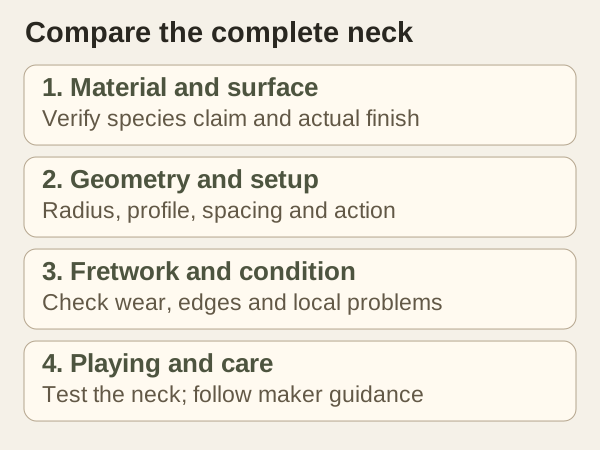
Keep geometry and setup out of a wood verdict
Radius is crosswise curvature; neck profile is the back contour. Width, actual string spacing, scale, fret dimensions and setup are separate records. Compare these before assigning a difficult grip or bend to ebony or rosewood.
Use the radius guide and nut-width guide for those dimensions. Buzz, catching edges or excessive effort are observations needing assessment; they do not identify a material fault or guarantee that a routine setup will resolve it.
Keep the tone question proportional to the evidence
This guide has no experiment isolating these board materials. Manufacturer tone adjectives and recordings of differently equipped guitars cannot establish a universal species ranking. A preferred sound from one guitar can still inform your purchase without proving its cause.
Use the same passage and signal path. Keep amplifier input settings fixed for a drive comparison, then judge sound preference at similar listening or recorded playback volume. Changing the guitar volume before a driven amp is another input condition. Record unmatched strings, pickup settings and setup rather than attributing all differences to the board.
Care depends on surface treatment and maker guidance
Identify the actual surface before choosing a treatment. Fender’s Magic Fretboard Oil instructions specify unfinished boards, including ebony and rosewood. This describes that product’s intended surface; it is not a recommendation for every guitar or a fixed oiling schedule.
Taylor’s cleaning guidance distinguishes finished areas from its unfinished fingerboards and bridges. Follow the exact instrument’s current directions and the product instructions. Its specific maintenance procedure is not copied here as a universal abrasive, steel-wool or oil treatment. Ask the maker or technician when a repair, unusual finish or persistent residue makes the method uncertain.
Sources: Fender: product scope is unfinished fingerboards; Taylor: different treatment of finished and unfinished areas
Inspect condition before paying for a material preference
On a used guitar, look at visible board wear, fret crowns and ends, cracks, loose-looking parts, binding and disclosed repairs. Ask whether a refret, replacement neck or refinishing changed the original specification. Normal playing observations cannot certify hidden condition.
Record the location and conditions of buzz, dead notes or unusual effort without diagnosing them from a wood name. Use the used-guitar inspection guide and obtain an assessment when required work affects the decision.
Ask for a material record when provenance matters
A brand’s general sourcing statement and this unit’s material record answer different questions. Taylor’s account explains its own ebony programme; it does not establish the origin of an unrelated instrument. Ask for the actual model’s material description and any relevant unit records.
This playing/care guide determines no species identification, certification or transaction-specific legal requirement. For a transport or purchase where those questions matter, keep missing records explicit and obtain current authoritative guidance for the actual material and destination.
When this advice changes
A coated, stained, synthetic, refretted or repaired board needs its own description. Fretless instruments and unusual surface treatments require the maker’s relevant instructions rather than a fretted-guitar routine. A material label is not a health assessment.
If your main question is a finished maple surface against an unfinished dark board, the maple-versus-rosewood comparison has that separate role. Here the record centres on verified ebony/rosewood claims, natural variation, delivered condition and care.
The ebony versus rosewood buying checklist
- Record model/version, documented material and actual surface treatment.
- Inspect ordinary-light photographs and visible condition separately from colour preference.
- Note neck geometry, strings, fretwork, action and unmatched variables.
- Try your useful passages and describe the actual task that differed.
- Keep sound observations tied to complete guitars and stated input/playback conditions.
- Confirm the maker’s care method; retain any sourcing or condition question before deciding.
| Record | Example of what to write |
|---|---|
| Documented | Material and treatment with model/source/date |
| Observed | Fret-edge location, surface condition, passage and posture |
| Unmatched | Different strings, fret dimensions, pickups or setup |
| Decision | Accepted compromise, verified care and unresolved question |
These are fields to fill during your own comparison, not completed observations by this site. Choose when fit, condition and the important care/documentation questions meet your needs.
Frequently asked questions
Must an ebony fingerboard be uniformly black?
No. Taylor documents natural colour variation. Inspect workmanship and condition separately; colour cannot identify or certify another unit’s material.
Can I use the same conditioner on ebony and rosewood?
Verify each surface and follow the exact instrument and product instructions. An unfinished-board product’s listed materials do not authorize its use on a finished or unusual board.
Can a sound preference prove which board material is better?
A trial of differently equipped guitars gives a complete-guitar preference, not an isolated board-wood result. Keep input-drive conditions separate from matched playback volume.
How this guide was prepared
AI-assisted review of Fender’s named ebony-range description and unfinished-board product scope, plus Taylor’s colour-variation and surface-care guidance. The four-field comparison record is an editorial proposal. No instrument was played, measured, cleaned, species-tested or independently provenance-certified; no controlled sound/durability experiment or human expert review was performed. Manufacturer descriptions are kept within their stated instrument/product scope.
Documentation checked .
Added near-claim primary references and a documented/observed/unmatched/decision record, clarified finished-surface and care-product limits, removed universal material performance inferences and corrected illustration identity.