
The decision in brief
Choose a Mustang or Jaguar by the exact version’s bridge, controls and physical fit. The Player II examples compared here both list a 24-inch scale; the Mustang has a hardtail bridge, while the Jaguar has a floating vibrato tailpiece. Those differences are more useful than assuming one family is always shorter, easier or better for a genre. Verify the model and try the functions you will use.
Attach the version to each family name
Write the series, full model name, pickup configuration and bridge before comparing two instruments. This article uses Fender’s Player II Mustang and Player II Jaguar as documented examples. It does not assign their features to every vintage, Squier, signature or modified version.
A photograph showing a familiar outline cannot settle the wiring or setup. Confirm the controls and hardware on the actual guitar, including any changes made after manufacture. Read an unclear or conflicting specification as a question to resolve.
The wider electric-guitar buying guide helps keep model identity, condition and physical fit together.
Sources: Fender Player II Mustang: published scale, bridge, pickups and controls; Fender Player II Jaguar: published scale, bridge, pickups and controls
Start with the shared scale and different bridges
| Documented feature | Player II Mustang | Player II Jaguar |
|---|---|---|
| Nominal scale | 24 in | 24 in |
| Listed pickups | Bridge and neck single coils | Bridge and neck single coils |
| Main selector | Three-position toggle | Three-position blade |
| Documented selector sequence | 1 bridge; 2 bridge plus neck; 3 neck (service manual) | 1 bridge; 2 bridge plus neck; 3 neck (product specification) |
| Main knobs | Master volume and master tone | Master volume and master tone |
| Bridge system | Six-saddle string-through hardtail | Jaguar bridge with Mustang saddles and floating vibrato tailpiece |
The table keeps specifications separate from preference. A shared scale figure does not establish identical neck dimensions, balance, action or string response. The scale-length explanation covers the reference itself.
The word Mustang in the Jaguar’s saddle description identifies a part style in that listing. It does not turn the Jaguar into a Mustang guitar. Likewise, a three-position selector gives a count and control type, not a complete wiring diagram.
Sources: Fender Player II Mustang: published scale, bridge, pickups and controls; Fender Player II Jaguar: published scale, bridge, pickups and controls; Fender Player II Mustang service manual: 014-0460/014-0462 families, page 4
Build a control log from reliable information
Fender’s Mustang product page lists bridge and neck pickups, while its detailed selector-position line uses the word “Middle”. The service manual linked from that page resolves the routing: page 4 shows position 1 with the bridge pickup, position 2 with both pickups and position 3 with the neck pickup. We use that manual for this map, rather than reproduce the inconsistent product-page labels.
The manual identifies Player II Mustang model families 014-0460 and 014-0462 and prints May 22, 2024, Rev. A. Those details scope the routing reference. Confirm matching documentation for another version or an instrument with modified wiring.
The named Jaguar page describes bridge alone, bridge plus neck and neck alone. Those positions concern this Player II example. Do not add a second circuit, a phase option or a coil split because another guitar in either family has one.
With the owner’s permission, identify the actual controls through an appropriate amplified setup. Record each selector position, knob setting and useful sound with a familiar phrase. Keep anything the demonstration cannot establish as unknown. Opening the guitar is a separate job. The pickup-system guide distinguishes coil layout, power and switching.
Sources: Fender Player II Mustang: published scale, bridge, pickups and controls; Fender Player II Jaguar: published scale, bridge, pickups and controls; Fender Player II Mustang service manual: 014-0460/014-0462 families, page 4
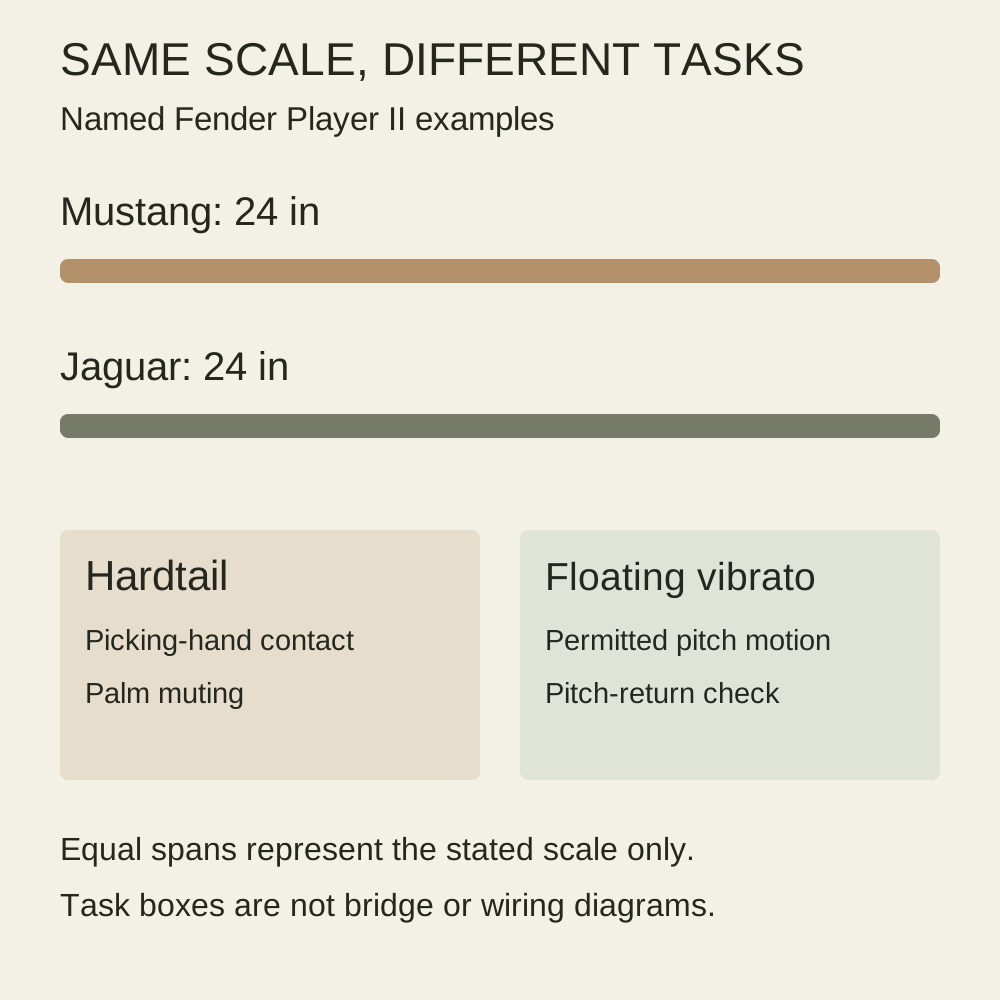
Decide whether pitch movement is part of the music
For the cited hardtail Mustang, assess picking-hand contact, palm muting and the normal playing result. Its fixed bridge does not remove the need to check nut behaviour, strings and setup.
For the cited Jaguar, decide whether you want to use the floating vibrato. Follow its instructions and the owner’s limits when trying a modest movement. Check pitch before and after with a tuner; describe the result for that instrument rather than promising universal stability.
A factory claim about tuning stability is not a test of a used or newly delivered unit. Record repeated faults for assessment. The fixed-bridge and tremolo comparison covers the broader setup decision. Cosmetic similarity cannot establish that another Mustang or Jaguar uses either of these systems.
Use the same musical task and your normal posture
Start with the same suitable amp or monitoring route and a short passage. Compare the guitar settings you can identify, keeping rig input settings fixed initially. Note output differences before changing gain. For a separate preference comparison, listen to recordings at similar playback level if practical.
Try seated and standing positions if both matter to you. Observe neck reach, picking-arm contact, strap balance and access to the selector. A 24-inch scale does not establish that one complete body and neck combination will fit your hands or posture.
Play the part for which you are choosing the guitar: accompaniment, a melody, a muted riff or permitted pitch movement. Avoid assigning a whole family to one genre. A result from two complete guitars also cannot isolate the body outline as the cause of their sound.
Keep preference and unresolved condition separate
| Question | Useful record |
|---|---|
| Which versions were compared? | Full model, pickups, controls and bridge |
| Which functions will you use? | Task, selector position and permitted vibrato use |
| How did the actual guitar fit? | Posture, reach and control access |
| What remains unresolved? | Source conflicts, modifications, setup or condition |
Use the hardtail example as a candidate when its documented functions meet your part and you prefer the actual instrument. Use the floating-vibrato example as a candidate when that pitch control serves the music and the guitar works for you. Either decision still needs the version and condition check.
For a second-hand instrument, continue with the used-guitar checklist. For another model-family comparison, Telecaster vs Stratocaster applies the same requirement to identify the actual versions.
How this guide was prepared
We checked Fender’s current Player II Mustang and Player II Jaguar pages on October 27, 2026. The Mustang product page contains inconsistent selector wording. We checked page 4 of its linked service manual, identifying model families 014-0460/014-0462 and printed May 22, 2024, Rev. A, to establish the bridge/both/neck sequence. These are documentation examples, not measurements or recommendations of an individual guitar. The function log and playing comparison are proposed methods. No guitar was played, opened or tested, and no human technical review is claimed.
Documentation checked .